Abortion has only been legal in Missouri for 49 years. Here’s what came before Roe v. Wade
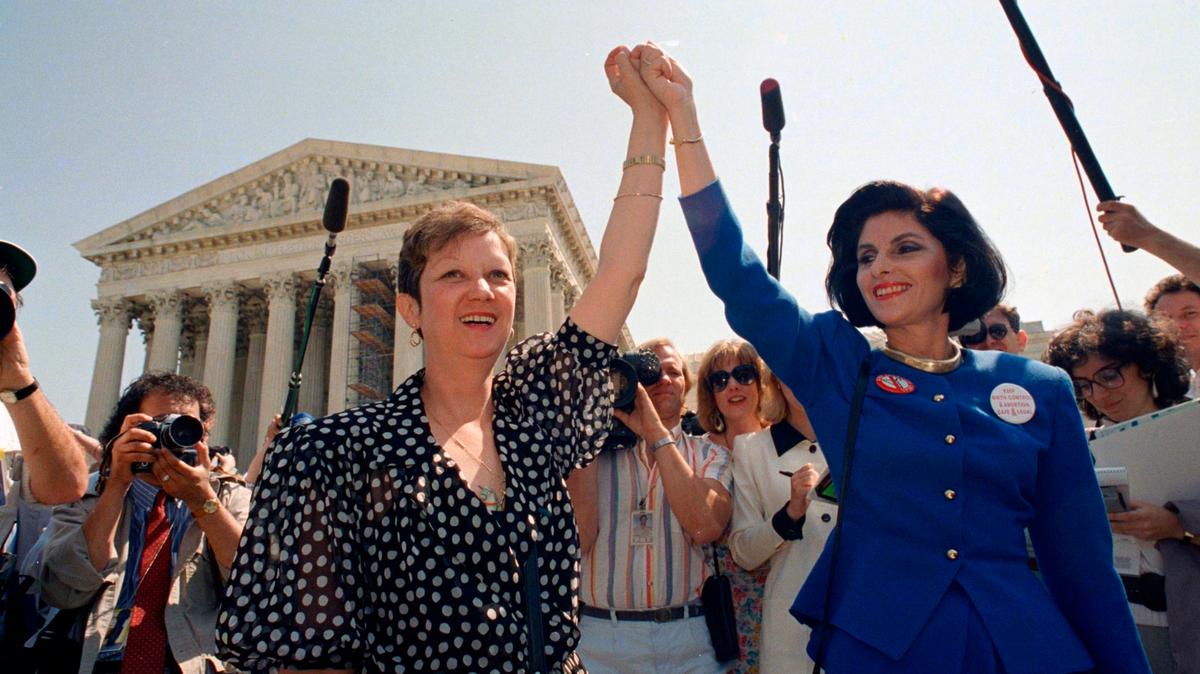
When Supreme Court Justice Samuel Alito’s draft opinion overturning Roe v. Wade leaked this month, it included an appendix of 19th-century state laws criminalizing abortion.
Missouri was first on the list.
“That every person who shall wilfully and maliciously administer or cause to be administered … any poison, or other noxious, poisonous or destructive substance or liquid,” the 1825 law read, “to cause or procure the miscarriage of any woman then being with child, and shall thereof be duly convicted, shall suffer imprisonment not exceeding seven years, and be fined not exceeding three thousand dollars.”
The looming end of the federal right to an abortion is refocusing attention on the states, where battles over the future of legal access to the procedure will be fought. In Missouri, nearly all abortions are poised to be banned under a 2019 law that imposes a sweeping prohibition if Roe is overturned.
But the current moment has also pushed Missouri’s long history of vehement opposition to abortion to the surface.
A review of the historical record– including books, interviews, legal documents and press reports– shows how Missouri has maintained a staunch anti-abortion stance for most of its history. The Roe v. Wade decision in 1973 immediately spurred a backlash from state legislators that continues to this day.
If abortion is again almost entirely banned in Missouri, it would mark a return to the state’s historic roots. Ending a pregnancy has only been legal for just over a quarter of the state’s 201-year history.
Abortion opponents are invoking that history as they urge lawmakers, in the final week of the legislative session, to smooth the way for quick implementation of the ban once the Supreme Court’s formal decision is handed down in a few weeks.
“Missouri has had a strong tradition, since 1825, just a few years after we became a state, of protecting unborn children,” Samuel Lee, a lobbyist for Campaign Life Missouri, told lawmakers on Tuesday.
Early laws were “poison control”
Admitted to the Union in 1821, Missouri was only the 2nd state to pass legislation on abortion, after Connecticut.
Scholars have called these early laws “poison control.” The Missouri and Connecticut laws of this period didn’t explicitly ban abortion itself, but rather banned abortions using poison.
“That really was because there were a lot of women dying and there were a lot of women dying because the things– the concoctions, ectcetera– they’re taking are deadly,” said Evan Hart, an assistant professor of history at Missouri Western State University who studies Missouri abortion laws and the courts in the late 19th and early 20th centuries.
The law also didn’t distinguish between phases of pregnancy. Poisonous substances couldn’t be used to end a pregnancy, regardless of how far along it was.
At the time, the most significant dividing line during pregnancy was quickening, when the woman begins feeling movement of the fetus. This often happens around the fifth month of pregnancy.
These early laws went further than British common law, which didn’t regulate abortion before quickening.
“Most women probably knew- at least theoretically - how to induce an abortion, but the methods were only semi-effective,” Michelle Morris, an associate professor of history at the University of Missouri-Columbia, said in an email. “They consisted mostly of combinations of herbs.”
Prosecutions of abortions involving pre-quickening pregnancies were rare.
James Mohr, in his 1979 book, “Abortion in America: The Origins and Evolution of National Policy,” wrote that in practice indictments couldn’t be brought against abortions performed before quickening because it was too difficult to prove the person administering the poison would have known beyond any doubt the woman was pregnant.
A decade later, Missouri approved a new abortion law. Abortion was now illegal regardless of the method used. The law also made performing an abortion on a “quick child” manslaughter, compared to a misdemeanor for others.
The law included a sole exception in which abortion was legal: To save the life of the mother. Like the first law, the 1835 law was targeted toward individuals performing abortions rather than women receiving them.
The same basic ban– with a division made between pre- and post-quickening abortions– would remain in place until the Roe decision. In 1907, lawmakers enhanced the crime for a pre-quickening abortion by upgrading it to a felony from a misdemeanor.
Abortion prosecutions almost always took place when a woman died during the procedure because the woman’s death was itself manslaughter, Hart said, though doctors would often defend themselves by arguing the abortion was medically necessary.
Prosecutions also often took place if a woman sought medical care from complications arising from an abortion and acknowledged receiving one. “If she says I had an abortion by Doctor So and So, they’re going to prosecute them,” Hart said.
“It’s almost always if something happens to mom, that those cases are going to be prosecuted,” Hart said.
Lawmakers revolt against Roe
When the U.S. Supreme Court issued its decision on Jan. 22, 1973, legalizing abortion nationwide – and imposing a trimester framework governing the legality of abortion – the consequences were not actually immediately clear in Missouri.
For instance, St. Louis Mayor Alphonso Cervantes had expected to allow city hospitals to perform abortion, but late that February held off because then-Missouri Attorney General John Danforth had not yet issued an opinion on Roe’s effects in the state. Confusion existed over whether the decision obligated public hospitals to provide abortion services.
Quickly, however, supporters of abortion rights began offering legal access to the procedure. Less than a year later, Reproductive Health Services, the state’s first legal abortion clinic, was opened in St. Louis by Judith Widdicombe, a nurse who prior to Roe had helped refer women seeking abortions.
“Finally, every woman who needed an abortion wouldn’t have to get on an airplane. Those who had to travel would be traveling, at most, from 300 miles across the state instead of 2000 or 3000 miles across the country,” Widdicombe, who died in 2011, told the author Angela Bonavoglia in 1989.
Just as swiftly, anti-abortion state lawmakers moved to strictly regulate the procedure.
One early proposal would have required a doctor to determine an abortion is medically necessary and required women to provide reasons for requesting an abortion. It would have also required women to obtain permission for an abortion from the father, if he was known.
“I am opposed to any liberalization of abortion laws, but because of the Supreme Court decision it is necessary to establish regulations,” Rep. Earl Schlef, a St. Louis County Democrat, told The Star at the time.
The General Assembly “tried to get as close to the line as it could without going over the line” set by Roe, Danforth said in an interview Thursday.
The early frustration at the Roe decision from Missouri lawmakers inaugurated what would become decades of push-and-pull between the state and federal government over abortion rights.
“They passed legislation doing their damnedest to minimize Roe,” said Leland Shurin, an attorney who was part of a legal team that helped Planned Parenthood challenge restrictions in the years after the decision.
One of the first major decisions came in 1976, when the U.S. Supreme Court struck down Missouri abortion regulations that required written consent from the woman’s husband if she was married. Frank Susman, an attorney for Planned Parenthood of Central Missouri, had urged the justices to stick to its decision in Roe and “not drive woman back to aseptic and illegal avenues of relief.”
Danforth argued the case personally before the U.S. Supreme Court, the only time he did so as Missouri attorney general.
“When you’re arguing, you have half an hour and you know you’re going to be interrupted. So if you’ve got a main point, you better make it quickly,” Danforth said. “So my main point in the first sentence was: I am not asking the court to overrule Roe vs. Wade.”
Danforth, summarizing the argument he made then, said, “I am asking whether post-Roe vs. Wade, there is any remaining role for state legislatures on such matters as health care and relations between parents and children and marriage and regulating marriage.”
Fifteen years later, Missouri’s anti-abortion legislators would score their biggest victory, when the Supreme Court upheld the state’s prohibitions on the use of public facilities to perform abortions and requiring viability tests on women who were 20 weeks or more pregnant. The law also included a preamble stating that life begins at conception, which the court chose not to rule on.
The 5-4 decision in 1989 at the time marked one of the most consequential Supreme Court rulings on abortion since Roe. The New York Times, previewing the decision, reported that the Missouri law was beneath “the public furor over whether the Supreme Court is on the verge of withdrawing the constitutional right” to an abortion.
In the decades since, Missouri has continued to restrict abortion, including a 72-hour waiting period to get an abortion. In 2019, Republican Gov. Mike Parson signed a law intended in part to prepare Missouri for the possibility Roe would be overturned.
The law bans abortions after 8 weeks of pregnancy and was immediately challenged in court. It also includes a so-called “trigger ban” on abortion that goes into effect in the event Roe is overturned. Except in the case of a medical emergency, it will become illegal to perform or induce an abortion.
Anti-abortion lawmakers are pushing to approve a resolution allowing quick implementation of the ban following the Supreme Court’s upcoming decision.
“Whereas, Missouri has a longstanding history from the state’s earliest beginnings of recognizing abortion as the murder of an unborn child and the prohibition of such remained the law of the land until the Supreme Court’s decision in Roe,” the resolution reads.