Missouri’s redistricting returns to stalemate as House rejects Senate congressional map
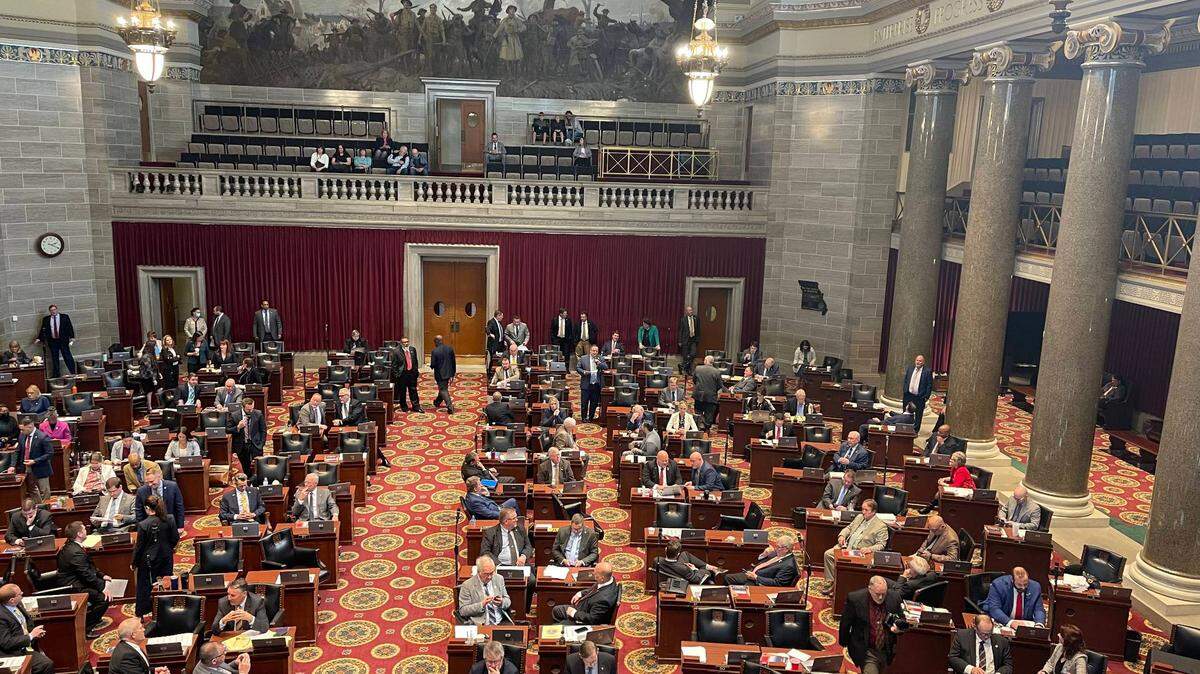
The Missouri House on Thursday overwhelmingly rejected new congressional district boundaries drawn by the Senate and is once again asking for negotiations with the chamber on a revised map.
Senate members rebuffed an earlier House request Wednesday and stood firm on its own boundaries. House members had wanted to send the map to a conference committee, where lawmakers would develop a final proposal.
The House voted 26-129 Thursday to reject the Senate’s map and asked for another conference committee.
“Through a voice vote, a voice vote in the Senate, late last evening, decided they didn’t want to discuss with us the map,” said Rep. Dan Shaul, an Imperial Republican and the chairman of the House Redistricting Committee. “They basically said to us, ‘take it or leave it.’ I would ask this body to consider that ‘take it or leave it’ proposition…”
With Thursday’s decision, the congressional map appears to have re-entered a stalemate. Missouri is one of the last states in the country without a congressional map.
The Missouri Senate approved its version of the map on March 24 after weeks of Republican infighting over how far to go in drawing GOP-leaning districts for partisan advantage. The final agreement was a compromise among Republicans, including between GOP leaders and some members of the Conservative Caucus, a hard-right group of seven senators who had filibustered previous proposals.
The district lines preserve the state’s current mix of six Republican and two Democratic members of Congress, falling short of the Conservative Caucus’ goal of seven Republicans.
Senate Majority Leader Caleb Rowden told reporters Thursday that a conference with the House was the right thing to do.
“I still remain hopeful,” Rowden said of the map. “I do think folks who are rigid in not wanting to continue the conversation through conference I think are irresponsible. I think they’re part of the problem.”
Rowden said he would talk with senators this weekend to see if a conference was possible.
“I would say, definitively, anybody at this point who doesn’t want to go to conference is responsible for it going to court,” he said. “There may be people who want it to go to court. And I’m not going to try to assign motive for why that would or wouldn’t be.”
However, Minority Leader John Rizzo and Sen. Bob Onder, a member of the hard-right Conservative Caucus, both said they were not willing to budge on the map.
“By not supporting the Senate compromise map, leadership in the House, Representative Shaul…is voting to allow the courts to draw our congressional maps,” Onder said. “We’re not going to conference.”
If the map is not approved by mid-May, Onder projected, it will be drawn by the courts.
Rizzo said there will likely be a caucus meeting on Monday to discuss the Senate’s next move, but he did not support going to conference.
The stalemate between the two chambers comes as the possibility of court intervention looms. At least two lawsuits have been filed — one by a group of voters and another by a St. Louis-area congressional candidate — asking state court judges to take action after legislative inaction.
The map approved by the Senate consolidates the 5th District — held by Cleaver — into the Kansas City area and eliminates its rural communities, which currently stretch into central Missouri. It also significantly redraws the St. Louis-area 2nd District, held by Republican U.S. Rep. Ann Wagner.
Instead of the blob that it is today, its new claw-like shape stretches from the St. Louis metro into southern Missouri, in hopes of making it more Republican.
And it places Fort Leonard Wood and Whiteman Air Force Base in the same district.
This story was originally published March 31, 2022 at 12:39 PM.