MO senators furious as hard-right faction want obscenity crime added to sex assault bill
READ MORE
MO Senate gridlock blocks redistricting, strains relationships
The state Senate has accomplished very little this year as Sens. Mike Moon, Bob Onder and other Conservative Caucus members use filibusters to fight GOP leaders.
Expand All
The Missouri Senate reached a new depth of hostility Wednesday as a bipartisan majority denounced a hard-right group of members known for aggressive tactics — a sign animosity in the chamber may be approaching a breaking point.
The anger came after the Conservative Caucus tried late Tuesday to amend a sexual assault survivors’ bill to make it a crime for teachers to provide obscene materials to K-12 students.
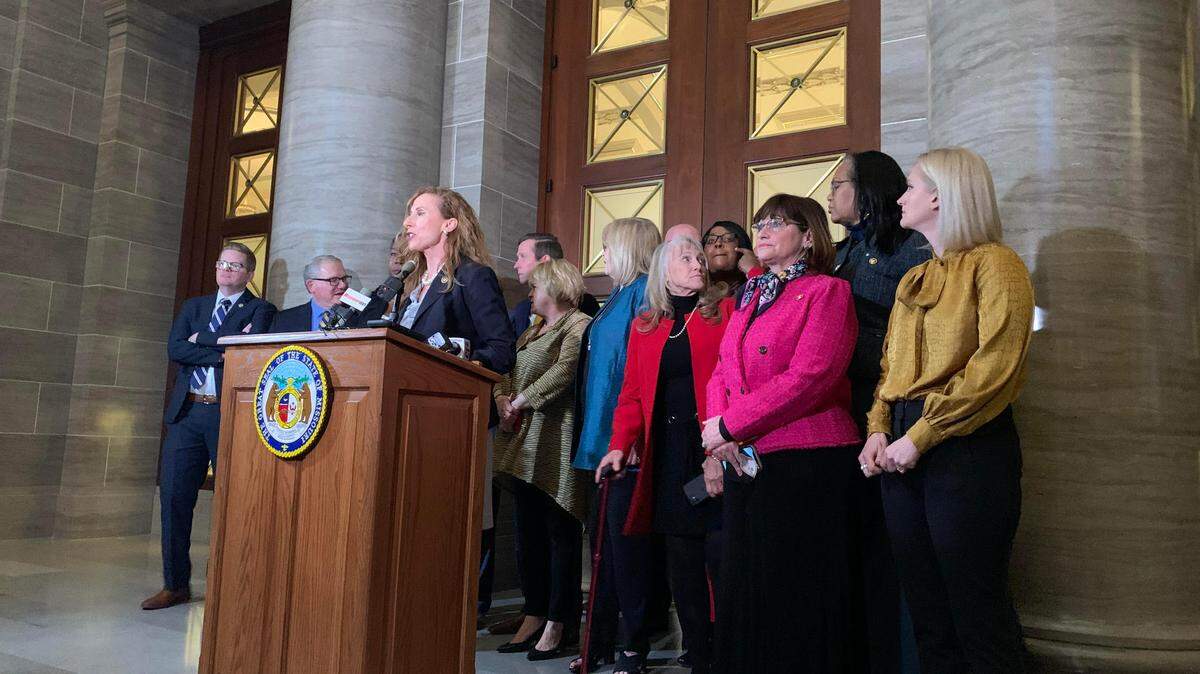
“Despite constant and classless actions, they seem shocked and appalled daily that no one is rushing to help them get their legislation passed. All they are after are political stunts and campaign soundbites,” Sen. Holly Thompson Rehder, a Sikeston Republican, said at a news conference.
The Conservative Caucus throughout the session has attempted to tack hardline language onto multiple bills. The result has often been to grind what had been relatively non-controversial legislation to a halt.
Last week, a bill to extend Medicaid coverage to low-income women for up to a year postpartum stalled after the Conservative Caucus brought an amendment to ban Planned Parenthood from receiving public dollars.
Thompson Rehder said the Conservative Caucus’ actions on the sexual assault legislation Tuesday marked a “red line” for her. The bill was worked on for months, she said, but has been “hijacked by a few men who wanted to talk about another issue.” She asked for the amendment to be withdrawn.
Twenty-two of 34 senators stood behind Thompson Rehder at the news conference.
Sen. Denny Hoskins, a Warrensburg Republican and Conservative Caucus member, struck back a few minutes later on the Senate floor.
“I was just notified about a press conference that happened where my name was brought up and it took a picture of, I guess the senators that are for having pornography books in school,” Hoskins said.
Hoskins then began a lengthy speech about the sexual assault legislation, though the Senate was on approval of previous day’s journal, not debating the bill.
The bill, sponsored by Thompson Rehder and Democratic Sen. Jill Schupp of St. Louis County, says survivors retain their rights regardless of whether a criminal investigation or prosecution occurs, including the right to consult a rape crisis center, a sexual assault forensic examination, a shower and a change of clothing.
It comes after a previous sexual assault law was challenged in court. Part of the law requires defense attorneys to remind their clients’ alleged victims of their right to have a support person present while being questioned. Missouri State Public Defender Director Mary Fox and several other public defenders sued, claiming that provision constitutes compelled speech and violates their freedom of speech. A lower court judge ruled that part of the law must not be followed, and the state appealed in defense of the law.
The Missouri Supreme Court heard arguments over the law in November.
During debate on the bill Tuesday evening, Sen. Rick Brattin, a Harrisonville Republican running for Congress, offered an amendment creating the crime of providing obscene material to a student. Teachers, administrators and anyone associated with a public or private elementary or secondary school would be prohibited from providing obscene material to students.
The amendment defines obscene material as that which under “contemporary community standards” has a predominant appeal to “prurient interest in sex” and that a reasonable person would find lacks serious literary, artistic, politicial or scientific value. The crime would be a class A misdemeanor, typically punishable by up to a year in jail and a fine of $2,000.
“Nobody is against the literary aspect of diving into culture and experience, but what is happening is the sexualization of that experience and it’s very graphic,” Brattin said during the debate.
Brattin wasn’t immediately available on Wednesday, an aide said.
Thompson Rehder held open the possibility calling the previous question, a parliamentary tactic that would allow a majority of the Senate to cut off debate on the bill and force a vote. Calling the previous question (PQ) is rarely used because the Senate prizes deliberation.
“We’re going to see about that,” Thompson Rehder said in response to a question about suing the PQ.
The Associated Press contributed reporting
This story was originally published March 9, 2022 at 12:31 PM.