Was MO health director doomed from the start? How angry conservatives fueled backlash
To the broader public, Donald Kauerauf’s first months as director of the Missouri Department of Health and Senior Services appeared relatively free of controversy.
A former Illinois health official with three decades of experience who shared the anti-mandate views of Gov. Mike Parson, he forged good relationships across the state after he began work in September. Katie Towns, director of the Springfield-Greene County Health Department, told reporters on Wednesday he had been an “exceptionally good” partner.
But out of sight, frustration had simmered for months.
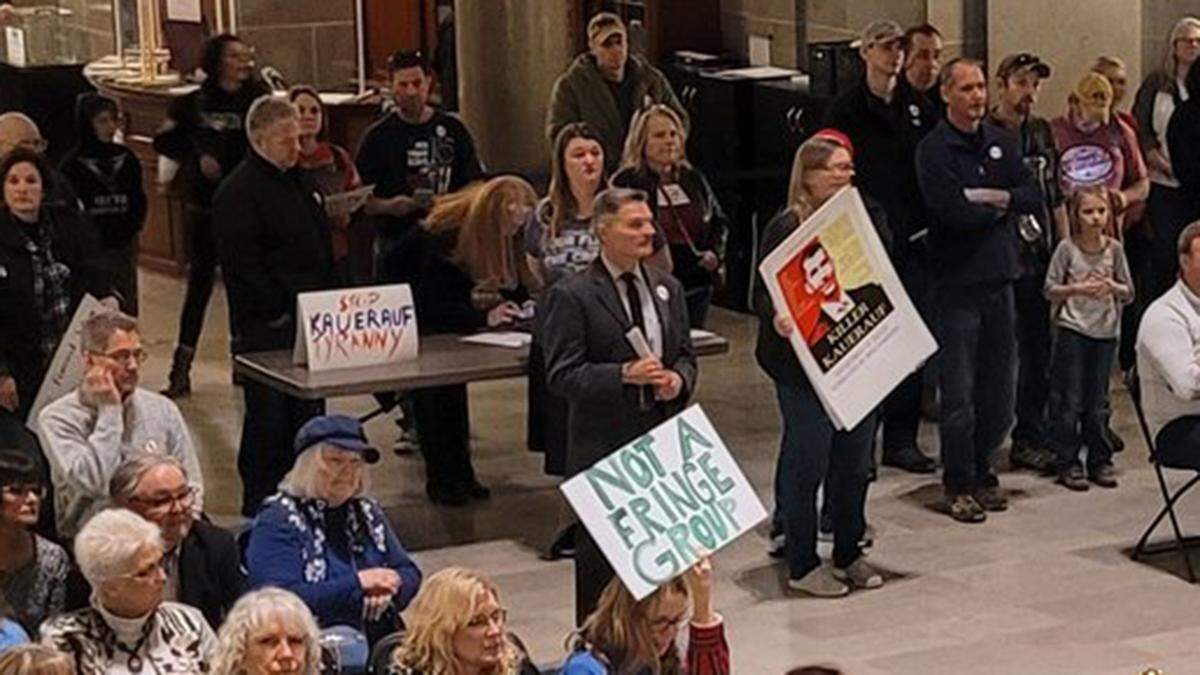
Anger directed early in the pandemic at lockdowns and mask orders — and more recently quarantines and vaccine mandates — converged this week on the acting health director. Hard-right opponents, driven in part by the conservative evangelical group Concerned Women for America and grassroots Republicans, including Jackson County GOP Chairman David Lightner, rallied against Kauerauf. The Conservative Caucus, a group of senators known for clashing with Parson and GOP leadership, took up their cause.
Republican senators took issue with his expressed desire to vaccinate 100% of Missourians against COVID-19. At least one pressed him on why he was even promoting the vaccine at all.
On Tuesday, Kauerauf resigned as it became clear his nomination had died in the Senate. In effectively ousting him, senators expanded the circle of what they consider unacceptable positions on the part of public health leaders. Wanting to inoculate an entire population against a contagious disease is now grounds for suspicion.
The consequences to Missouri’s pandemic response — which is overseen by DHSS — are only beginning to come into focus.
“If you called me tomorrow and asked me to apply for state health director position, not only would I not do it … anyone who was qualified and was being asked to take the position and wanted to talk with me ahead of time, I’d have to say, ‘Well, don’t move your family,’” said Rex Archer, a professor at Kansas City University who led the city’s health department for more than 20 years.
Anne Bloemke-Warren, a laboratory grants manager at the Missouri State Public Health Laboratory, wrote in a public Facebook post that she was “indescribably pissed” about the Senate’s failure to confirm Kauerauf, who she called an “all-around good guy.”
Bloemke-Warren, who is a candidate for the Jefferson City Board of Education, wrote that she liked the direction Kauerauf was taking the department and “we wanted him around.”
“So, once again, the leading public health department in the state is without solid leadership during a global pandemic,” Bloemke-Warren wrote. “I can’t trust that his replacement will trust science since trusting science is what tanked Kauerauf’s confirmation.”
But Sen. Bob Onder, a Lake St. Louis Republican and caucus member, who called Kauerauf a “very slippery politician,” situated the confirmation fight within a larger, ongoing struggle over public health authority during the pandemic.
“And all of a sudden, they’ve had absolute control of our lives, our businesses, whether our kids get to go to school, whether we have to wear a piece of cloth over our face and whether an experimental use authorization vaccine can be required before you get to hold a job,” Onder told NewsTalkSTL.
‘100 percent’ vaccine coverage
At Kauerauf’s confirmation hearing on Monday, Sen. Mike Moon, an Ash Grove Republican and congressional candidate, led the skeptical questioning. He wanted to know about whether Kauerauf’s wife, Judy Kauerauf, communicable disease section chief at Illinois Department of Public Health, had been involved in developing an app that Republicans feared was essentially a vaccine passport. He probed Kauerauf on his contention that he is “pro-life.”
And he zeroed in on Kauerauf’s past comments.
“The goal of public health vaccination programs is to achieve 100 percent coverage,” Kauerauf told St. Louis Magazine in October.
In the magazine interview, he immediately followed that comment by saying: “However, for the COVID vaccination initiative, our goal is to ensure that everyone who has considered getting vaccinated has the opportunity to do so.”
About 64% of Missouri adults are fully vaccinated (two doses of Pfizer or Moderna or one dose of Johnson and Johnson), according to the Centers for Disease Control and Prevention. Nationwide, 74% of adults are fully vaccinated. Kauerauf on Monday told Senators he’d like to see Missouri achieve a 75% vaccination rate.
Kauerauf defended public health authorities in other ways that bothered conservatives.
In September, he told reporters a new law subjecting local health orders to elected officials’ approval “haunts” him. He urged against the politicization of public health, telling St. Louis Public Radio in November, “when we question the expertise of public health officials, that’s I think where we cross the line.” Though he said he was firmly against mandates, he insisted to lawmakers that masks work to prevent the spread of COVID.
An analysis conducted by DHSS in November found mask mandates had been effective, Kauerauf wrote in an email reported by the Missouri Independent. The analysis wasn’t disclosed publicly until the Independent reported on it in December.
He also unsuccessfully asked Attorney General Eric Schmitt to appeal a Cole County court ruling that stripped power from local departments to issue disease control orders. And he came from Illinois, where Democratic Gov. J.B. Pritzker had issued much more stringent COVID response measures than Parson.
Moon said in an interview Wednesday that he began hearing concerns over Kauerauf’s nomination sometime last fall, but opposition from the grassroots ballooned in the past week.
“I think [Kauerauf’s comments on vaccinations] was part of it,” Moon said of the initial skepticism. “And then because he was from Illinois and their public health department, that was a red flag in many people’s minds.”
Kauerauf last worked in the Illinois Department of Public Health in 2018. During the COVID-19 pandemic he advised the emergency management department as chair of the Illinois Terrorism Task Force. He declined to say at Moon’s urging whether Illinois or Missouri had a better pandemic response — suggesting that such an assessment could only be made “years from now” — but praised Parson’s approach.
Following the hearing on Monday, Kauerauf’s nomination never made it to the full Senate. The General Assembly adjourned for the week early because of an impending snow storm, even though the Missouri Constitution required action on the nomination by Friday or he would be banned from the job of DHSS director for life.
Parson had ways around the deadline. He could have withdrawn Kauerauf’s nomination, then reappointed him or made him a deputy director, which wouldn’t require Senate confirmation. Instead, shortly before 6 p.m. Tuesday Parson announced Kauerauf had resigned.
For now, DHSS general counsel Richard Moore is leading the agency. The governor’s office said Tuesday Parson “will further evaluate the state’s options in the coming days.”
Kauerauf didn’t respond to a call on Wednesday. Parson’s office didn’t immediately release a resignation letter.
John Lumpkin, a former director of the Illinois Department of Public Health who had worked with Kauerauf, said his entry into public health was like a “fish to water.” Kauerauf cares about people and is dedicated, he said.
“It really saddens me because, really, managing this epidemic and responding and protecting the public’s health should rise above politics,” Lumpkin said.
Falling GOP support
While Moon was Kauerauf’s most prominent opponent in the Senate, interviews suggest his support was flagging well beyond the Conservative Caucus.
“My concern was his concepts on having a goal of 100 percent vaccination,” said Sen. Bill White, a Joplin Republican and the assistant majority leader.
The vote would have been “close” if the nomination had gone to the floor, Senate Majority Leader Caleb Rowden, a Columbia Republican, said. Republican leaders knew there was opposition, he said, but hadn’t gone as far as figuring out exactly what the vote count would be.
Democrats did not appear to have complaints about Kauerauf. If all 10 Democratic senators voted in his favor, only a third of the chamber’s 24 Republicans would have needed to vote yes to confirm him.
Senate Minority Leader John Rizzo, an Independence Democrat, said Kauerauf – who believes masks work and is pro-vaccine – had been a “softball” for the Conservative Caucus.
“The guy answered the questions right. But at that point the die had been cast, that he was some deep-state, socialist, whatever,” Rizzo said. “The guy could have given the cure for cancer and it wouldn’t have mattered.”
This story was originally published February 3, 2022 at 5:00 AM.