Kansas Supreme Court accepts finding that ‘Club Foreplay’ judge violated judicial rules
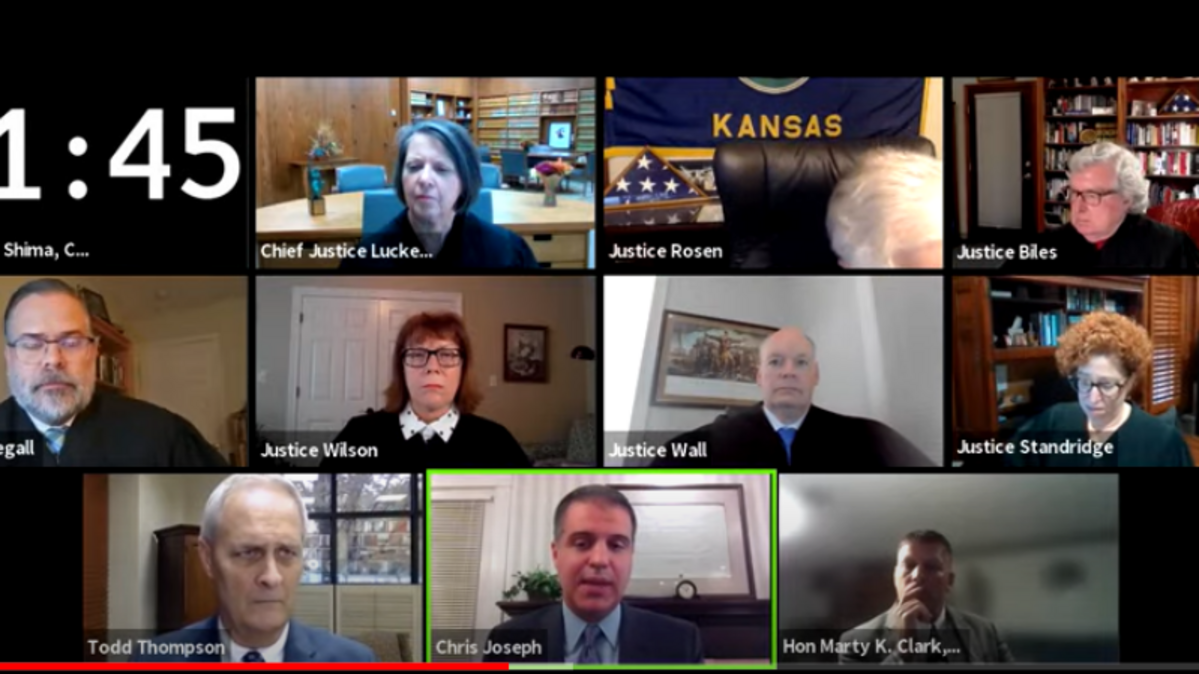
The Kansas Supreme Court accepted a disciplinary panel’s ruling that a county judge violated rules of judicial conduct when he shared nude photos of himself on a site called “Club Foreplay,” but declined Friday to take any additional action affirming or rejecting the finding.
In March, the Kansas Commission on Judicial Conduct determined that Russell County Magistrate Judge Marty Clark breached ethical standards when he shared nude photos of himself with another couple on “Club Foreplay,” an online dating site for swingers. Clark resigned from the bench in May.
Because he had already stepped down, the court said that it would accept the commission’s decision and take no further action.
“Because everyone involved in this case has come to the same conclusion, we see no need to further question their resolution,” the court said.
The commission ruled in March that Clark’s actions violated judicial ethical standards by failing to “avoid impropriety or the appearance of impropriety in (his) personal life” and protecting the public impression of the judiciary.
Todd Thompson, the commission’s examiner, said Clark and his wife met the couple once before sharing photos. In addition to sharing photos, he said, Clark exchanged “salacious” text messages with the wife in the couple that included discussion of having sex in his chambers.
The action, he said, should bar him from ever being a judge again.
“We all have standards that we think is appropriate or inappropriate behavior,” Thompson said. “Just taking pictures of your genitals and distributing them in any way to the public in my opinion does nothing to enhance the integrity of the judiciary.”
Justice Caleb Stegall did not dispute the commission’s finding but did note that “while Judge Marty K. Clark’s behavior was embarrassing, foolish, and grossly immoral, it was not a violation of any of our rules governing judicial conduct.”
Stegall argued that, because Clark’s action had no true connection to his work as a judge, he had not violated any rules. Instead, Stegall said, the conduct commission was enforcing a higher standard for judges that included a demand that they operate only in “traditional sexual relationships.”
“Today’s case illustrates that one consequence of elevating judges to the “supreme” arbiters of society is that we will endure bizarre replays of age-old religious controversies concerning the qualifications of priests to administer religious rites,” Stegall wrote.
“The rule of law is not so weak it will collapse in the face of a few bedroom peccadillos or the occasional clownish, embarrassing episodes of official misadventure. But it is not so strong it can long endure the misrule of arbitrary double standards — which amount to a special kind of breach of the social contract.”
This story was originally published January 28, 2022 at 12:14 PM.