
‘I feared I would become another statistic’: Kansas mothers look to curb maternal deaths
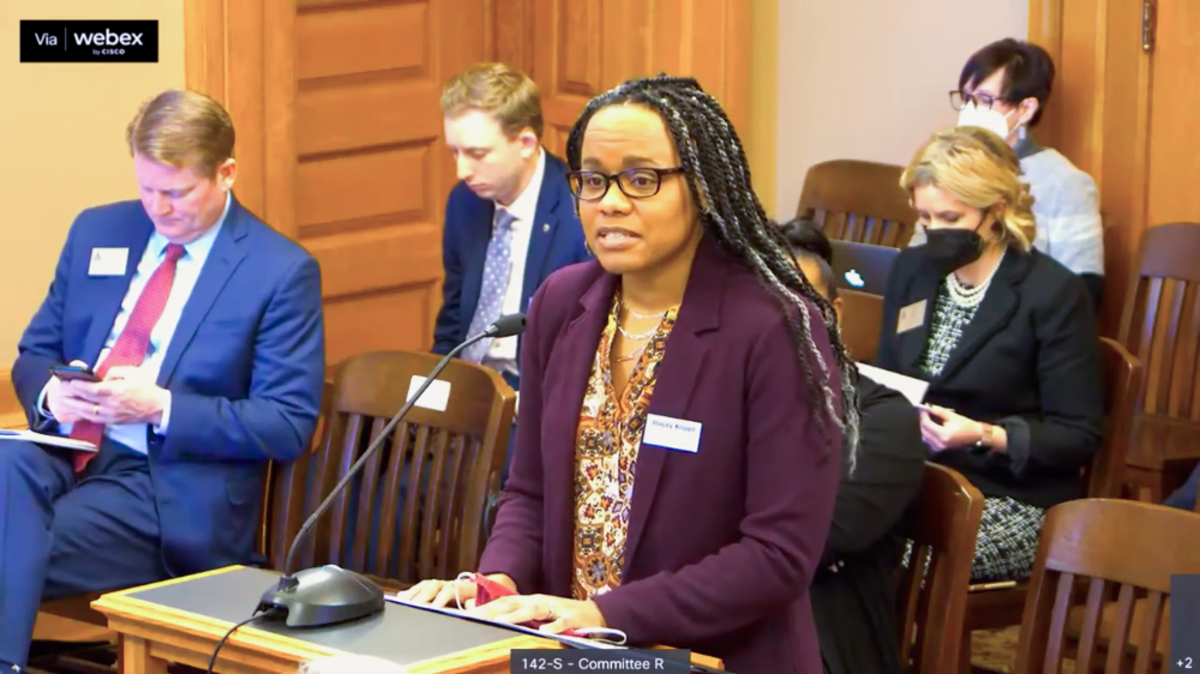
When Stacey Knoell, executive director of the Kansas African American Affairs Commission, gave birth to her second child, a C-section at 39 weeks, she heard the doctor say, “She’s bleeding.”
“With those two words, ‘She’s bleeding,’ I feared I would become just another statistic in a long line of Black women who died in childbirth,” said Knoell, who was at high risk of complications because of previous surgeries on her uterus.
About 700 U.S. women a year die during pregnancy, child birth or from complications within 12 months. Black women are three times more likely to succumb from pregnancy-related causes than white women, according to the Centers for Disease Control and Prevention. Maternal mortality can be preventable if correct steps are taken, the CDC said.
While these statistics exist at a national level, advocates say what Kansas lacks is data that drills down into social factors behind maternal death. Mothers and their OB-GYN doctors are looking to state officials to gather and analyze more information.
Kansas’ maternal mortality rate was 17.7 per 100,000 live births in 2018, placing it in the middle of the 50 states, slightly below the national rate of 20.7.
A bill sponsored by Sen. Oletha Faust-Goudeau, a Wichita Democrat, would require the state’s Department of Health and Environment (KDHE) to include race, socioeconomic status and level of care during and post-pregnancy.
“No Kansas woman should die of a preventable death, and no Kansan should have to worry about dying of childbirth,” said Sharla Smith, founder of Kansas Birth Equity Network, at a hearing for the bill Thursday.
“However, we cannot assure that in Kansas. We cannot assure that women survive if we don’t thoroughly examine the deaths. may help doctors in prevent fatalities.”
Smith and other healthcare providers told the Senate Public Health and Welfare committee that KDHE should utilize a “social determinants of health” form with a section on racial inequities and performance measures for healthcare facilities so that local health officers can compile and share statistics.
KDHE established a Kansas Maternal Mortality Review Committee in 2018 to study pregnancy-related mortality and morbidity in Kansas from 2016-2018. Its report, released in 2020, details 57 “pregnancy-associated” deaths and 767 cases of maternal morbidity — any physical or mental illness directly related to child birth or pregnancy.
The report examined demographics, prenatal care, median household income and other social factors of mothers who died during or after childbirth. It listed several recommendations to decrease maternal mortality, including better communication between healthcare providers and patient education and empowerment.
Of 13 deaths the committee found directly related to pregnancy complications, 12 of them were considered preventable.
Sapphire Garcia-Lies, president of the Wichita Birth Justice Society and a professional labor assistant in Kansas, said the committee’s report released important data but didn’t offer enough specific insight on how to improve care for pregnant women.
“A lot of the factors at play in these deaths aren’t going to be things you find in the chart. It’s not going to be the hard data saying what the blood pressure was at 30 weeks,” Garcia-Lies said. “It’s soft factors, it’s community factors, and if we aren’t asking the right questions about why these deaths are occurring, how can we ever expect to find the answers?”
Garcia-Lies, Smith and Knoell emphasized the importance of looking at social determinants to minimize racial disparities. Knoell chose a woman of color as her obstetrician to ensure any complication during her pregnancy would be taken seriously, she said. As she was recovered from the birth of her second child, her doctor checked on her routinely until she fully recovered.
But Knoell said Black women too often faced mistreatment and neglect in healthcare settings. Missouri Rep. Cori Bush, a Democrat from St. Louis, told the U.S. House Oversight Committee in 2021 that she went into preterm labor with both of her children after doctors brushed off her complaints of severe pain.
Bush’s first child, born at 23 weeks, survived only after spending a month on a ventilator. When she went into preterm labor with her second child, Bush said her sister threw a chair to get the nursing staff’s attention after a doctor told Bush to go home to miscarry her child.
“This is what desperation looks like: That chair flying down the hallway. This is what being your own advocate looks like,” Bush said. “Every day Black women are subjected to harsh and racist treatment during pregnancy and childbirth. Every day Black women die because the system denies our humanity. It denies us patient care.”
KDHE said it has already started doing what the bill requires.
The Maternal Mortality Review Committee still meets monthly, said Kelli Mark, bureau chief of the KDHE Family Health Bureau. It also formed a Social Determinants of Health Subcommittee, which had its first meeting in December, to examine social factors that contribute to maternal mortality.
“There isn’t really any change for us if this bill passes because the review committee is already looking at all maternal deaths,” Mark said. “The (Social Determinants of Health Subcommittee) is in its infancy, they’ve had one meeting, their second is scheduled for February, and during that February meeting that’s when they’re really going to start developing the form that they use to review cases.”
Several members of the committee questioned if the legislature should play a role, rather than the health department collaborating directly with hospitals and doctor’s offices across the state.
Sen. Molly Baumgardner, a Louisburg Republican, said she did not yet support the bill because she felt KDHE should take initiative to collaborate with healthcare providers in decreasing the maternal mortality rate.
“The department of health could save the legislature a whole lot of time, and just implement a plan, and get it rolling,” she said.
The fate of the bill is uncertain. Faust-Goudeau did not respond to requests for comment regarding the ongoing Kansas Maternal Mortality Review Committee’s work.