
‘Hand in hand’: Missouri Democrats eye Medicaid, voting rights as House passes map
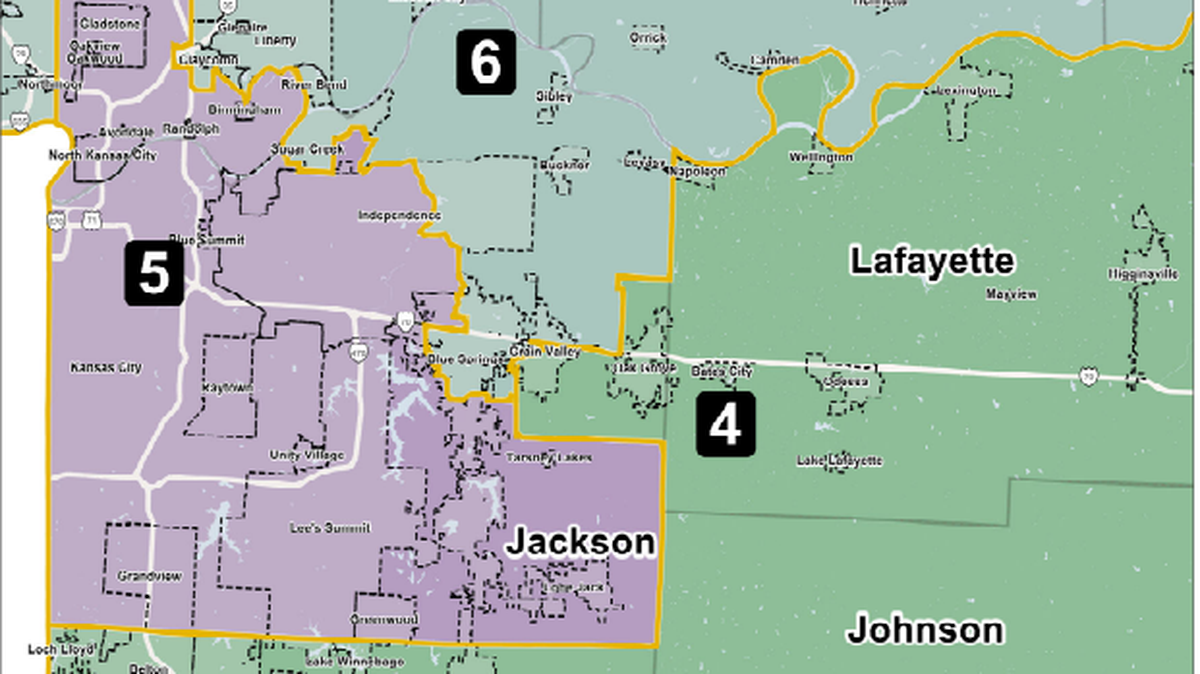
The Missouri House on Thursday approved a new Congressional map that preserves Kansas City’s safe Democratic district, but Democrats blocked a crucial measure to implement it ahead of the August primary elections.
Democrats are interested in concessions from Republicans on Medicaid expansion and voting rights as the once-a-decade redistricting based on the 2020 Census continues.
Republicans dominate the General Assembly but lost their supermajority status in the House after a series of resignations, handing Democrats greater-than-usual leverage. Thursday’s vote marked the first time Democrats have exercised their expanded influence in a significant way.
With few changes made since it was unveiled in December, the map that draws two safe Democratic seats and six safe Republican ones was sent to the state Senate on a 86-67 vote. Democrats and some hard-line Republicans, who wanted new district boundaries making it more difficult for nine-term Democratic Rep. Emanuel Cleaver of Kansas City to retain his seat, and likely deliver a seventh district to the GOP, voted no.
Cleaver represents the 5th Congressional District, which currently includes much of Jackson County and rural areas east of the Kansas City metro. The proposed map would shed most of the outlying areas and bring all of Lee’s Summit into the district.
Most Democrats and 14 Republicans, many of whom opposed the map, then voted down an emergency clause that allows the map to go into effect immediately.
Missouri’s redistricting is already operating on a delayed schedule after 2020 Census data was delivered late last year. Republican Gov. Mike Parson did not call an expected special legislative session to pass a new map.
Failing to approve the emergency clause throws into question whether the 2022 Congressional primary elections will be held on Aug. 2 as scheduled. Laws passed without emergency clauses go into effect on Aug. 28 each year. Candidate filing begins on Feb. 22.
Lawmakers could delay candidate filing as a way to buy time. The Senate, which could make changes to the map, also could add an emergency clause — though those changes would need another round of House approval.
With vacancies reducing their membership to just one vote shy of a supermajority, House Republicans needed the support of some Democrats to pass the clause, leverage that the minority party has been trying to wield to get a more favorable map.
House Minority Leader Crystal Quade, a Springfield Democrat, said on the floor Wednesday she did not believe the situation merited an emergency clause, which is reserved for events that threaten public health and safety. In an interview afterward, she left room to change her position, however, saying those in favor of the clause “made some good points.”
Quade said her party is looking for agreements on other legislation. Blocking Republican attempts to pass stricter voting laws and ensuring the voter-approved Medicaid expansion plan is fully funded are among the top priorities this session.
“It’s not one specific, ‘Give me this bill and we’re going to vote for it,’ because it is such a convoluted once-in-a-decade conversation and we’re not going to take this lightly,” Quade said in an interview. “A conversation around redistricting goes hand in hand with access to the ballot box, to voters being able to have a voice in the process.”
The Missouri Supreme Court has upheld the constitutionality of Medicaid expansion, but legislators have so far refused to fund it. Unless the legislature approves additional spending, the program is in danger of running out of funds sometime in February.
Republicans have also expressed interest in tightening requirements for initiative petitions to make it harder to place changes to the constitution on statewide ballots. Some GOP lawmakers complain constitutional amendments have become too frequent.
Rep. Dan Shaul, the Republican chair of the House redistricting committee, asked members to support the emergency clause “in order to have a safe, transparent, trustworthy election” and noted lawmakers will be busy with a “mountain” of other priorities when the map is returned to the House by the Senate.
He got the support of a handful of Republicans who had opposed the map itself.
“We have certain constitutional obligations involved in this Congressional map,” said Rep. Shane Roden, a Cedar Hill Republican. “We should be doing our best to actually get this done before the primaries.”
Other hard-liners were angered Thursday, arguing Shaul and other Republicans should have pushed harder to gerrymander out Cleaver or keep St. Charles County, a GOP stronghold, in the same district.
Their two attempts to do so on Wednesday were quickly rejected by the majority of Republicans, along with Democratic attempts to increase the minority voting population in the St. Louis district, and make a district in the St. Louis suburbs more competitive.
“The people in Missouri have given us a mandate” to send another Republican to Congress, said Rep. Sara Walsh, an Ashland Republican who is running for Congress in Fourth District. “The Democrats voted no, and they’re going to vote no today. We bend over backwards. We work with them all the time and they still vote against what we put forward.”