As Biden travels to KC, area leaders say new federal law could aid numerous projects
When President Joe Biden arrives in Kansas City on Wednesday to promote the new federal infrastructure law, he’ll encounter a metro area that local leaders say is ripe for investment in highways, bridges and rail.
Biden will speak at the Kansas City Area Transportation Authority in his first trip to the city as president. It’s the latest stop in his administration’s ongoing national tour to tout the $1.2 trillion law, which he signed last month.
Kansas is set to ultimately receive $3.2 billion and Missouri $7.9 billion under the law — money that could go toward an array of projects that encompass not just transportation but also broadband internet coverage and water systems.
Area leaders are hopeful that everything from the Buck O’Neil Memorial Bridge downtown, to an east-west streetcar, to highway expansions in Johnson County could eventually benefit.
Biden and other supporters of the bipartisan law have cast it in transformational terms, though it will take years for the region and the nation to feel the full effects of the spending. Project development and the funding process take time, let alone the additional months for construction and implementation.
For now, local leaders describe the law’s potential future impact in sweeping terms even as, with some exceptions, the exact details of how much money will flow into the Kansas City area and how it will be spent have yet to be determined.
“I think it’s important for American cities to make sure that we do it right,” Mayor Quinton Lucas said, “that we are building well, that we’re paying people well, and that we’re making sure that we’re building infrastructure, not just to last a generation or two, but that makes a cleaner environment for all of us.”
When Lucas looks out of his office window on the 29th floor of City Hall, he sees roads and bridges in need of repair. In an interview, the mayor said he’s hopeful the new law will change that and demonstrate that investments in green energy and public transportation can happen.
Lucas supported the bill, and when Biden signed the legislation at a White House ceremony in November, the mayor sat in the second row. For months, he’s promoted Kansas City’s infrastructure projects in visits with U.S. Department of Transportation officials in Kansas City and D.C. Lucas also served as the vice chair for transit for the U.S. Conference of Mayors. This spring, he joined three other mayors in Washington to jump start the push for the infrastructure bill.
And while Kansas City may be in a competition with other cities across the country for project funding, Lucas said he’s worked to ensure the city is in a good position. He said Kansas City is ready to move past its late 20th century infrastructure and into areas including zero fare transit, electric buses, new bridges and bicycle lanes.
The White House is still working on how the funding will be implemented, and Lucas said he’ll work with anyone to ensure roads get built and opportunities are expanded.
“We’re certainly pushing the White House ... to ensure that there is a formula plan that, while perhaps working with the state, still emphasizes the city’s metropolitan regions,” Lucas said.
The bulk of the money in the bill is set aside for transportation.
Kansas is set to receive $2.6 billion to repair highways over the next five years, just shy of the $3 billion the state spent over the last decade to preserve roads through the T-Works project. Missouri will get $6.5 billion for roads over the next five years. In the 2019 fiscal year, Missouri’s Department of Transportation spent $1.5 billion on roads and bridges.
The law also allocates money to fix the 1,321 miles of bridges in poor condition in Kansas and the 2,190 miles in Missouri. Kansas and Missouri will get $225 million and $484 million respectively over the next five years.
Both states will be able to apply for additional funding for specific projects through a $12.5 billion fund to fix important bridges and a $16 billion fund for road projects that spur economic development. The law also includes $100 million for Kansas and Missouri each to expand broadband infrastructure.
Missouri is slated to get $674 million to improve public transportation over the next five years, while Kansas is allocated $272 million. For water infrastructure improvements, Kansas is expected to get $454 million over four years and Missouri is expected to get $866 million over five years.
‘This golden money’
Hannes Zacharias, a professor of practice in local government management and urban policy at the University of Kansas, said it’s too early to know fully how the dollars will be administered. Still, he said there’s “no question” the law will have a significant impact on the economy and meeting the country’s infrastructure needs.
He emphasized the importance of communities and states prioritizing their infrastructure needs first before hunting for money.
“I think people will probably look at and kind of start salivating, so to speak, ‘Well, now we can get this golden money,’” Zacharias said. “Well, that certainly will be part of it. But I think we are wiser to go ahead and plan first.”
The funding is available, but it will eventually be used up. “I would certainly be advocating for strong planning and financial management, long-term financial management, before we kind of start writing a lot of grants,” Zacharias said.
Mitch Landrieu, a White House senior adviser and infrastructure coordinator, said there’s always a conflict “with getting our money fast and getting our money right.”
“The president has tasked me and the cabinet members with making sure as we work with governors and mayors — who, by the way, are going to build 90% of this stuff — that the money is spent well,” Landrieu said in an interview.
Some areas of funding are already coming into focus. Last week, the Environmental Protection Agency announced that under the new law, Kansas will receive $79 million next year for water infrastructure upgrades.
Kansas Rep. Sharice Davids, a Democrat who vocally supported the infrastructure bill, said the EPA announcement marked Kansas’s first official funding allocation from the law.
“These historic investments in our water infrastructure, including targeted funding to identify and replace lead pipes, will help deliver safe, reliable water to our communities for years to come,” Davids said in a statement. “I look forward to continuing to support our local public works and utilities as they put these funds to work for the Third District.”
Davids, Kansas’s sole Democrat in Congress, was the only member of the state’s congressional delegation to support the measure. In Missouri, Sen. Roy Blunt, who isn’t running for re-election, was the only Republican to vote for the bill. Missouri Rep. Cori Bush was one of six Democrats who voted against it.
“As far as the infrastructure plan, look there are some good things in there but Kansas and Missouri are both getting the shaft here,” said Sen. Roger Marshall, a Kansas Republican. “That infrastructure bill disproportionately set up for the coastal states; New York, California got the lion’s share of all that, so Kansas is getting shortchanged.”
While large states are getting a significant portion of total dollars, an analysis by U.S. News and World Report found that Kansas and Missouri are competitive with both New York and California when it comes to per capita funding.
Project possibilities
In Kansas City, Lucas has said projects aided by the infrastructure law could include fixing bridges, building a solar farm at Kansas City International airport, and expanding the KC Streetcar to the east and west.
When asked about Buck O’Neil Memorial Bridge, the triple-arch bridge connecting downtown and the north previously set to be torn down once the replacement bridge is completed, Lucas said he was against demolishing the bridge, saying it’s “a representation of years of history here in Kansas City. It should be retained, it should be beautified. It should be a civic space.”
He said he’s worked with MoDOT and city government to make the bridge into a space like that the city hasn’t seen before. The bridge could be used as a pedestrian and cyclist crossing, he said, and would be cheaper to do so.
“I don’t think you need to tear down all your old infrastructure,” Lucas said. “I think there are ways to have solid adaptive reuse. And I think this is just one example.”
Lucas said they’re having the same conversation about a bridge spanning the Kansas River in the West Bottoms.
City spokeswoman Maggie Green said the city has not made a final priority list for projects it will pursue as it waits on federal guidelines for the infrastructure bill.
In Kansas, Secretary of Transportation Julie Lorenz said specific details about plans the state will move forward with are expected by the end of the year.
The influx of federal funds, Lorenz said, will allow Kansas to put large and small projects that have sat lower on the priority list in the state’s 10-year transportation improvement plan into development. Projects could include improvements on the Centennial Bridge in Leavenworth and the 18th Street Expressway and Central Avenue Bridge in Wyandotte County.
Kansas, Lorenz said, is anticipating an additional $85 million per year for highways alone, allowing for major projects as well as small safety improvements like adding shoulders to roads and highways.
She said the guaranteed funding combined with bipartisan support for transportation projects in Kansas creates a “strong dynamic” moving forward.
“Money matters. So does having goals aligned and working with your local partners,” Lorenz said. “Oftentimes a little bit of investment can really help cinch a deal.”
Additionally, Lorenz said, Kansas will be working with local and state governments across the Midwest to apply for grants established by the infrastructure bill.
While specific details on the state’s plans remain unclear, Lorenz said one project — reconstructing the 167th street interchange on U.S. 69 in Overland Park — is definite and construction will begin next year.
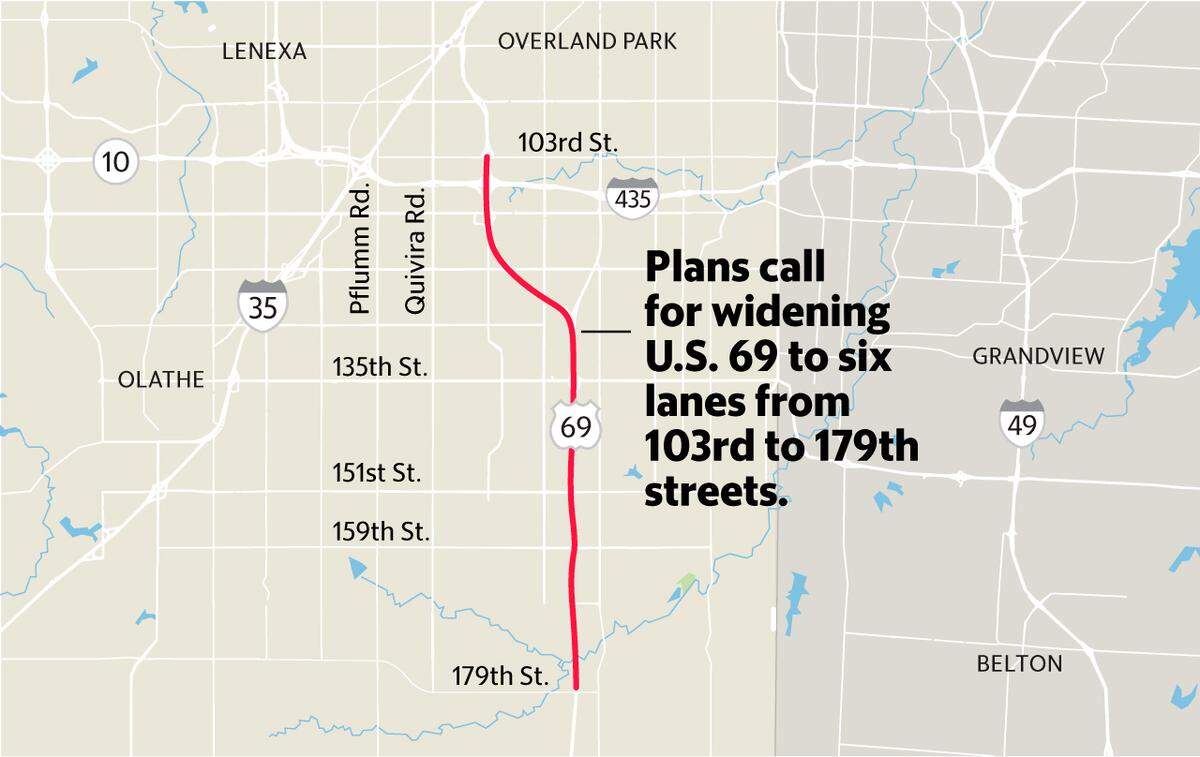
State and local officials had already planned to expand the highway to six lanes but Lorenz said reconstruction of the interchange wasn’t in the cards without the federal dollars.
“We wanted to do that all along,” Lorenz said. “We just didn’t know if we would have the funds.”
The Star’s Daniel Desrochers contributed reporting
This story was originally published December 8, 2021 at 5:00 AM.