
Missouri Democratic Senate candidates pitch paths to victory with ‘persuadable’ voters
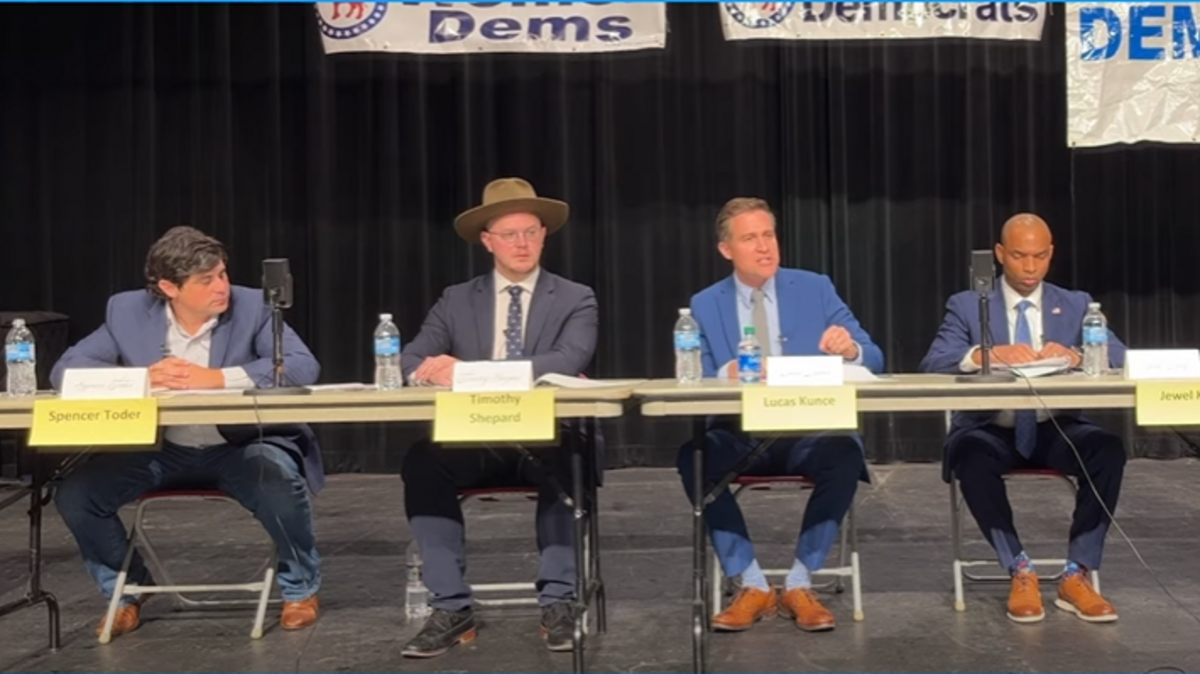
The night after their party suffered a stunning loss in the Virginia governor’s race, Missouri Democrats seeking the nomination for U.S. Senate made their pitches on the path to victory next year in the deep-red state.
None of the six, who appeared at a forum Wednesday night in Hillsboro hosted by several eastern Missouri Democratic groups, are big names. Their prospective Republican opponents — Reps. Vicky Hartzler and Billy Long, Attorney General Eric Schmitt, former Gov. Eric Greitens and famed St. Louis lawyer Mark McCloskey — are all more recognizable.
But in between answering questions on China and climate change, some said a populist message focused on economic issues could persuade some working-class voters to cross party lines. Others framed their campaigns as chipping away at the massive inroads Democrats need to make after losing statewide power precipitously in the past decade. Parts of the forum were streamed online.
“This isn’t going to be a state that we’re going to be able to flip by advertising at people in social media, we have to get to know people, we have to be there,” said Spencer Toder, a St. Louis businessman. “That’s the principle of my campaign.”
The chances of a Democratic victory in the race for the retiring GOP Sen. Roy Blunt’s seat are low. But Republicans and Democrats alike believe the race could be competitive if former Gov. Eric Greitens, who resigned under a cloud of scandal in 2018, is the Republican nominee. Even then, Democrats would need to excite both urban liberals and a greater share of the rural population, where the party has been losing ground over the years.
Lucas Kunce, a Marine Corps veteran who lives in Independence, said his message of reducing corporate influence in politics could help deliver a win. Kunce received national attention for his commentary this year on the U.S. withdrawal from Afghanistan and notably outraised every candidate in the race — Democrat and Republican — in the quarter that ended Sept. 30.
He said he’s rejected corporate campaign donations, a move embraced by left-wing figures in the Democratic Party such as Sen. Bernie Sanders. He also touted a message of economic populism and said he would invest in American manufacturing to reduce imports from the likes of Taiwan and China.
“I have a very clear message that we need to fundamentally change who has power in our country, so that it’s not these massive corporations stripping our communities for parts, and that message resonates no matter where you are,” he said.
Former Afton state Senator Scott Sifton said he would focus on “persuadable suburban battlegrounds” such as his old south St. Louis County district, where he won competitive races in 2012 and 2016, and a Kansas City Northland state Senate district that Democrat Lauren Arthur flipped in 2018.
Sifton is the only Democratic candidate in the U.S. Senate race who has held elected office.
“We need to compete everywhere and Democrats need to do better everywhere to win, but where the persuadable voters are in suburban areas, like the ones I’ve proven that I can win,” he said.
Other candidates include Air Force veteran Jewel Kelly, activist Tim Shepard and community college professor Gena Ross.
There was little mention of Republican opponents by name, though candidates criticized the GOP for what they called divisive rhetoric on issues like critical race theory.
They also all criticized their own party’s moderate Senators, Kyrsten Sinema of Arizona and Joe Manchin of West Virginia, for opposition to parts of President Joe Biden’s ambitious social spending proposal.
“You have two that are basically voting as if they’re Republican, and then you have all the Republicans lined up against us so we’re in a very tough situation,” Kelly said. “But we can look at ways where we can reduce the amount right so the goal should be universal, but if we can’t get there immediately, start small.”