‘You still vote’: These Kansas, Missouri lawmakers are outcasts, but remain in office
The three representatives sit at the front of the Missouri House, off to one side, effectively banished to a corner of the cavernous chamber after being booted from their party caucuses.
Off the floor, they work in cramped offices tucked away in obscure recesses of the Capitol. Stripped of committee assignments, they struggle to get attention for their bills.
After humiliating headlines and calls to resign, the handful of Missouri and Kansas lawmakers ensnared by scandal are outcasts this year. While they remain in office, they often work in the shadows, their influence greatly diminished.
In Missouri, Rep. Patricia Derges, a Nixa Republican, has been criminally charged with fraud. Rep. Rick Roeber’s adult children have accused the Lee’s Summit Republican of a history of sexual and emotional abuse, a matter that remains under investigation by the House Ethics Committee.
And Rep. Wiley Price, a St. Louis Democrat, was censured by the House in January after the same committee accused him of threatening an aide who reported that he had bragged about having sex with an intern.
In Kansas, Rep. Aaron Coleman, a Kansas City Democrat, has been accused of abusive behavior toward women, some of which he has acknowledged. Democratic leaders mounted an unsuccessful effort to remove him from the House.
The shunned lawmakers and their aides insist they are still serving constituents. But the weight of controversy has rendered them pariahs in statehouses that thrive on relationships and connections to get things done.
Derges has been reduced to emailing the caucus that exiled her, asking members to carry her bills. One would require that children seeking mental health care be immediately evaluated for being a danger to themselves. Another proposes warning labels for pet food.
“I would love to see these bills sent to committees and presented,” she wrote last month to House Republicans. “I believe they are very important and worthwhile bills. If you would like to co-sponsor any of them, are able to encourage them to go to committee or If you would be interested in carrying any of these bills, please let me know.”
None of her nine proposals have been assigned to a committee.
An assistant physician who owns a chain of southwest Missouri clinics, Derges is charged by federal prosecutors with pocketing nearly $200,000 from patients by selling a purported stem cell treatment that was actually amniotic fluid without the cells. She also holds a medical license unique to Missouri that allows medical school graduates to treat patients without residency. Her first bill would have allowed herself and other assistant physicians to become traditional physicians without residency after five years.
Another stalled measure would allow school districts to temporarily take on extra debt to complete projects. She described it in her email to colleagues as “critically important for my district,” and filed it on behalf of her local Ozark School District.
Reached for comment on the bill’s chances, Ozark School District spokeswoman Casey Owens said the district appreciates the support from Derges and other lawmakers.
“Our hope is that the bill would be assigned to committee,” Owens said.
In a brief interview, Derges said when other lawmakers are in committee meetings, she is “working and studying on bills and responding to constituents.”
She denied that having no committee or caucus affiliations had diminished her abilities as a lawmaker.
“You still vote,” she said.
Through an assistant, Roeber declined to comment for this story. House leaders in December announced that the ethics committee would open an investigation into the accusations made by his children. Roeber has said he is innocent, and the committee has not yet issued a report.
Price did not return messages left with his assistant, who emphasized that the lawmaker is still sponsoring bills and helping constituents. Prior to his censure, he had introduced bills to legalize recreational marijuana and create automatic voter registration.
Diminished influence
In Kansas, Coleman has offered testimony at legislative hearings as a way to keep his voice in the committee process, even though he has no committee assignments. Last month, in response to a bill increasing criminal penalties for purchasing sex, he urged the House Corrections and Juvenile Justice Committee to legalize sex work.
Coleman maintains an active Twitter presence, where he often criticizes other Democrats. He has also begun raising money for his re-election. In January, he tweeted a link to a website calling for donations to aid him, but the page doesn’t contain any disclosures about who paid for the site or where the money is going.
Mark Skoglund, director of the Kansas Governmental Ethics Commission, who wouldn’t comment on Coleman specifically, said that in general if a candidate has a website viewed by more than 25 people that includes express advocacy, “they would have to have ‘paid for’ attribution on that page.”
Express advocacy includes phrases like “vote for” or “cast your ballot for…” The page Coleman tweeted says, “Help Re-Elect BernieCrat Rep. Aaron Coleman!”
Even as he raises money, Coleman remains persona non grata among many of his colleagues.
He has been accused of hitting, choking and leaving violent messages with an ex-girlfriend. He has also suggested he wanted a former Republican lawmaker to die of COVID-19 and promised to take out a “hit” on Gov. Laura Kelly.
“Words matter. Actions matter. He is unfit to serve,” seven newly-elected female Democratic representatives said in a January statement.
In response to emailed questions, Coleman wrote: “The KC Star has done me dirty, they’re trash and everybody in Wyandotte County thinks that.”
Sen. Eric Burlison, a Battlefield Republican whose district includes Derges’, said committee assignments are not the only way for lawmakers to influence legislation.
“Anybody who’s in that situation, one would think they would focus on building relationships,” he said.
Lawmakers also seek out fellow representatives with experience in certain fields, such as health care, Burlison said.
Kansas Sen. John Doll, a Garden City Republican, left the Republican Party in 2018 in order to join the ticket of Johnson County businessman Greg Orman, who was running for governor as an independent. Under Senate rules, he was stripped of his committee assignments.
Doll, who has since rejoined the party and regained a place on committees, said his time as a political nomad wasn’t so bad, though he wasn’t ensnared by scandal.
Doll said he became much more aware of legislation that would affect his district and gained a broader knowledge of what was happening in the Legislature.
“When you’re in committee, if you’re on three or four committees, that’s pretty much it … it’s hard to stay up with what’s going on in other committees. Very hard. In fact, it’s damn near impossible,” Doll said.
At the end of a basement hallway
Kansas and Missouri politicians have a mixed record of surviving scandal.
Missouri House Speaker John Diehl resigned in 2015 after The Star revealed sexually-suggestive texts between him and an intern. Gov. Eric Greitens famously left office in 2018 as the General Assembly moved toward impeaching him.
But Kansas Rep. Michael Capps remained for a full term despite allegations he had been emotionally abusive toward children. And Rep. Vic Miller, then a Kansas senator, was charged with driving under the influence after a 2019 crash but won election as a representative in 2020 after reaching a diversion agreement.
Beyond past apologies, Coleman has largely stopped discussing the allegations against him. He has instead used social media to further project an image as a leftwing Bernie Sanders-esque politician.
On a Friday morning in late February, Coleman walked through the basement of the Kansas Statehouse carrying a lifesize cardboard cutout of Sanders. On Monday, he tweeted an image of himself next to the cutout in his office.
“Bernie Sanders came to Kansas. He stands over my desk keeping me dedicated to the people,” Coleman wrote.
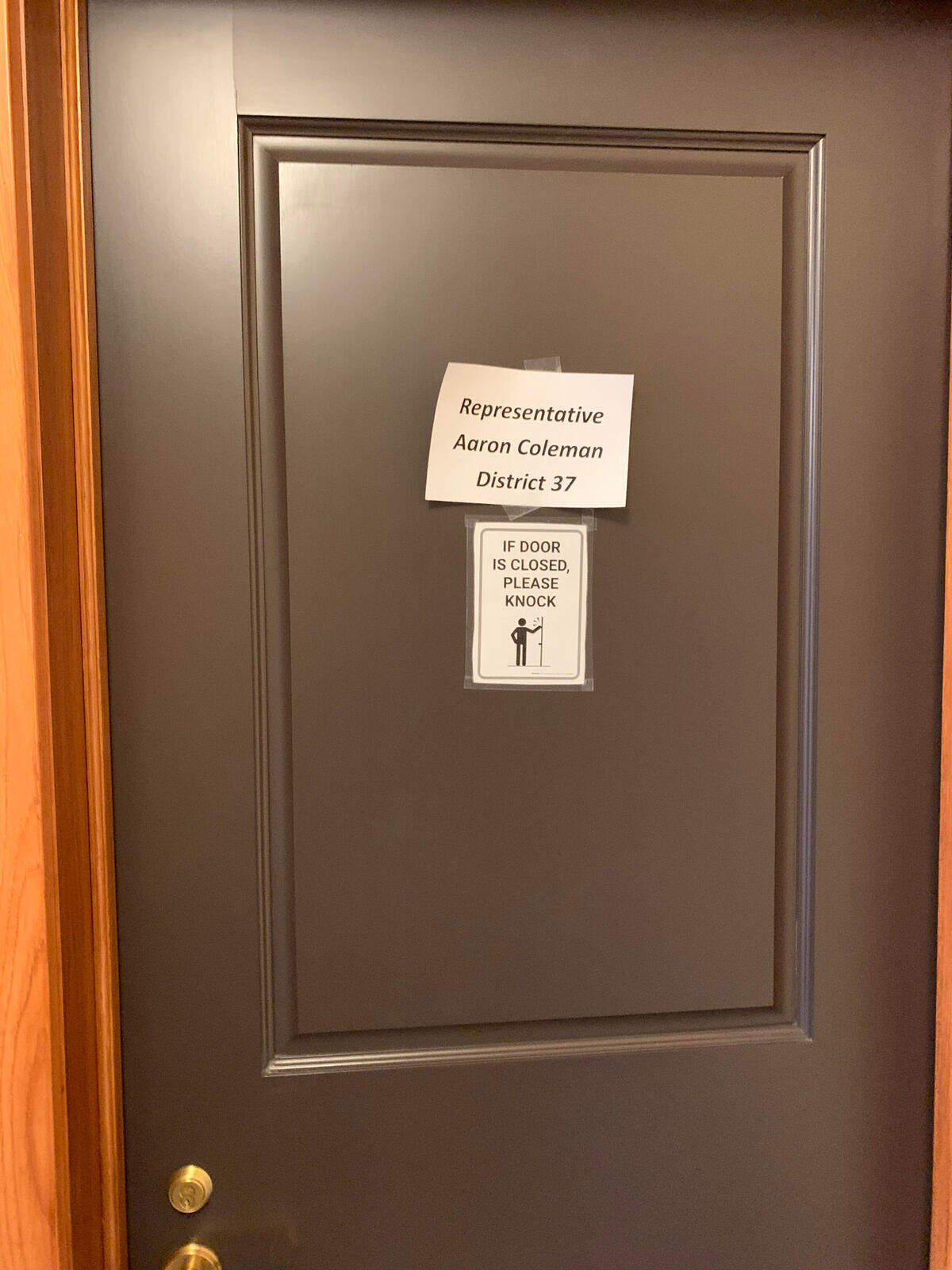
Only Coleman would know. His windowless office sits at the end of a long basement hallway.
The Star’s Katie Bernard contributed reporting