‘I think it’s here to stay.’ Trump’s grip on Kansas, Missouri Republicans still strong
On Jan. 6, Kansas Sen. Jerry Moran voted to certify the presidential election results in a Senate chamber that had just been ransacked by a violent mob hunting for politicians perceived as disloyal to President Donald Trump.
Moran had defended Trump’s right to fight the outcome in court. But ultimately, he said, he was bound by the Constitution.
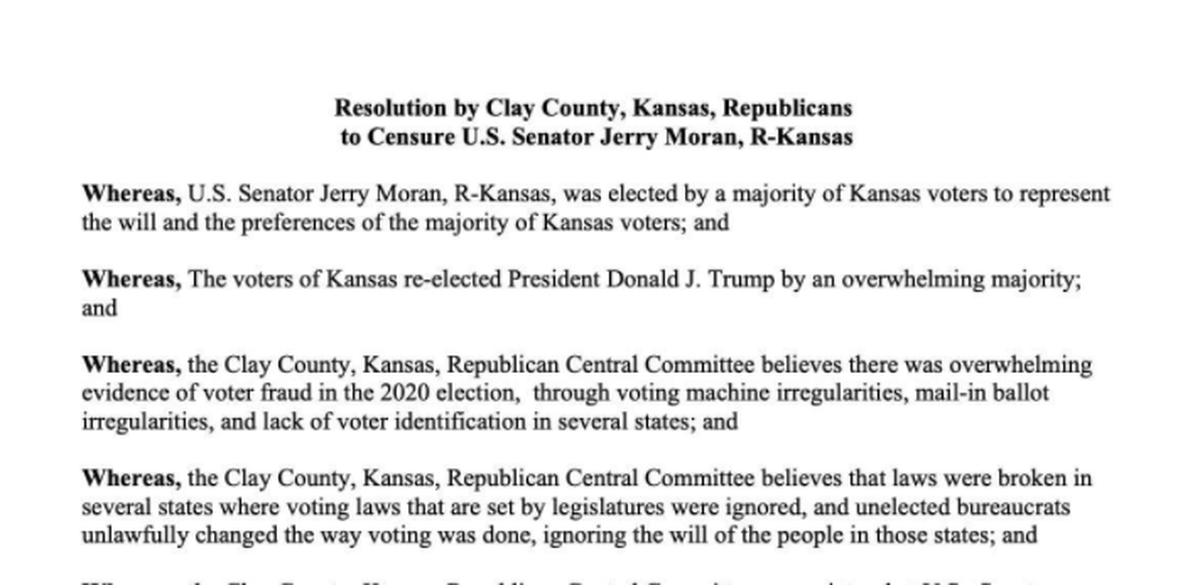
That wasn’t enough for the Republicans of Clay County, Kansas.
A resolution of censure, posted by the Clay County Republican Party to Facebook on Feb. 5, said Moran had caused “great harm” to the citizens of the county, to Kansas, and to the United States by not objecting to electoral votes from several key states won by President Joe Biden. The party said the resolution passed the county’s central committee with “overwhelming support” but didn’t provide a vote count.
He “violated the trust of voters, failed to faithfully represent a very large majority of Kansas voters and neglected his duty” to represent the will of those who elected him, the document said. A Moran spokesman declined to comment.
“I think if Donald Trump ran again tomorrow and we didn’t have Dominion Voting machines, he would win in a landslide. I really think that,” said party chair Vonda Wiedmer, alluding to the debunked conspiracy theory that the company’s machines were somehow used to rig the election.
Trump is out of office after a chaotic term that produced two of the four presidential impeachments in history and an explosion of violence that shocked the nation. He has left behind a Republican Party remade in his image and a national political atmosphere more toxic than ever.
His influence also reaches deep into the foundations Kansas and Missouri Republicanism in ways that could persist for many years. In state and local parties, the former president’s repeated falsehoods about the election and flirtation with conspiracy theories have found a receptive audience among some rank-and-file and leadership. Some who have attempted to challenge the discredited narrative have been marginalized or threatened.
Trump’s near-total grip, even after exiting the Oval Office, is frustrating those within the party who fear that the cult of personality will damage the regional Republican brand. One Kansas strategist said the party infrastructure is largely “putting its head in the sand.”
Interviews with more than a dozen Kansas and Missouri Republicans reveal parties mostly united in admiration for Trump’s ability to attract previously disconnected voters with his support for core conservative positions, such as opposition to abortion.
“The influence of Donald Trump is not going to go away soon. I think it’s here to stay,” said Wiedmer, whose north-central Kansas county went 76-21 for Trump in November. “Once you’ve had a Donald Trump for a president, you’re never the same again.”
Others worry about what happens if extremism and disinformation gain a stronger foothold.
“If conservatives and Republicans continue to cling to, ‘Trump or nobody else,’ it will lead to more Democratic dominance,” said Jean Evans, executive director of the Missouri Republican Party until December.
Evans left the position weeks before the end of her term, after threatening calls from Trump supporters. In an interview last week, she said the party would hear messages that anything less than unwavering support for the president made you a RINO, a Republican In Name Only.
Kansas state Sen. J.R. Claeys, a Salina Republican and regional field director on Trump’s re-election campaign, argued that politicians who abandon the former president will face political danger.
“Those who speak ill of the former president or who oppose his policies do so at their own peril,” Claeys said. “I think that the America First agenda is something those voters are going to hold on to for a very long time, even after Trump is done with his public life.”
Remaining loyal
While state-level polling is scarce, Republicans nationally remain solidly committed to Trump. Nearly three-quarters say it’s either very important or somewhat important for the party to remain loyal to Trump, according to a CBS News poll conducted earlier this month.
Many longtime Republicans who supported Trump were pleased by his push for better trade deals and harder line on immigration. But Evans acknowledged some members were “turned off” by his personality, rhetoric and “just some of the nastiness.”
Kansas and Missouri Republicans didn’t start out embracing Trump. Most who participated in Kansas’ caucus and Missouri’s primary in 2016 backed other candidates.
The future president earned 23% in Kansas, losing to Sen. Ted Cruz. In Missouri, Trump won nearly 41%, enough to beat Cruz for a plurality of voters, but still well short of majority support.
Republicans quickly rallied around Trump as the nominee, however. Mike Pompeo, then a Wichita congressman who supported Sen. Marco Rubio and warned Trump would be an authoritarian president if elected, went on to become one of his closest allies, serving as both CIA director and secretary of state.
The Republican Party was already becoming more focused on opposing abortion and embracing gun rights when Trump came along. His presidency gave “great voice” to those who wanted the party to continue moving in that direction, contends former Kansas state Rep. Jan Kessinger, a moderate Republican from Johnson County who endorsed Democrat Barbara Bollier’s U.S. Senate bid this fall.
“I think what we saw with the Trump presidency already had a pretty good foothold in Kansas, but it truly empowered the true believers and now we’re seeing the effects of it,” Kessinger said.
Some local Republicans are sidestepping Trump, arguing it’s time to get down to business. Johnson County Commissioner Charlotte O’Hara, who campaigned last fall as a Republican, said she is focused on local issues.
“In Washington, that’s their food fight. They spin and spin and spin, and that’s what drives a wedge between the good people of Johnson County. And I’m done with it,” she said. “At the local level, we are where the rubber hits the road. And that’s what we need to focus on.”
Johnson County has grown more supportive of Democrats in recent years. After Trump narrowly won the county in 2016, Biden carried it in 2020 by 8 points.
O’Hara believes her win in the southern district — technically a non-partisan seat — shows the party is holding strong in parts of the county. The message, she said, has to be no-nonsense and focused on the issues.
“We can’t get bogged down in rhetoric and narratives. Let’s just see what the job is at hand and learn how to have a conversation with people. The heated rhetoric is not helpful,” O’Hara said.
False claims, conspiracy theories
Trump’s close connection with Kansas and Missouri Republicans held strong through the waves of presidential scandal and dysfunction: the pressure campaign in Ukraine that led to his first impeachment, separation of migrant children from their parents at the border, his handling of the pandemic.
His share of the vote held relatively steady between 2016 and 2020, staying within 1 percent in either state.
The months since the election have tested those bonds unlike anything before, as Trump and his loyalists pursued a desperate strategy of disinformation to delegitimize and overturn the results.
Throughout it all, many Republicans in Kansas and Missouri have continued to support Trump and promote the false claims. The disinformation is sustained by the reach of social media.
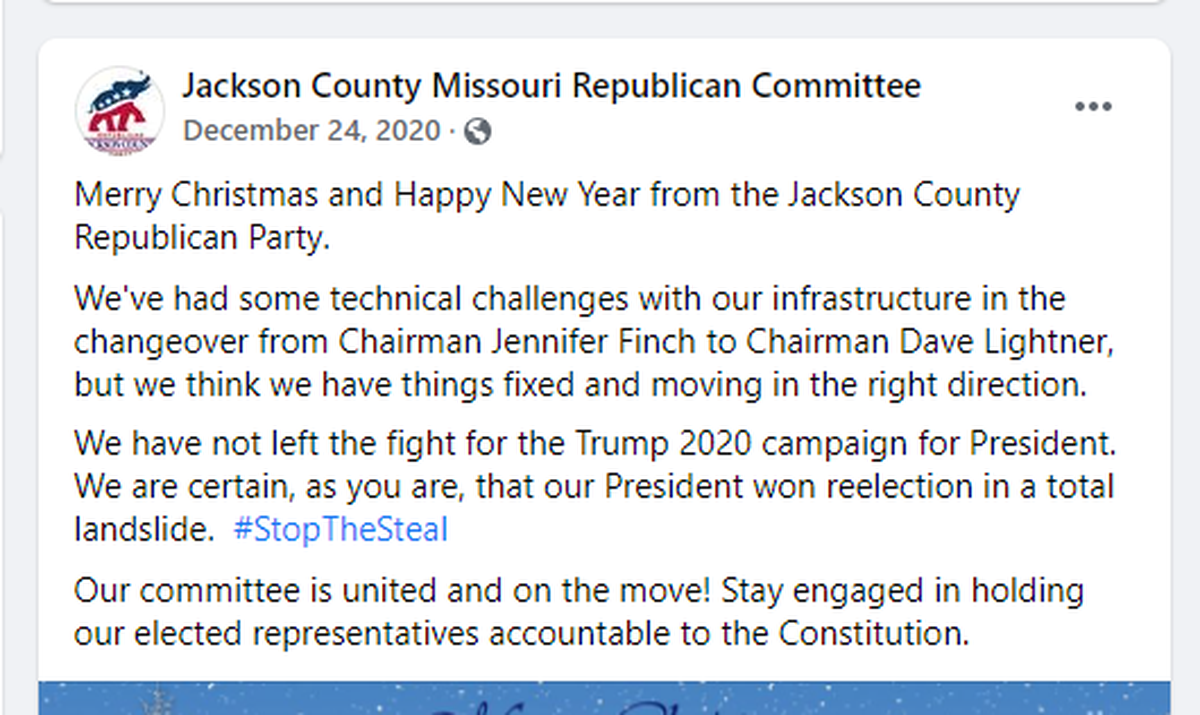
On Christmas Eve, the Jackson County, Mo., Republican Party posted on Facebook that Trump “won reelection in a total landslide. #StopTheSteal”. On Jan. 2, Kansas Republican national committeewoman Kim Borchers posted an Epoch Times article with a headline alleging more than 17,000 votes in Georgia were switched from Republican to Democrat (election officials have debunked claims of fraud).
And earlier this month, a Twitter account describing itself as the Douglas County GOP tweeted, “Stop Saying Capitol Cop is a ‘Fallen Officer’ — He did not Die from the Riot” and a link to a related article.
Shannon Golden, director of the Kansas GOP, tweeted that the account was not run by county Republican officials. Democrats quickly pointed out that the county party’s website linked to the Twitter account.
Golden then told The Star that county chapters had recently undergone reorganizations and that the current county chair hadn’t been given access to the account and hadn’t updated the website. “The tweet that was sent yesterday was not sent by any current official, and that account no longer represents the Douglas County GOP,” Golden said in an email.
The account was soon suspended.
Missouri state Sen. Eric Burlison, a Battlefield Republican, said an unwillingness to talk about the appearance of voter fraud has driven conspiratorial views.
“My view is that free speech is of the utmost importance and free speech means letting people be wrong, allowing people with different opinions to post things that, yes, might be fact checked false or whatever, but let people with intelligent minds debate,” Burlison said.
The Republican National Committee has formed an election integrity panel that the party says will help ensure confidence in future elections. But its launch comes after months in which Trump and other Republicans were the chief drivers of doubt.
At least 165 bills restricting voting access have been filed in state legislatures this year, according to the Brennan Center for Justice at New York University. Republicans in Kansas and Missouri are pursuing changes to ballot collection and voter ID requirements.
“I have practiced law for 30 years and that has probably shaped how I deal with people when there’s controversy. And my view is that for people who are concerned about voter fraud, about conspiracies, it’s not the right thing to do to tell them that they’re just wrong,” said Mike Kuckelman, chairman of the Kansas Republican Party. “The better thing to do is to address their concerns and make changes that give them confidence and faith,”
‘Nobody has to say anything’
Trump’s grassroots popularity means any forceful effort by Republican officials to distance the party from the former president, or the false claims he’s promoted, risks the wrath of his supporters — or Trump himself. A single statement or endorsement can send a flood of donations to candidates for Congress or even governor.
Kansas state Rep. Steven Johnson, an Assaria Republican, said he’s not sure what percentage of the party doesn’t believe the election was legitimate. “But it is a group that has a meaningful impact on primary elections, which gives us the choices for the general, and I think it’s possible that you have a plurality that can govern,” Johnson said.
The first big test of Trump’s continuing regional influence will come in 2022, when Moran and Missouri Sen. Roy Blunt, a Republican, are both up for re-election. Kansas Gov. Laura Kelly, a Democrat, will also be on the ballot.
Moran and Blunt both voted to certify the election results, though both also voted to acquit Trump earlier this month. The election vote angered some conservatives, and speculation exists that both men could face primary challengers.
“I think that the majority of Missourians do support Donald Trump but I don’t think it’s to the point of they’re going to disown everyone,” said Evans, the former Missouri GOP director.
Missouri state Sen. Mike Cierpiot, a Lee’s Summit Republican, said talk of censuring Trump critics will be “short-lived” as passions over the election subside.
Still, like frustrated Republican voters, he chafed at the former president’s Republican critics.
“I think those people probably are going to wish they hadn’t done that,” Cierpiot said. “I wish they’d all just be quiet. Nobody has to say anything. They can let it go, he’s now the ex-president.”
The Star’s Katie Bernard contributed reporting
This story was originally published February 21, 2021 at 5:00 AM.