Deadly siege at Capitol marks beginning of new era of violent extremism, experts say
The deadly insurrection at the nation’s Capitol marks the start of a new era of violent extremism and should serve as a wakeup call to those who have ignored the warnings, some experts say.
“It’s an absolutely new ballgame,” said Devin Burghart, executive director of the Institute for Research and Education on Human Rights, which has tracked far-right activity for decades. “What was on display Wednesday in many respects is the beginning of a new movement, not the end of an old one.”
The nation’s response, he said, will determine whether the movement takes hold.
“Right now, we are at a critical juncture,” Burghart said. “Left unchecked, this newly forming movement could become something far worse than any we’ve ever seen. And what we saw in our nation’s capital could look tame compared to what we could experience in the near future.”
The country watched the disturbing scenes unfold on Wednesday as supporters of President Trump stormed the Capitol in an effort to stop the certification of President-elect Joe Biden’s win. In the first breach of the building since 1814, rioters shattered windows and battered locked doors with metal police barricades, then roamed through offices and invaded the House and Senate chambers.
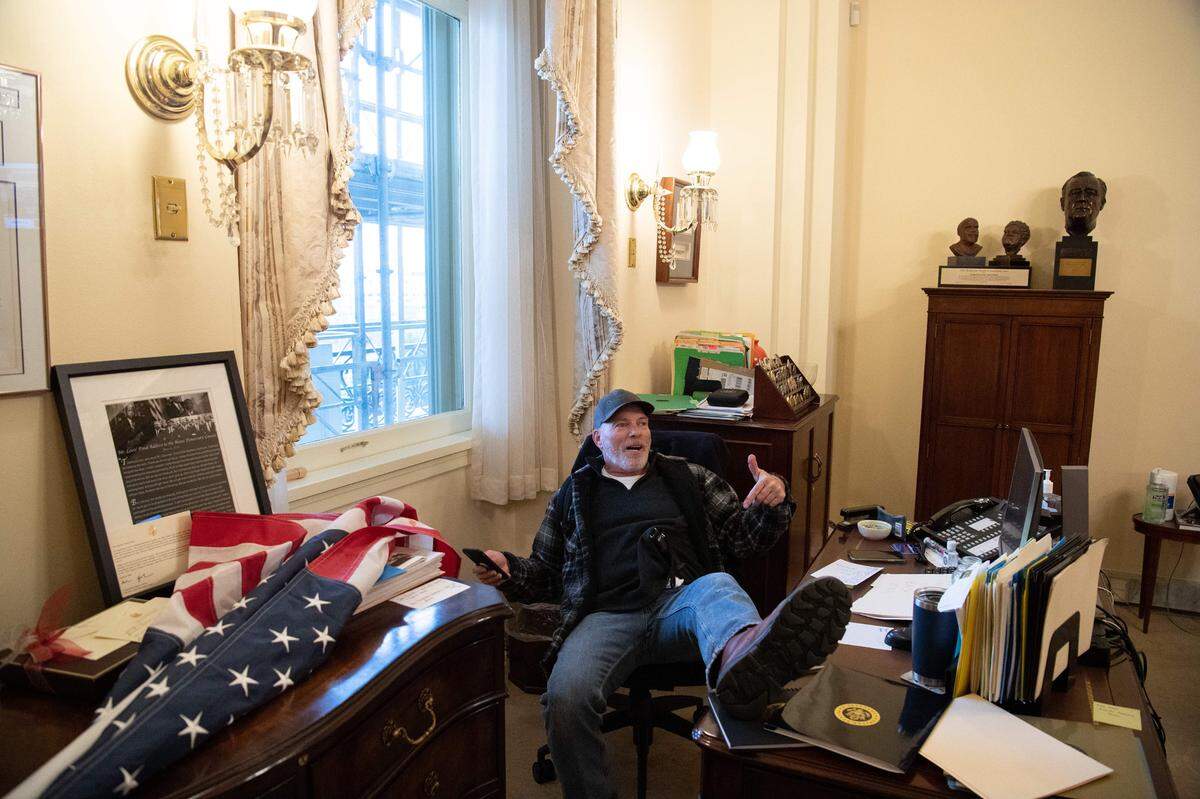
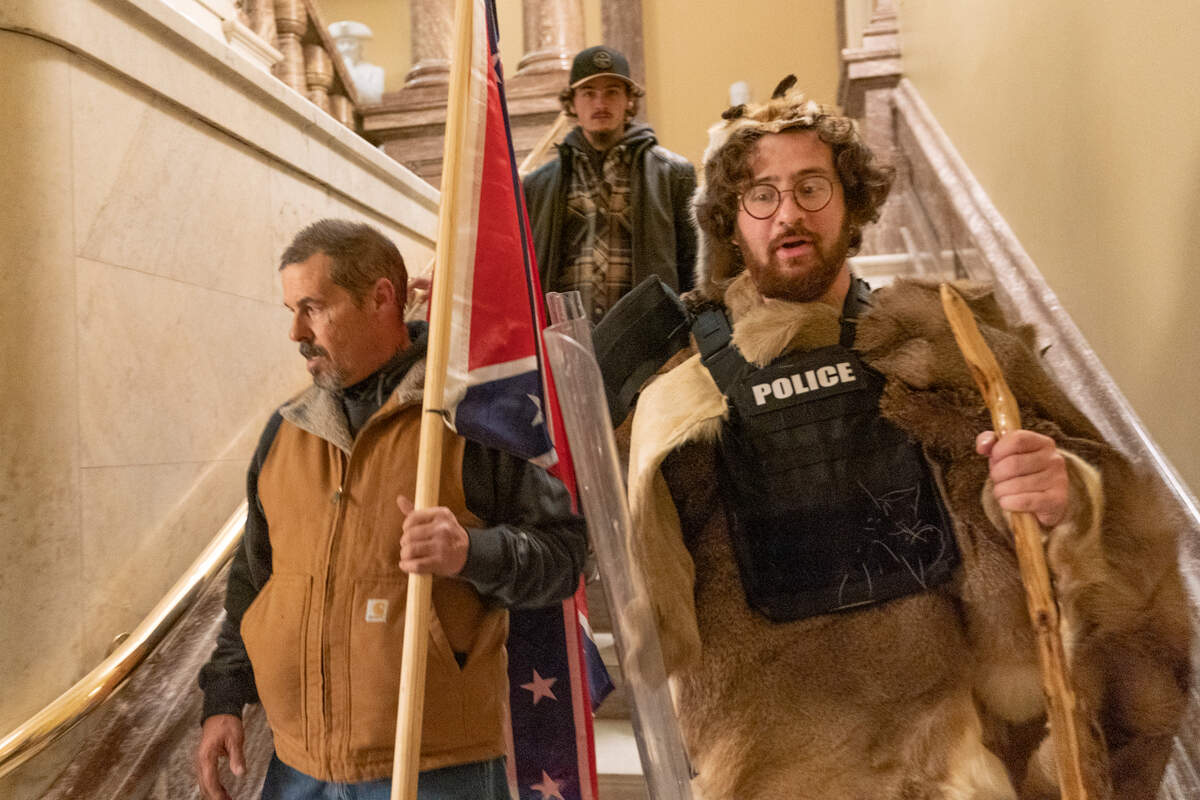
One man paraded through the halls with a Confederate flag; another put his feet up on a desk in House Speaker Nancy Pelosi’s office after it had been ransacked. Furniture and cabinets were damaged, and authorities said electronic items and documents were stolen from congressional offices.
One troubling video showed a police officer being crushed against a door frame, screaming in pain and his mouth bloodied, as he and other officers frantically tried to push back the angry mob.
Five people died in the siege, including U.S. Capitol Police officer Brian D. Sicknick, a military veteran who authorities said died of injuries sustained while on duty. California native and Air Force veteran Ashli Babbitt was fatally shot by police as she and other rioters invaded the building, and authorities said three others died of medical emergencies in the area surrounding the Capitol grounds.
“If this act of domestic terrorism didn’t awaken people to the threat of far-right radicalization in the United States, nothing is going to,” Burghart said. “It was a truly shocking situation that rivals only some of the most horrible moments in the country’s history, like the Oklahoma City bombing, in terms of its overall ability to capture the threat that’s posed by these groups.”
Photos of a rioter in tactical gear carrying zip ties through the Senate chamber and the arrest of an armed Alabama man who authorities said had 11 Molotov cocktails and an assault rifle in his pickup nearby, along with images of a makeshift gallows with a hangman’s noose that had been erected on the Capitol grounds, were alarming signs of just how explosive the situation was, Burghart said. Some videos even showed people in the crowd chanting, “Hang Mike Pence!”
“This wasn’t just people taking a tour of the Capitol building,” he said. “There were those in the crowds that because of the rhetoric they’ve been fed, decided that this was an existential threat and that they were going to engage in staging a coup — including show trials, which could have ended in the execution of elected officials.”
Watchdog groups have been warning for months that violence could escalate in the period leading up to the November election and beyond. Over the past year, Burghart’s organization has tracked a sharp increase in paramilitary groups across the country.
Violence directed at government buildings also has been on the rise, he said. Among the most recent incidents occurred in Salem, Oregon, when Proud Boys, Three Percenters and militia activists invaded the state capitol. And Wednesday’s breach didn’t occur only in the nation’s capital, he noted, but also in a number of states.
On Friday, Burghart’s organization issued a report saying it had documented 45 “Stop the Steal” rallies that took place in 32 states on the same day as the U.S. Capitol invasion. Violence and breaches of government property occurred in several instances, the report said, and far-right groups — including the Proud Boys — were in abundance.
“As shocking as it was to watch, what happened Wednesday was entirely predictable if you were paying attention to what the far right has been doing,” Burghart said.
It’s not uncommon to see activity ramp up around an election, said Brian Levin, director of the Center for the Study of Hate and Extremism at California State University-San Bernardino.
“But because of the unusual drawn-out nature of this particular election and the way Trump has weaponized it, it’s actually extended through a season, with ebbs and flows,” he said. “We had this locomotive train of ideology and subcultures, some of which were really different — but they all were looking at things like a purge, a storm, a Civil War. And a lot of these folks really thought that the president was going to ultimately prevail.”
But as Trump began losing court challenges and his support from mainstream Republicans dwindled, things changed, Levin said.
“And the date and time for this particular battle in the Civil War became January 6.”
When Trump was elected, Levin said, the far-right movement was united behind his candidacy.
“We kind of saw them on a more organized dance card,” he said. “But then these larger groups fell apart. Their leadership was hobbled by lawsuits and doxxing and criminal prosecutions.”
And that led to what Levin called “elastic grievance movements,” such as those staging “open states” or “liberate” protests against government officials’ stay-at-home directives and mask orders issued during the coronavirus pandemic.
“These elastic grievance movements take in an array of ideologies and complaints, some of which are closer to the mainstream and others which are just lunatic, cultish and oftentimes bigoted conspiracies,” he said.
The so-called Liberate Movement has become a swap meet of sorts, Levin said, “where we have people, some who were legitimately aggrieved, with others who are Second Amendment insurrectionists, conspiracists, QAnon and militant Trump supporters.”
“So what happened was they got to cross-pollinate and really create a mutant form of extremist hate virus.”
The recent alleged plot by a militia group to kidnap Michigan Gov. Gretchen Whitmer and put her on trial for treason is a good example, Levin said.
“When Liberate Michigan was pronounced by the president and he labeled the governor as a target of derision and aggression, we saw people then show up with guns at the state capitol,” he said. “And among that group was someone who was involved in the kidnapping plot. So we had cross pollination of anti-authority grievances.”
The escalation in the number of extremists who harbor these intertwined mixtures of ideology is a serious concern, said Levin, a former New York City police officer. And their targets are different than before. Now, he said, they include not only Democrats and progressives, but Republicans, law enforcement, Vice President Mike Pence and even Chief Justice of the United States John Roberts.
“Their ire previously was directed at state and local authorities,” he said. “Now, it’s federal as well. And threats against public officials at workplaces and homes.”
The immediate concern, Levin said, is the transition of the presidency.
“But afterward, when Trump is forced on a smaller dingy, the ones who will be there will be true believers, and they will adhere to a variety of ideologies, hatreds and conspiracy theories,” he said.
“But now, they’ll have the worst seats in the stadium. And it’s harder to cheer when you’re in the nosebleed section. So they’ll be more desperate and radical. Leaner and meaner.”
A former Secretary of Homeland Security on Thursday called Wednesday’s invasion “one of the saddest days in our country.”
It was “domestic terrorism coming from within our own borders, encouraged by, incited by, the sitting president of the United States,” said Jeh Johnson, the head of Homeland Security during the Obama administration, in an interview with Wolf Blitzer on CNN. “I never would have anticipated that in my lifetime. It was a sad, sad state of affairs. And let’s not beat around the bush. This was insurrection. This is the very definition of insurrection.”
Johnson, who also is a former general counsel for the Department of Defense, said there were many images from the riot “that will be burned into my memory for the rest of my life.”
“The two that were the most shocking to me, aside from the destruction of property, was the hangman’s noose on the western front of the Capitol...as well as people brandishing Confederate flags in the U.S. Capitol,” he said. “We fought an entire Civil War to prevent exactly that from happening, but that’s how far Washington descended yesterday.”
Johnson said the problem has become more than just an issue of bridging the divide.
“There needs to be a harder look at how a large segment of this country could get to a place where they believe that the election was stolen and that they therefore have to take to the streets and invade the Capitol to somehow seek redress,” he told CNN. “That’s a very, very sad state of affairs.”
Burghart said several things must take place to prevent future violence.
“The nation as a whole needs to fully condemn all of those involved and all of those who enabled what took place Wednesday,” he said. “And conservatives need to have a reckoning in their own house and hold accountable all of those who helped enable what we saw.”
There also must be a national discussion on the racial resentment and conspiracy mongering that fueled the insurrection, he said, and a strong law enforcement response to bring those committing crimes to justice.
Just as important, Burghart said, the social media industry must take a more active role in preventing the spread of inciteful rhetoric and misinformation.
“I think for the big five social media giants, it’s been too little, too late,” he said. “They haven’t responded swiftly enough or fully enough, and they’ve continued to let it grow.”
On Friday night, Twitter announced that it had permanently suspended Trump’s account “due to the risk of further incitement of violence.” Twitter had temporarily shut down Trump’s account on Wednesday after his supporters stormed the Capitol.
Burghart said his organization is tracking more than 1,000 groups on Facebook with a total membership of 3 million nationwide that are promoting conspiracy mongering over COVID-19.
“Facebook’s done little about those, and that’s true for the other social media platforms as well,” he said. “I think what they did was a step, but they’ve got a lot more steps to make before they are truly on the way to helping mend all the damage they’ve done over the last four years.”
Some of the smaller platforms, like DLive, Rumble, MeWe, Gab and Parler have become new homes for these groups, Burghart said.
“But they won’t stay on those platforms,” he said. “It just festers in those echo chambers. And then at some point, it’s pushed out into the mainstream once again.”