Kelly gets her shot — and takes some from Republicans over vaccine allotment choices
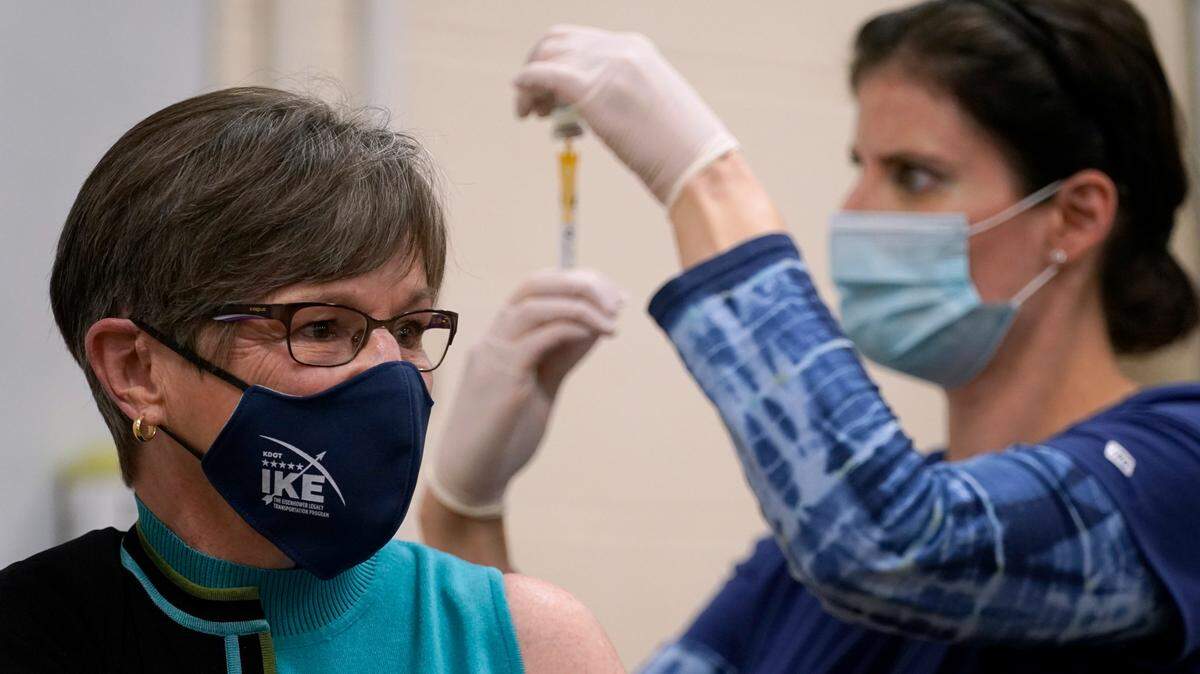
Kansas Gov. Laura Kelly slipped off a jacket and chatted with a medical worker Wednesday as she received her first dose of Moderna’s COVID-19 vaccination.
When asked how it felt, she said she didn’t feel a thing.
“No pain, but hopefully a lot of gain,” Kelly joked while encouraging other Kansans to get the vaccine when they could.
The 70-year-old governor’s decision to be vaccinated this week, and to allow other top officials to get early vaccinations to ensure the government can continue to function, has drawn criticism from some Republican lawmakers who say more vulnerable Kansans and those on the front lines deserve priority.
In addition to Kelly, the governor said Wednesday afternoon that hundreds of state workers whose work was essential to coronavirus response and continuity of operations in state agencies would be vaccinated.
Health secretary Lee Norman said he was on that list, though it was not immediately clear who the other state workers were.
The governor’s office had previously released a list of 11 officials, including her, from the three branches of government who could be vaccinated. Among those who said they would: Treasurer appointee Lynn Rogers, incoming Lt. Gov. David Toland, Supreme Court Chief Justice Marla Luckert and Insurance Commissioner Vicki Schmidt.
Several Republican leaders said they would wait to get their vaccine until it was their “turn” and that other Kansans needed the doses more than them.
Among them are Senate President Ty Masterson, Speaker of the House Ron Ryckman, Speaker Pro Tem Blaine Finch and Attorney General Derek Schmidt.
“We should not be giving politicians access to scarce vaccine doses until vulnerable Kansans have been protected,” Masterson said in a statement. “The priority for the vaccine should be placed on front line health care workers and vulnerable Kansans.”
At the news conference Kelly said her administration is not putting politicians ahead of the population but rather prioritizing state leaders who are necessary for the state government to operate.
Kelly said public officials who can get a vaccine should.
“It would be consistent with the desire to work together to really promote the mitigation efforts that work and in the case of the virus do something that will actually stop the spread of the virus,” she said.
Meanwhile, concerns are mounting that health departments across the country have been too slow to vaccinate the population. In remarks Tuesday, President-elect Joe Biden said that it would “take years” to vaccinate the American public at the current pace.
Just over 2 million Americans have been vaccinated, according to the Centers for Disease Control and Prevention, far below the Trump administration’s goal to vaccinate 20 million before the end of the year.
Several states have fallen behind expectations for administering the vaccinations. According to Bloomberg at least 12 states have administered less than 20% of the vaccine doses sent to them thus far.
In a news conference Wednesday, Randall Williams, director of the Missouri Department of Health and Senior Services, said 66,000 vaccines had been administered in the state, less than a third of the 314,000 sent to Missouri this month.
Williams said only a small proportion of the doses had been administered because half the doses were set aside for long-term care facilities, and the state’s partnership with CVS and Walgreens to administer those doses only began Monday.
All the initial vaccines, Williams said, should be administered by the middle of January.
The Kansas Department of Health and Environment said Wednesday that it did not have data available for the number of Kansans who have received the vaccine. The agency is experiencing reporting delays because many providers are not yet trained in the computer system used to record data, spokeswoman Kristi Zears said in an email.
In her news conference Wednesday, Kelly said the state has received 159,000 doses of the vaccine and is anticipating more shipments next week. Though specific data is not available, Kelly said the state is on track with its vaccinations.
“We’re very confident that vaccines are not sitting on shelves, that they’re getting in people’s arms,” she said.
Kansas has taken a phased approach to vaccine distribution with healthcare workers receiving the first doses followed by residents at long-term care facilities, essential workers and those at high risk for complications from the virus.
In a meeting with legislators last week, Kelly said her husband, a pulmonologist, had been immunized after he came out of retirement to work with respiratory patients.
A previous version of this story incorrectly quoted Gov. Kelly’s reaction to receiving the vaccine.
This story was originally published December 30, 2020 at 6:18 PM.