
As sun rises, Kansas Legislature passes restrictions on Gov. Kelly’s COVID-19 powers
After a marathon all-night session, the Kansas Legislature approved a sweeping bill Friday morning that asserts control over Gov. Laura Kelly’s pandemic response and hands counties the power to set rules that are less stringent than her statewide standards.
The Republican-controlled Legislature would also gain the power to block decisions by the Democratic governor on how to spend the $1.2 billion in federal coronavirus relief flowing into the state.
Kelly now faces a pivotal decision that will determine what daily life in Kansas looks like in the weeks and months ahead. How restaurants, bars and other businesses operate — and who makes those decisions — are all on the line.
The governor can allow the bill to become law and have her emergency powers extended at the price of legislative control. Counties would be free to set their own restrictions, effectively undercutting her ability to regulate the state’s reopening.
Or she can veto the measure and issue a new, legally shaky emergency declaration to replace the current directive that expires May 26. That approach would likely trigger a court fight over the limits of her executive authority.
At a Friday afternoon press briefing, Kelly said she still needed to review the legislation, along with several other measures passed in the wee hours of the morning, before deciding to sign or veto.
But she had scorching criticism for the comportment of lawmakers during the nearly 24-hour session, which included the flight of a paper airplane and a series of bills passed after the designated adjournment time of midnight.
She called the Legislature’s behavior “the most embarrassing, irresponsible display of governing that we have witnessed” during the COVID-19 public health crisis.
“What happened in the Kansas Legislature yesterday was simply indefensible from start to finish. And there’s no way for me to sugarcoat that,” she said.
Kelly’s emergency powers are allowing her to reopen Kansas gradually in phases. Retail stores, restaurants, theaters and museums can resume operations. But bars, night clubs, swimming pools and large venues remain closed. Mass gatherings of more than 15 are prohibited.
The gradual easing of limits is expected to continue well into June.
Without emergency powers, the restrictions could end abruptly — effectively dismantling a public health strategy aimed at limiting the spread of the coronavirus, which has infected more than 8,500 and killed 178 statewide.
The Senate passed the bill at 6:30 a.m. in a 27-11 vote largely along party lines. The House followed just before 8 a.m. in a 76-34 vote, sending the bill to Kelly’s desk.
Kelly hasn’t promised to veto the bill, but her office said the Legislature’s actions didn’t represent “an honest conversation” about overhauling the state’s emergency management law.
“Quite frankly, I think she’ll veto that bill when it’s all said and done,” Senate Minority Leader Anthony Hensley, a Topeka Democrat and a close ally of Kelly, said Thursday. “In fact, I would encourage her to do that.”
Confusion and uncertainty marked the one-day legislative session, scheduled to end at midnight. But staff did not finish drafting the bill until the early hours of Friday morning. Lawmakers frequently complained that they were uncertain what they were doing. For instance, when Senate Republicans gathered at around 4 a.m. to discuss the bill, no one was able to produce a copy.
The legislation culminated of weeks of mounting conservative anger at Kelly over executive orders that Republicans contend overstepped her authority and worsened the pandemic’s economic toll by keeping businesses closed. Even as Kelly has moved to lift restrictions, GOP lawmakers contend the pace is too slow.
“It doesn’t make sense -- what’s open, what’s closed,” Senate President Susan Wagle, a Wichita Republican, said.
As legislators huddled inside the Statehouse, several dozen demonstrators rallied outside, urging lawmakers to restrain the governor. Rep. Leo Delperdang, a Wichita Republican, thanked the crowd for “not wearing the damn face masks” to cheers and applause.
“We’re at war, people, with the virus and that is the time we need the constitution the most,” Delperdang said.
The sharp words came after President Donald Trump praised Kelly’s “fantastic job” during a White House meeting this week. And Sen. Pat Roberts, a Republican, said the governor and her emergency management team had done a “great job.”
The bill would allow the governor’s emergency powers to continue through May 31. After that the State Finance Council, a panel of legislative leaders chaired by Kelly, could approve extensions of up to 30 days. Kelly would have to return to the council at least once a month to retain her authority.
The governor would have the power to close businesses for only up to 15 days, a period slightly longer than the two-week incubation period for COVID-19. The State Finance Council would need to authorize additional closures.
Additionally, county commissioners could implement rules less strict than Kelly’s statewide standards. Currently, counties are only allowed to have more stringent requirements.
The bill eliminates criminal prosecutions for violations of executive orders. Prosecutors could instead seek civil penalties for violations, including fines of up to $2,500.
“You are taking steps here today that will make Kansas less safe,” Rep. Jim Ward, a Wichita Democrat, told his fellow lawmakers.
If Kelly vetoes the bill, the state’s current disaster declaration — which authorizes the governor’s emergency powers — will expire on May 26. At that point, Kelly could issue another one, but Attorney General Derek Schmidt strongly suggested that a fresh declaration would be illegal.
“The plain language of (state law) authorizes the governor to proclaim only one state of disaster emergency arising from the same continuing disaster,” Schmidt wrote in a legal opinion.
The bill also imposes legislative oversight on Kelly’s use of the $1.2 billion in federal coronavirus aid awarded to Kansas. The Legislative Coordinating Council, made up of Republican and Democratic leaders, would approve any spending of the funds.
The legislation potentially overrides the process Kelly has already created to distribute the aid. Under her plan, a task force of business and civic leaders will oversee major spending decisions.
The bill would also protect medical providers and businesses from lawsuits related to COVID-19. The issue has proved especially divisive, with the Kansas Chamber of Commerce lobbying for sweeping immunity and the Kansas Trial Lawyers Association warning against limits on lawsuits.
Eric Stafford, a lobbyist for the chamber, called the protections “extremely important in the current climate that we’re in.”
But David Morantz, president of the trial lawyers association, warned that legislation passed during the compressed, extraordinary session “runs the risk of creating consequences far beyond what a bill’s supporters, stakeholders and lawmakers can currently conceive.”
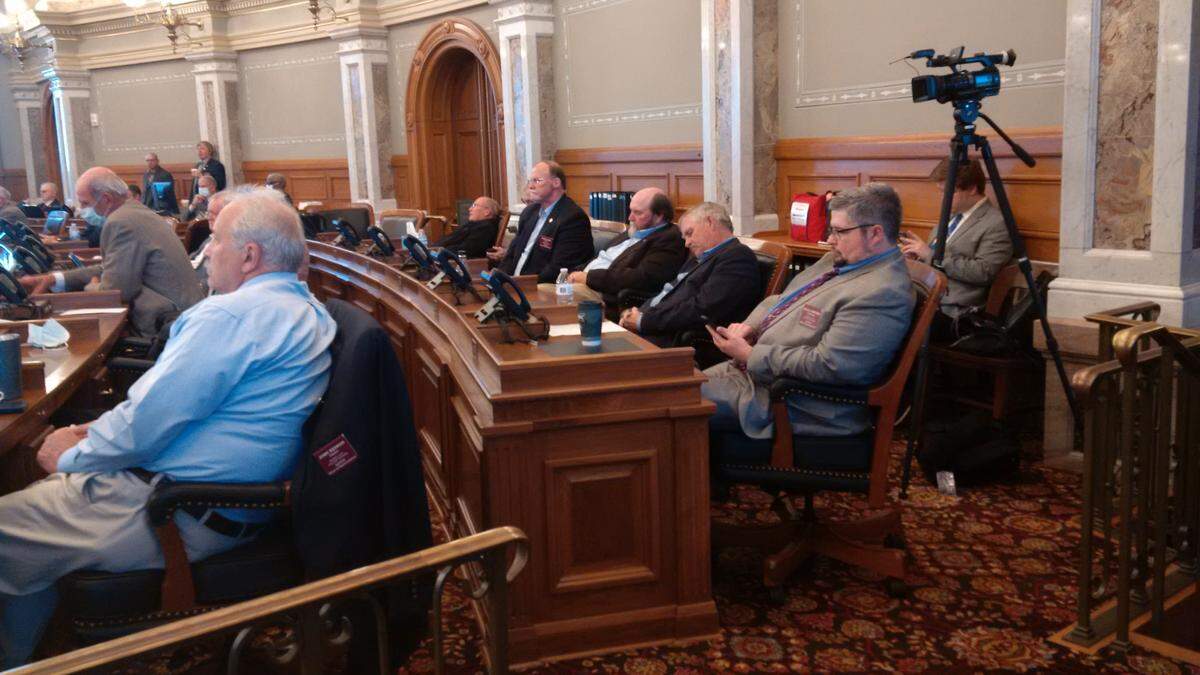
Almost nothing was normal during Thursday’s session. The final meeting of the year is typically ceremonial but was marked by frantic legislating this time.
Some lawmakers wore masks, others didn’t. A few practiced social distancing, but many did not.
The House implemented elaborate procedures to clamp down on contact between lawmakers, including having lawmakers vote in small groups. But by Thursday night, most of the chamber’s 125 members were sitting in the chamber.
Republicans insisted throughout the day that bills had to be passed by midnight or would become susceptible to legal challenges. By Thursday night, it became clear lawmakers wouldn’t make that deadline and would instead rely on hope that their actions will stand up in court.
In a desperate effort to pick up the pace, Senate Republicans earlier in the day drastically limited debate on bills and forced votes before amendments could be offered.
GOP senators shifted their approach after a morning speech by Sen. Vic Miller, a Topeka Democrat, who listed every day this year that the Senate didn’t hold debate.
“So when I hear criticism from leaders of the Senate criticizing other leaders of our state for their job performance, I get a little irritated,” Miller said. “If there was ever the pot calling the kettle black, that is such a situation.”
Senate Majority Leader Jim Denning, an Overland Park Republican, then announced that he was “out of patience” and Republicans cut off debate on measures for the rest of the day. GOP lawmakers later gave up on any full debate over legislation and instead began sending bills to conference committees, where lawmakers negotiate compromise measures.
“This is wrong what we are doing here,” Rep. John Carmichael, a Wichita Democrat, said earlier in the night.
This story was originally published May 22, 2020 at 8:55 AM with the headline "As sun rises, Kansas Legislature passes restrictions on Gov. Kelly’s COVID-19 powers."