
Kansas altered meatpacking guidance to let possibly exposed workers stay on the job
After industry executives repeatedly raised the issue with the state’s top agricultural official, Kansas relaxed its quarantine guidelines so meatpacking workers potentially exposed to the coronavirus could stay on the job.
Text messages and emails obtained by The Kansas City Star and The Wichita Eagle show that executives at Tyson and National Beef, which employ thousands at massive plants in southwest Kansas, pushed back at Secretary of Agriculture Mike Beam over the guidelines.
As the number of workers who tested positive for COVID-19 climbed, the companies drew Beam’s attention to more lenient guidance from the Centers for Disease Control and Prevention (CDC).
“The sooner we get the CDC new guidance in place the better,” National Beef chief operating officer Terry Wilkerson texted Beam on April 20, adding he had just heard two meatpacking plants elsewhere in the country were shutting down.
Ultimately, Kansas — which processes more than a quarter of the nation’s beef — shifted its guidance to align more closely with the federal agency as COVID-19 swept through the state’s plants. Nearly 2,000 people have been infected from outbreaks linked to the state’s meatpacking plants and six people have died.
The new Kansas guidelines, last updated May 2, allow meatpacking employees who have come into close contact with positive cases to continue working as long as they showed no symptoms and took precautions, such as wearing a mask. The state had previously advised contacts to quarantine for two weeks.
“We are very happy with the guidance from KDHE,” Ruth Bradley, manager of state and local government relations at Tyson, texted Beam on April 30.
Prior to the change, Beam privately suggested Kansas Department of Health and Environment Secretary Lee Norman, who has been leading the state’s pandemic health response, was resisting relaxation of the guidelines.
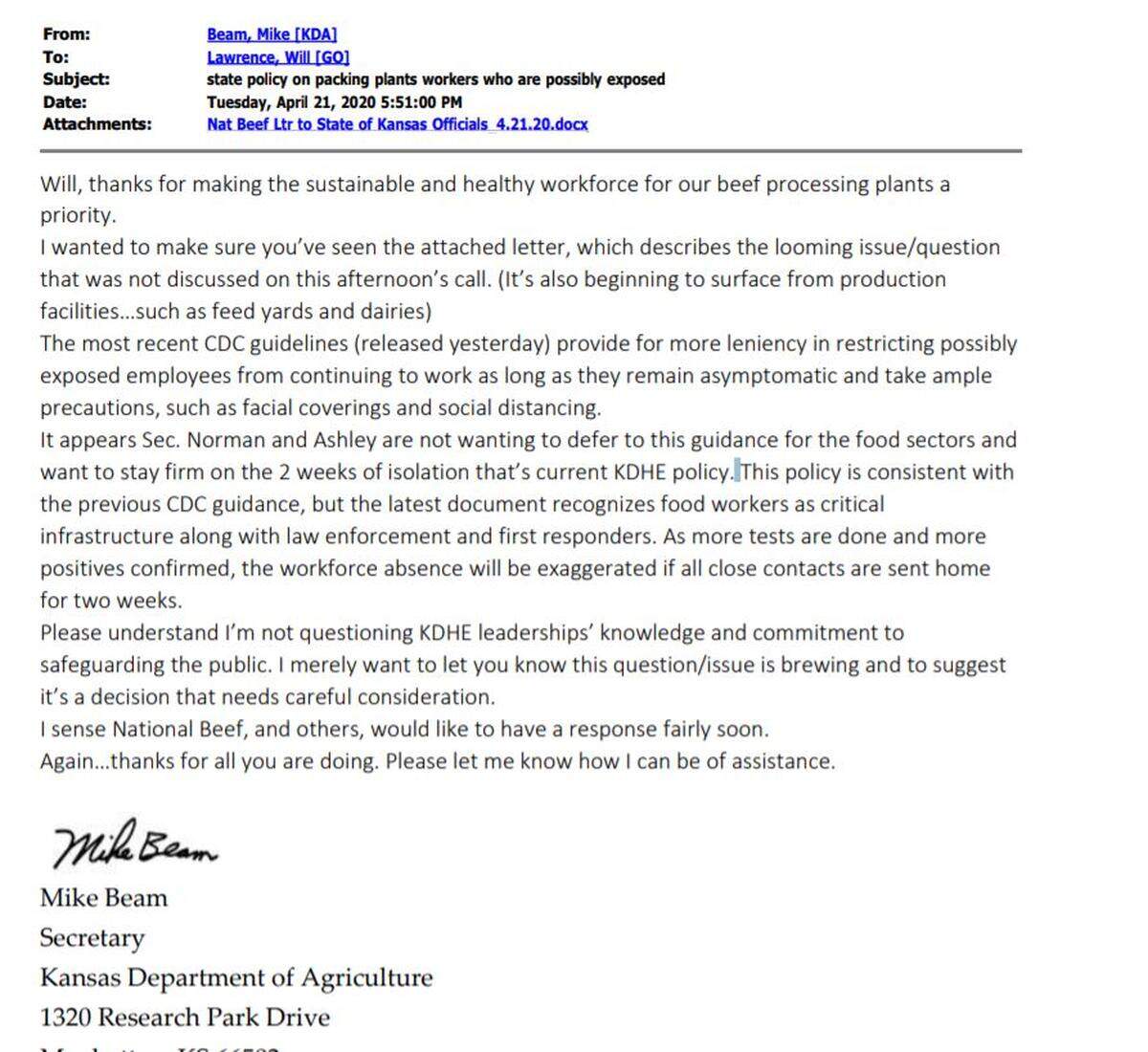
In an April 21 email to Will Lawrence, Gov. Laura Kelly’s chief of staff, Beam wrote that the CDC guidelines provide “more leniency in restricting possibly exposed employees from continuing to work” as long as they remain symptom-free and take ample precautions.
Beam wrote that it appeared Norman was “not wanting to defer to this guidance for the food sectors and want to stay firm on the 2 weeks of isolation that’s current KDHE policy.”
Beam said the latest CDC guidance recognized food workers as critical infrastructure.
“As more tests are done and more positives confirmed, the workforce absence will be exaggerated if all close contacts are sent home for two weeks,” he told Lawrence, adding that he wasn’t questioning Norman’s knowledge and commitment to safeguarding the public.
“I merely want to let you know this question/issue is brewing and to suggest it’s a decision that needs careful consideration,” he wrote. “I sense National Beef, and others, would like to have a response fairly soon.”
Two days later, Beam texted some of his meatpacking contacts that he would be calling “regarding a POSSIBLE path for letting close contacts return to work.” By the end of the month, the guidance had changed.
The Star and Eagle obtained Beam’s texts and emails through a records request to the Kansas Department of Agriculture. In response to questions, spokeswomen for the agricultural agency and the Kansas Department of Health and Environment on Tuesday said the two departments collaborated on food supply issues.
KDA spokeswoman Heather Lansdowne said decisions about guidelines were made by KDHE and that while the agriculture department offered input, “we were not involved in development of that guidance” and didn’t see or review any drafts prior to April 30.
“Secretary Beam was supportive of considering the CDC guidance for critical infrastructure workers and following the protocols outlined in that updated CDC document, with the understanding there would be considerable requirements in place to ensure work conditions were as safe as possible,” Lansdowne said in a statement.
KDHE spokeswoman Ashley Jones-Wisner said conversations involving meatpacking companies occurred regularly. She noted that President Donald Trump signed an executive order on April 28 directing meatpacking plants to stay open – before the state issued its updated guidance.
“The guidance our state issued put restrictions in place, while minimizing risk within the work environment,” Jones-Wisner said in a statement. “This included requirements for engineering and administrative controls that would allow the plants to stay open.”
Both Kelly and Trump have placed a high priority on keeping plants running. With the exception of a Johnsonville plant in Holton, the state’s biggest processors have continued operating throughout the pandemic, though at a reduced capacity.
Messages show concern
In the early weeks of the pandemic, Kansas meatpacking plants largely dodged outbreaks that were shutting down facilities elsewhere. But by early April, the state was beginning to feel the effects.
Bradley texted Beam on April 7, telling him that Tyson was experiencing “increased absenteeism” at its Kansas facilities. The next day, Bradley told Beam the company’s operation in Finney County — where Garden City is located — was running at 50 percent capacity, but that new barriers between workers were expected to reduce absenteeism.
On April 10, National Beef Chief Financial Officer Simon McGee emailed Beam, asking that the governor’s office speak to the union that represents workers at the company’s Dodge City plant “about the importance and special responsibility” of plant workers.
McGee requested the governor’s office, when speaking to the United Food and Commercial Workers Local 2, “encourage its folks to continue to report to work … and certainly to not take any action to discourage attendance.”
Less than a week later, on April 15, Bradley texted Beam at 7:42 p.m. Apologizing for the late message, Bradley wrote that because of a higher rate of absenteeism among workers, Tyson wanted to follow CDC guidelines allowing workers without symptoms to still work if they wear a mask. Bradley noted the company is providing masks and mandating workers use them.
“I think this is in conflict with Kansas’s current guidelines. Do you have a second to talk about this tomorrow morning?” Bradley wrote.
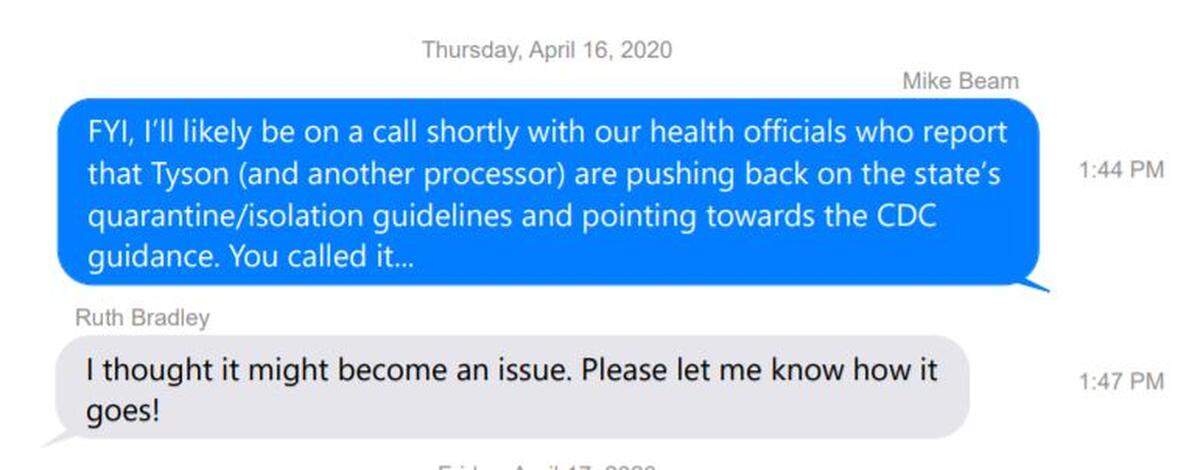
The following afternoon, Beam texted that “FYI, I’ll likely be on a call shortly with our health officials who report that Tyson (and another processor) are pushing back on the state’s quarantine/isolation guidelines and pointing towards the CDC guidance. You called it…”
“I thought it might become an issue. Please let me know how it goes!” Bradley responds.
Beam texted Bradley on April 19 that Kansas may have to consider the newest CDC guidelines if “this gets more problematic.”
Later that evening, Kelly issued a statement announcing the federal government was speeding testing supplies to four counties with large plants to contain virus clusters around meatpacking plants.
‘Protect the health’
Tyson spokeswoman Liz Croston said Tuesday the company “will not ask anyone to work in our plants unless we are confident that it is safe.” In a statement, she said the CDC guidance includes precautions that aren’t part of the state’s guidelines but didn’t elaborate.
“Throughout this fast-moving situation, our focus has been to meet or exceed CDC guidelines as we work to protect our team members. Our correspondence with state officials reflects our interest in the consistent application of federal safety guidance at our plants,” Croston said.
She added that Tyson’s Kansas plants didn’t shift to the federal guidance until after local health departments accepted the change.
National Beef spokesman Keith Welty said CDC, state and local health departments all initially used the same rules. But at some point, according to Welty, the departments began treating critical infrastructure workers differently “and we simply inquired as to the inconsistency.”
Welty said in a statement that the company’s focus throughout the pandemic “has been to take the necessary steps to protect the health, wellness and safety of our employees while operating our processing plants producing high quality beef products to meet the demand of our customers across the United States.”
Across the country, meatpacking plants have been deemed essential and kept in business even as they have turned into virus hot spots.
A Triumph Foods plant in St. Joseph is home to one of the nation’s largest clusters of COVID-19 cases, with more than 400 positive cases. Employees said workers who tested positive for the coronavirus but showed no symptoms were permitted to return to work days after receiving their tests. And some worked as they waited for their test results.
A nine-year veteran employee of the plant recently told The Star going to work there was like “walking into a death trap.”
Triumph Foods said asymptomatic workers who tested positive for coronavirus were required to self isolate at home for 10 days before returning to work.
Last month, workers and advocates filed a lawsuit against Smithfield Foods, alleging the company failed to take the proper precautions to distance and protect employees at its Milan, Missouri plant.
That suit was dismissed with a judge referring plaintiffs to the Occupational Safety and Health Administration.
But David Muraskin, an attorney with Public Justice representing the unnamed plaintiff, said workers have since tested positive for coronavirus, which may cause the legal case to resurface. He said workers at large meat processing plants across the country are reporting similar safety concerns.
Packing plants have grown bigger as industry consolidation has sought to drive out inefficiencies, said Timothy Safranski, a University of Missouri professor of animal sciences.
“They were designed to capture economies of scale so they got big. And part of that means they have more people there,” he said.
And those workers are close together.
“It’s not shoulder to shoulder,” he said. “But many of the people are working close enough that they can almost hand something to the next person. They’re not six feet apart.”
The American meat market is built around providing a cheap and consistent product, he said. A system of smaller, regional packing houses might have been more resilient in the face of a pandemic. But the large, centralized operations that reign the market keep prices down for consumers.
“If you’re dealing with commodity products, then you’ve got to be cheap,” Safranski said. “If it’s pork, then you’re competing with everybody else’s pork so it’s who is selling it the cheapest. Whoever can produce it the cheapest makes the most money.”
This story was originally published May 20, 2020 at 5:00 AM with the headline "Kansas altered meatpacking guidance to let possibly exposed workers stay on the job."