
Kansas Gov. Kelly has broad powers in pandemic. Here’s why Republicans want to curb them
For several weeks, McPherson barber Luke Aichele’s shop on the ground floor of the city’s restored Opera House sat empty, closed by Gov. Laura Kelly’s orders to fight the spread of the coronavirus.
With bills due and his savings depleted, Aichele reopened in defiance of statewide restrictions. He soon faced criminal charges from the local prosecutor and agreed to again shut down. The charges were dropped.
But the barber’s brief rebellion instantly became a flashpoint in a growing Republican struggle against the Democratic governor’s public health strategy, an illustration of the overreach and criminalization of everyday life they say Kelly is leading.
“When anyone has a responsibility to make a living to support themselves and their family, there’s a clear argument they should be deemed essential,” Aichele told legislators last week. “Gov. Kelly is picking winners and losers.”
Opposition to Kelly will culminate on Thursday when Republicans attempt to pass a bill limiting her authority during the pandemic. GOP leaders indicate it will focus on whether her orders can be enforced with criminal penalties and if the Legislature has the power to review her decisions when not in session.
The coming week offers lawmakers their first and likely only chance to take control of the state’s reopening. The Legislature meets for just a single day before adjourning until next year.
The outcome will shape how fast Kansas businesses reopen and something approaching normal life resumes. The consequences are nothing short of life and death as COVID-19 continues to spread through the population and the death toll ticks up daily.
“The decisions we make in the coming weeks and months … will determine what Kansas looks like after this pandemic has run its course,” Kelly said in a televised address at the end of April.
For the most part, Republicans have not contended that Kelly’s decisions are unsound from a health perspective or ineffective responses to the virus. And examples of open defiance remain rare, despite Achiele’s widely-chronicled clash with authorities.
Still, complaints over the governor’s approach have grown louder in recent weeks. Objections have centered almost exclusively on the economic damage inflicted by continuing restrictions and allegations that they violate constitutional rights.
“When they finally decide ‘I can’t do this anymore,’ they’re served with an arrest warrant,” House Majority Leader Dan Hawkins, a Wichita Republican, said. “It is beyond me how we can do that to people and to me that may be the most egregious thing that we have done in this whole thing.”
Kansas lawmakers and governors have faced off in the past over executive power, but the pandemic is unlike any crisis the state has faced in a century. Other states are witnessing similar power struggles..
The confrontation marks another low in the relationship between Kelly and Republican leaders, especially Senate President Susan Wagle, a Wichita Republican who has promised the Legislature will prevent a “dictator” from controlling everything.
Former Democratic Gov. Kathleen Sebelius, a close friend of Kelly’s, said some legislative leaders are modeling “the worst of Washington, which I think is disturbing and dismaying to most people.”
‘Everybody is essential’
Kansas law gives the governor sweeping power during disasters. During the pandemic, Kelly has closed non-essential businesses, ordered people to stay home, shut school buildings and waived regulations on everything from telemedicine to tractor-trailers.
She is now using that power to slowly reopen the state.
Her plan gradually eases restrictions in phases every two weeks as long as metrics related to hospitalizations, deaths and case counts are met. The state was originally scheduled to move into phase two on Monday, which would have allowed additional businesses – including bars and night clubs – to reopen with restrictions.
Instead, Kelly declared “phase 1.5”, allowing barber shops like Aichele’s, hair salons and other personal services to reopen by appointment only. Gyms may also operate with some restrictions, but bars and night clubs will stay shut.
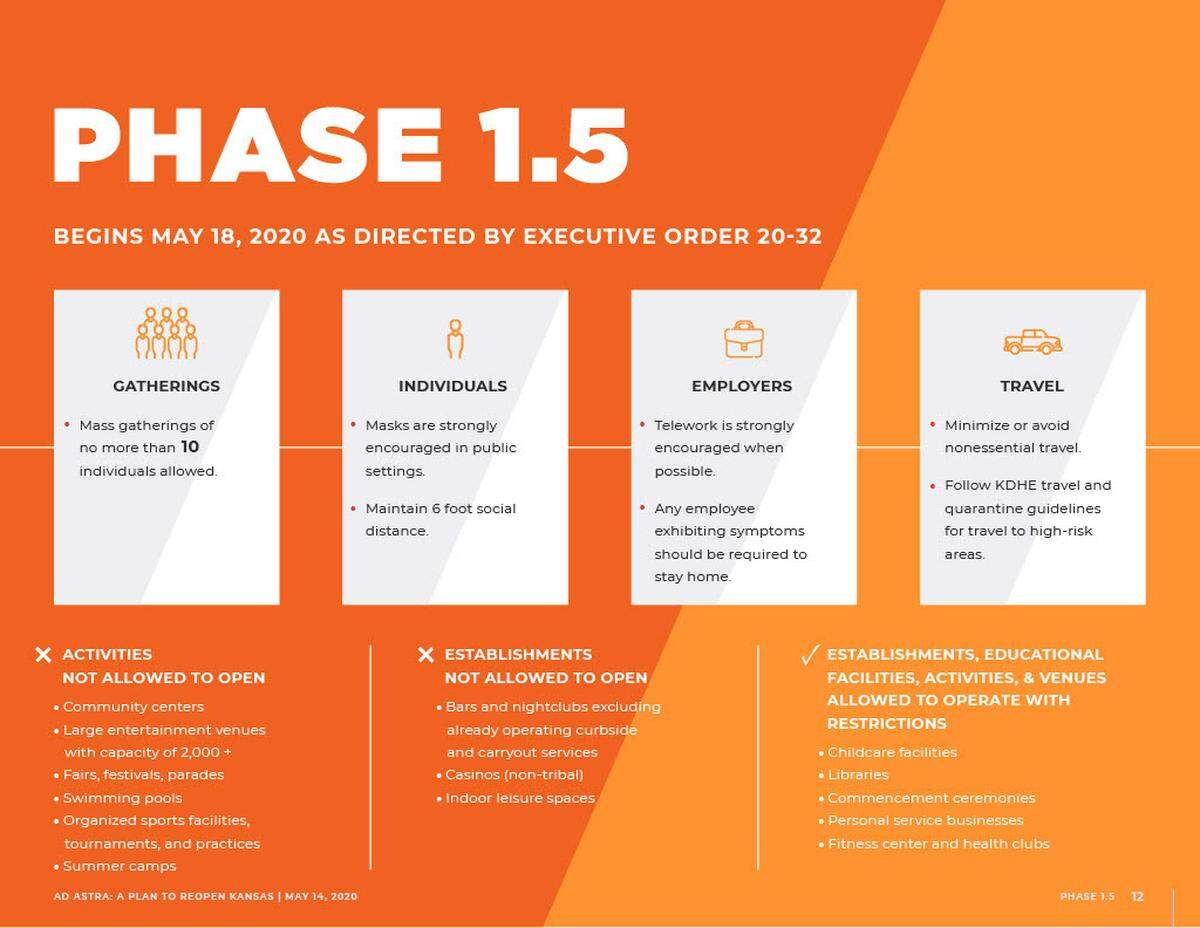
But Kelly’s ability to continue the plan hinges on the statewide disaster declaration, which gives her emergency powers. The current one will end May 26 unless the Legislature extends it.
Some lawmakers want to accelerate the reopening.
“Every week that we go through with these emergency orders that are discriminatory, we’re having more bankruptcies,” said Wagle, who is running for U.S. Senate.
Republicans plan to use the looming expiration of the declaration as leverage to get Kelly to sign any bill they pass that limits her authority. Senate Majority Leader Jim Denning, an Overland Park Republican, told Kelly this week it would be in her “best interest” to sign such a bill.
Whether the Legislature extends her emergency authority or not, Republican Attorney General Derek Schmidt has already placed a cloud of uncertainty over Kelly’s orders.
Schmidt, a Republican, said this past week he plans to issue an opinion as to whether violations of the order can be criminally prosecuted. Under the state’s emergency management law, violations of the governor’s orders are a class A misdemeanor, punishable by a fine of $2,500 and up to a year in jail.
An opinion that says prosecutors can’t bring such cases would undercut Kelly’s ability to carry out the reopening plan. It would also prevent the scene that played out in McPherson over the past two weeks.
After Aichele reopened his store, McPherson County Attorney Gregory Benefiel received an affidavit from law enforcement and charges were filed. On social media, Aichele said an arrest warrant had been issued, but Benefiel said one was never served.
The situation produced such an outcry that the local 911 center pleaded with residents not to call to complain.
“Calling in and being belligerent and rude to our dispatchers might make you feel better, but it’s making for a very unpleasant evening for us, and we’re essentially innocent bystanders in this whole thing,” McPherson County 911 posted to Facebook.
Aichele has declined interview requests. On Thursday, he told a Senate committee that the government dividing individuals and businesses into essential and non-essential showed “great bias and discrimination.”
“Everybody is essential,” he said.
Kansans complying with orders
Most law enforcement agencies are trying to achieve voluntary compliance and avoid criminal enforcement of public health directives, said Ed Klumpp, a former Topeka police chief who now lobbies for several Kansas law enforcement associations.
Klumpp said policymakers need to look at whether every event requiring emergency management should come with the same potential for criminal charges, or whether different options should be allowed.
“What is law enforcement supposed to do with someone who is refusing to obey quarantine and isolation orders? What are you supposed to do with them? You can’t take them and throw them in the middle of your jail or you just have another story about the pandemic in the jails,” Klumpp said.
Even so, Kansans have been “relatively compliant” throughout the pandemic, Klumpp said, adding that the state hasn’t experienced the kinds of unrest taking place elsewhere.
Michigan’s Legislature cancelled the rest of its session amid the presence of armed protesters. In Pennsylvania, some counties have threatened to defy statewide orders. And in Wisconsin, the state Supreme Court struck down the state’ stay-at-home order.
Wendy Parmet, a professor at Northeastern University School of Law in Boston who specializes in public health law, said the underlying consensus that appeared to be holding in the early stages of the pandemic is breaking down. Public health orders are becoming yet another issue viewed through a political prism.
The judicial system isn’t completely immune, either.
“In general, courts tend to give deference to public health authorities, especially in what appears to be an emergency. The deference was never total,” Parmet said.
In Kansas, courts have had only limited opportunities to weigh in on Kelly’s orders.
Republican leaders attempted to cancel an April order limiting in-person religious gatherings to 10 people. Kelly sued and the Kansas Supreme Court just before Easter released a narrow ruling upholding the order but sidestepping underlying questions over freedom of religion.
Two churches sued over the same order in federal court, where a judge temporarily blocked authorities from enforcing it. The judge never made a final ruling in the case because Kelly lifted the order and reached an agreement with the churches, allowing them to meet.
Schmidt said one of the reasons he is taking a look at whether violators can be criminally charged is because no appellate court has ever reviewed the question of whether the Legislature, through state law, properly gave the governor the power to effectively impose new crimes during emergencies.
“The Kansas constitution grants the legislature, not the governor, power to define what behavior may subject Kansans to potential arrest, criminal prosecution, fines or imprisonment,” he said.
The Eagle’s Chance Swaim contributed reporting
This story was originally published May 17, 2020 at 5:00 AM with the headline "Kansas Gov. Kelly has broad powers in pandemic. Here’s why Republicans want to curb them."