‘We need him to protect us’: Tenants line up on I-70, ask for Missouri governor’s help
Tiana Caldwell and her family have lived in their home for less than a year. They spent the six months before that homeless and staying with family members and in and out of hotels after Caldwell’s second ovarian cancer diagnosis.
Now, she and her husband, Derek Caldwell, are out of work because of the novel coronavirus. She said they don’t have the money for their May rent.
“We haven’t even had a chance to rebuild from that,” Caldwell said, “and here we are in this thing that we have no control over at all. Just like cancer, it kind of happened to us. … It’s like back-to-back crisis for us — just trying to keep from drowning.”
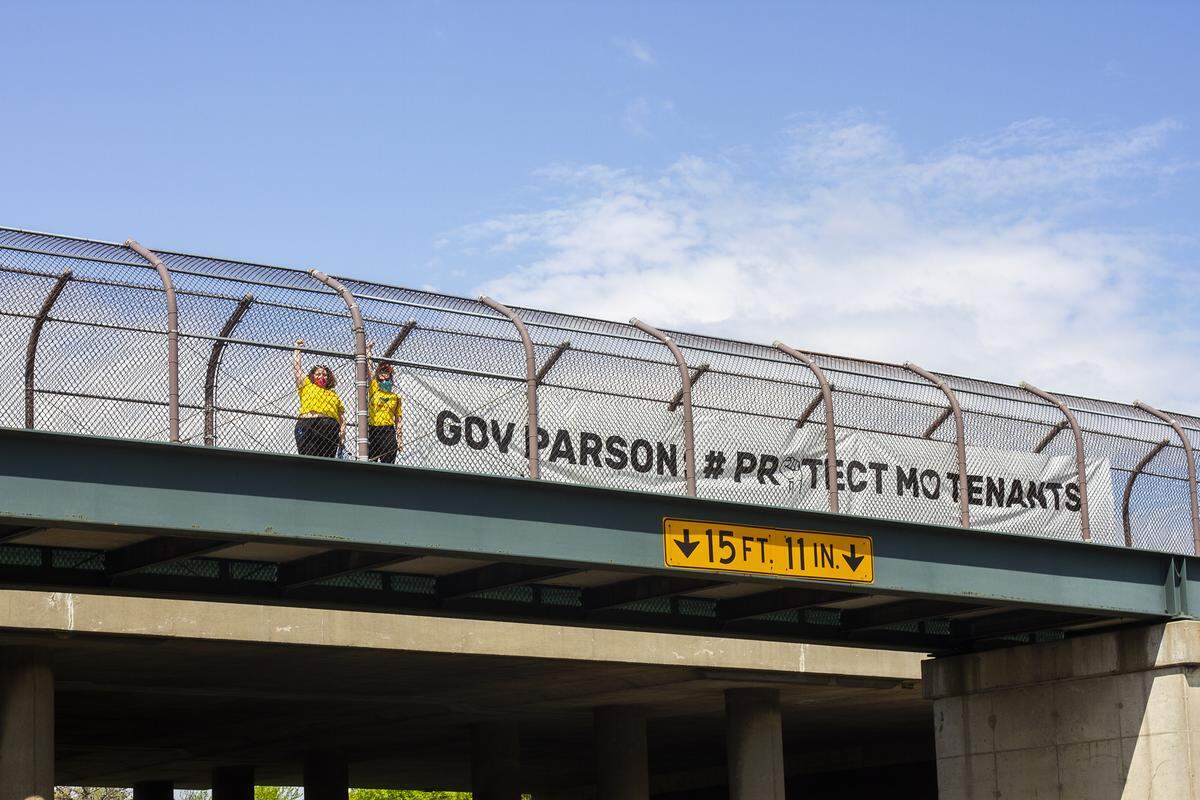
So she and fellow leaders in KC Tenants — part of a statewide group called the Coalition to Protect Missouri Tenants — spaced themselves out in parked cars across Missouri on Interstate 70. With their cars decked out in signs and car paint, they called on Gov. Mike Parson to enact protections for struggling tenants, including a rent and mortgage suspension, a robust eviction moratorium, a ban on utility shutoffs and expanded services for homeless Missourians.
“We need him to protect us,” Caldwell said. “We need him to protect Missouri tenants and cancel rent during this crisis so we can be allowed to rebuild once this is over without devastation.”
Asked about the group’s demands in his daily press briefing, Parson said eviction was a court matter.
“We’re not going to do an order for the entire state to allow people not to pay your rent,” Parson said. “There’s a process in place for that, and that system needs to work.”
He added that he speaks frequently with mayors across Missouri and wasn’t hearing complaints from them.
The economic fallout from the spread of coronavirus has been swift and severe. Within weeks, thousands of residents were put out of work, and unemployment claims soared. Workers who had no problems making rent earlier this year were suddenly in precarious positions when April 1 rolled around and rent became due.
Not only that, but it’s unclear how long the pandemic, let alone the ensuing economic crisis, will continue. Caldwell said her husband may be able to go back to work, but she’s worried about going back to work with an immune system weakened by cancer.
Financial constraints of a pandemic
The Caldwells are among countless Kansas Citians who suddenly find paying bills challenging or even impossible.
For now, she said, their landlord is accommodating and has asked them to stay in touch. But she knows that’s not a long-term solution. And going out to work could be dangerous for her. In addition to the weakened immune system, she said cancer treatments left her with congestive heart failure and damaged lungs.
“It may come to a point where I feel compelled that I need to be employed and I need to be looking for work — that I have to go out into that environment knowing that it could be deadly for me,” Caldwell said. “I think about that all the time.”
She added: “I’ve still got to take care of my family.”
Caldwell and other Jackson County residents are protected by an eviction moratorium. And courts have halted in-person hearings necessary to process an eviction. But even if Caldwell isn’t forced from her home during the pandemic, she knows once the eviction moratorium is lifted, any back rent will be due.
“You’re going to have a whole bunch of people in crisis all at the same time,” she said, “and that could be detrimental to the economy in itself.”
KC Tenants is instead advocating for an outright rent and mortgage suspension — “no payments, no late fees, no debt.”
“The suspension should last through the duration of the declared state of emergency and the entire recovery period,” the group says in its list of demands. “The policy should come with a fund for landlords to recoup losses, conditioned on a set of tenant protections. “
They’re also asking for a more robust eviction moratorium than exists in many places — one that bars landlords from filing new cases. Right now, property owners can still file eviction cases, but the pandemic has stopped those cases from moving through court.
The group also wants a ban on utility shutoffs and mandated service for everyone. Many utility companies have halted shutoffs, and Parson said if there were any instances that residents’ utility service was being halted, the state needed to know about that.
Finally, the group is demanding housing for those who are homeless during the pandemic.
Even for those who haven’t lost their jobs, the pandemic can be financially crushing.
Jenay Manley, a fellow KC Tenants leader, is a single parent of two children.
Her children’s father was staying with them, contributing to rent and watching the kids while she was at work, but their relationship turned “toxic,” and she had to put him out.
She’s now on her own for rent, plus child care while she works nights at a convenience store. Manley said she’s struggling to rest and help the kids keep up with their school work during the day. Last month, she scrimped and sold plasma to make her April 1 rent bill.
“We made it through last month,” Manley said, “but I don’t know how we’re going to make it through this month.”
To her, an eviction moratorium isn’t enough. And any disruption to her utilities could stall her children’s education.
“With my kids, if you shut off our internet, how are they going to learn?”
Lining up along I-70
Manley said not more than a few minutes after she arrived at her stretch of I-70 and Van Brunt Boulevard for the demonstration, a police officer arrived behind her car.
The coalition consulted attorneys ahead of time, who said members were within their legal right to be there. But they both said they were forced to move.
“It was like, ‘Leave or we will arrest you,’” Caldwell said.
Manley said she felt “robbed” of her opportunity to take part in the demonstration.
“I got off at 7 this morning, and then I prepped for four kids to be in a car with me for an hour.”
In an email, Sgt. Jacob Becchina, a spokesman for the Kansas City Police Department, said officers had contacted a few drivers and suggested they not stand outside their cars.
“Although not against ordinance, it can be very dangerous to be outside of a vehicle along the interstate unless it’s an emergency,” he said.
Sgt. Bill Lowe, a public information officer for the Missouri Highway Patrol, said in an email that the state’s officers were “monitoring the protest to ensure traffic was not interfered with and there were no safety hazards to other motorists.”
“We did not ask anyone to leave,” he said.
The Star’s Jason Hancock contributed to this report.
This story was originally published April 20, 2020 at 5:14 PM.