
In coronavirus fight, Kansas and Missouri hold ‘awesome’ powers to isolate you
Kansas and Missouri hold sweeping, authoritarian-like powers to separate from their friends, families and communities anyone who has coronavirus or has been exposed to it.
Health officials can order you to stay in your home or keep you in a secluded location. Neighborhoods and even entire cities can be locked down. You can be prosecuted for non-compliance.
Neither state has invoked these broad powers so far. But measures that just a few weeks ago seemed to be the stuff of dystopian novels and movies are becoming reality in the United States and around the world.
New York state has established a “containment zone” around the New York City suburb of New Rochelle. Italy, a country of 60 million people, has been brought to a standstill.
As COVID-19 spreads around the United States, Kansas and Missouri officials are implementing increasingly tough restrictions. Kansas City Mayor Quinton Lucas has barred gatherings of more than 1,000 and Friday Sedgwick County banned groups of more than 250. Governors of Kansas and Missouri have declared states of emergency, giving them expanded legal and budgetary authority.
All of it raises the possibility that as the virus spreads as experts project — potentially infecting millions and killing thousands nationally — authorities will resort to even more aggressive measures available under seldom invoked laws. These include steps that will challenge fundamental American notions of personal freedom and civil liberty.
“The public health emergency powers are astonishingly broad,” said Wendy Parmet, a professor at Northeastern University School of Law in Boston, who specializes in public health law.
“The word I tend to use is they’re awesome, in that more primeval sense of the word.”
Because quarantine and isolation is so rarely used, modern courts have had relatively few chances to assess whether these laws strike the right balance between public protection and civil liberties.
“We are deep into uncharted territory. We’re not at the edge of it,” said Parmet.
Mandatory treatment possible
Some of these laws pre-date the modern era. Others are the legacy of 9/11 as officials scrambled to prepare for new bioterror threats. A 2005 Kansas law enshrined specific quarantine and isolation powers but also guaranteed due process protections.
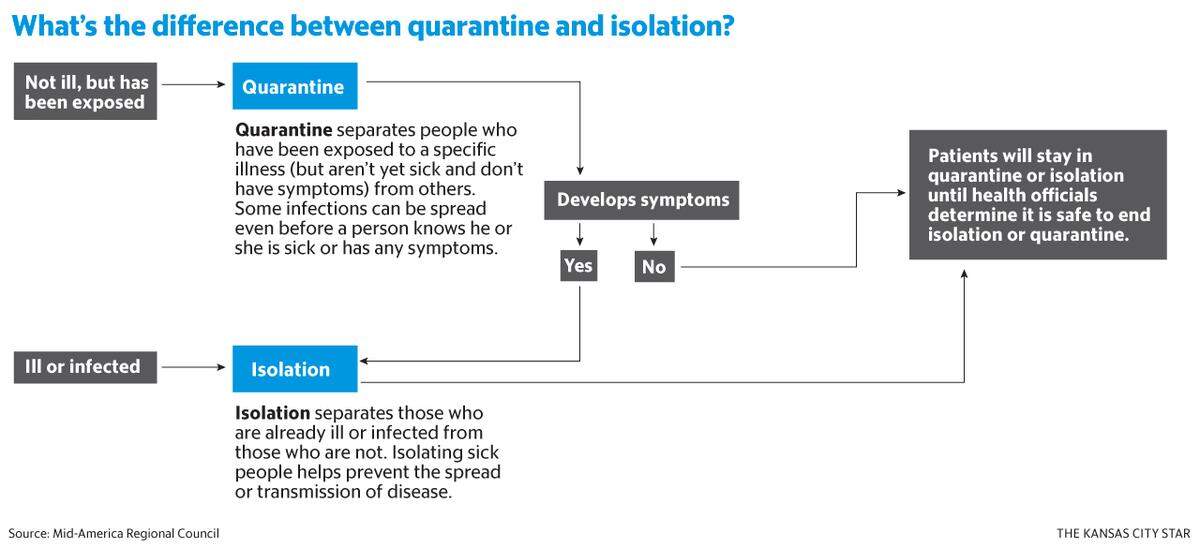
Emergency public health powers in both states run along similar lines. Kansas and Missouri give authorities wide discretion to quarantine individuals who may have been exposed to diseases, and isolate those who show symptoms or have tested positive.
In Kansas, local health officers and the secretary of the Kansas Department of Health and Environment (KDHE) can order medical evaluation, testing and treatment for anyone they have reason to believe has been exposed to a contagious disease. They can isolate or quarantine those who refuse.
Kansas appears to have the authority to order widespread testing for the coronavirus. But Lee Norman, the KDHE secretary leading the state’s response, has been cool to the idea of testing people who are not showing symptoms.
Vaccinations can also be made mandatory, with anyone refusing subject to quarantine. It opens the possibility that Kansas could order residents to receive the COVID-19 vaccine whenever it is ready, likely a year from now. Such a decision could be explosive, given the recent vocal pushback to new vaccine mandates for schoolchildren.
Breaking a quarantine or isolation order is a Class C misdemeanor in Kansas, which can bring a month in jail and a $1,000 fine.
So far, Norman has played down the possibility of mandatory measures.
“That’s obviously a drastic move, very seldom comes up,” he said last week. “Usually, we negotiate with people, work out a good situation and they’re comfortable being quarantined, or excuse me, isolated in their own homes.”
Missouri law gives state and local health directors the power “to isolate a patient who poses a threat from an infectious disease to the public safety,” said Randall Williams, director of the Missouri Department of Health and Senior Services.
While the state can use the courts to enforce a quarantine, Williams said, “that kind of heavy-handed thing” is a last resort because officials don’t want to scare people away from getting tested.
The law gives state and local health officials the power to not only establish and maintain a quarantine, but to also “use the legal means necessary to control and investigate any disease or condition deemed a public health threat.”
They can, for instance, “inspect any premises that they have reasonable grounds to believe” are conducive to spreading the disease.
As in Kansas, breaking a mandatory quarantine in Missouri is a misdemeanor, punishable by up to one year in jail and/or a fine up to $2,000.
“So if you need to stay there for two weeks and you agree, and I find out that you didn’t do it, then it’s a misdemeanor,” he said. “Usually, in that case, it (becomes) house arrest. And the sheriff comes out and they make sure you stay in that house.”
Williams said his department was not involved in the situation in St. Louis County, where the father of a young woman who was presumptive-positive for the coronavirus left the home where they were self-isolated and attended a school function with his other daughter.
Most people who are advised to self-quarantine usually do, said Kayla Parker, spokeswoman for the Jackson County Health Department in Kansas City.
Like Williams, Parker said that local health officials can work with law enforcement to impose a quarantine.
“This is really a last step that we would take. It’s not usually something we would have to do at all. Normally people are receptive,” said Parker.
It is up to the health department to clear the quarantined, based on recommendations from the federal Centers for Disease Control and Prevention (CDC), she said. In the case of someone who has tested positive and is in isolation, “it’s going to be on a case-by-case basis,” Parker said.
Concerns over civil liberties
As states come to grips with the coronavirus and the extraordinary steps that may be needed to stop it, health authorities and civil liberties advocates are also grappling with just how far these legal powers should extend.
When the United States began authorizing quarantines of individuals returning from China in early February, the American Civil Liberties Union called the measures “extraordinary incursions on liberty” that flew in the face of evidence that travel bans and quarantines can do more harm than good.
“During a disease outbreak, we recognize that individual rights may need to be balanced with the health of the larger community. This can be done while preserving the liberties that form the foundation of American ideals,” ACLU of Kansas spokesman Mark McCormick said in an email.
The ACLU of Kansas contends limits on personal movement should be proportionate and supported by science. Voluntary isolation should be considered as an alternative to quarantine.
The Kansas Supreme Court has only rarely addressed quarantine and isolation powers. A 2009 article in the Journal of the Kansas Bar Association reported there have been no Kansas court opinions regarding infectious disease control since the 1940s.
In the few cases on the books, the judiciary has largely deferred to health officials.
The court ruled in 1943 that a woman believed by authorities to have a dangerous venereal disease could not challenge her isolation by petitioning for habeas corpus, the country’s foundational legal process for fighting confinement. Instead, the court ruled, she had to appeal to the local board of health.
In a 1919 case, the court found that a man confined to the state penitentiary at Lansing because of chronic gonorrhea did not have the right to be isolated in the city where he lived.
“Considerations of delicacy and privacy may not be permitted to thwart measures necessary to avert the public peril,” the court wrote. “Only those invasions of personal privacy are unlawful which are unreasonable, and reasonableness is always relative to gravity of the occasion.”
In the years following 9/11, Kansas and many other states took a fresh look at their emergency powers.
“The discussion centered around the possibility of the ‘What if?” said Jim Barnett, a physician and former Republican senator who chaired the Kansas Senate’s health committee at the time. “Was the state ready in the event of something like (what is) now happening, which is now a pandemic?”
“It was for this type of scenario,” he added.
The bill the Kansas Legislature approved in 2005, which remains in effect, allows individuals and groups under quarantine or isolation to request a hearing in district court to challenge their confinement. The hearing must be held within 72 hours unless health officials can show “extraordinary circumstances” exist to warrant an extension.
The law requires judges to balance the rights of the affected individuals, the protection of public health and the severity of the health emergency.
Judges must grant individuals their freedom “unless the court determines that the isolation or quarantine order is necessary and reasonable to prevent or reduce the spread of the disease or outbreak believed to have been caused by the exposure to an infectious or contagious disease,” according to the law.
Those challenging quarantine or isolation have the right to an attorney, with the court required to appoint counsel for people without representation.
Additionally, Kansas employers may not fire individuals solely because they are in quarantine or isolation.
Sen. David Haley, a Kansas City Democrat, said the public will accept even significant infringements on their freedom as long as restrictions are enforced fairly and consistently.
“If they’re broad, evenly-dispersed measures for public safety...then I think that most Americans and most Kansans would agree that civil liberties are second place,” he said.
This story was originally published March 15, 2020 at 5:00 AM with the headline "In coronavirus fight, Kansas and Missouri hold ‘awesome’ powers to isolate you."
.jpg)