
Families of Kansas inmates fear losing touch if loved ones are sent to Arizona prison
The drive from Topeka to El Dorado Correctional Facility takes about two hours each way. Leoti Masterson makes the trip every week without hesitation.
She would never pass up a chance to see her son.
But as Kansas prepares to send hundreds of inmates to a private prison in Arizona run by CoreCivic, the families of inmates are fearful the time they cherish with their sons and husbands will soon be taken away.
They worry the location of the private prison hundreds of miles away will make in-person visits rare or impossible.
“It’s hard for me to even comprehend that I would no longer be able to visit on a weekly basis. That has been such a gift to both of us,” Masterson said.
She said her son, Jeff Masterson, who is serving time for sexual exploitation of a child, is now “clear-headed” and that she wants to be part of his rehabilitation.
In interviews in the week since the Kansas Department of Corrections announced an agreement with CoreCivic to take up to 600 male inmates, family members grew emotional describing their frustration with the decision. Phone and video calls are no match for the power and intimacy of being there, they say.
Researchers say in-person visits have a positive effect on inmates. Most notably, studies have shown inmates who receive more visits are less likely to commit crimes when they get out.
Some relatives of inmates – including those who are involved in a new group pushing prison reform in Kansas – fault Gov. Laura Kelly for the move. They’re angered after the Democratic governor advocated for sentencing changes in the past.
“It feels like a lottery. You don’t know whether it’s going to be your person or not and the fear is huge,” said one woman whose husband and son are both serving time for burglary and robbery at El Dorado. She asked that her name be withheld out of fear her family members could face retaliation.
Kansas plans to send 360 inmates to Arizona by the end of the year, with inmates sent in waves of 120. The state’s contract with CoreCivic allows the company to ultimately house up to 600 inmates if necessary.
The state will pay $74.76 a day per inmate to CoreCivic. The arrangement will end up costing millions a year.
The decision marks the most dramatic action yet to stabilize Kansas’s troubled prison system.
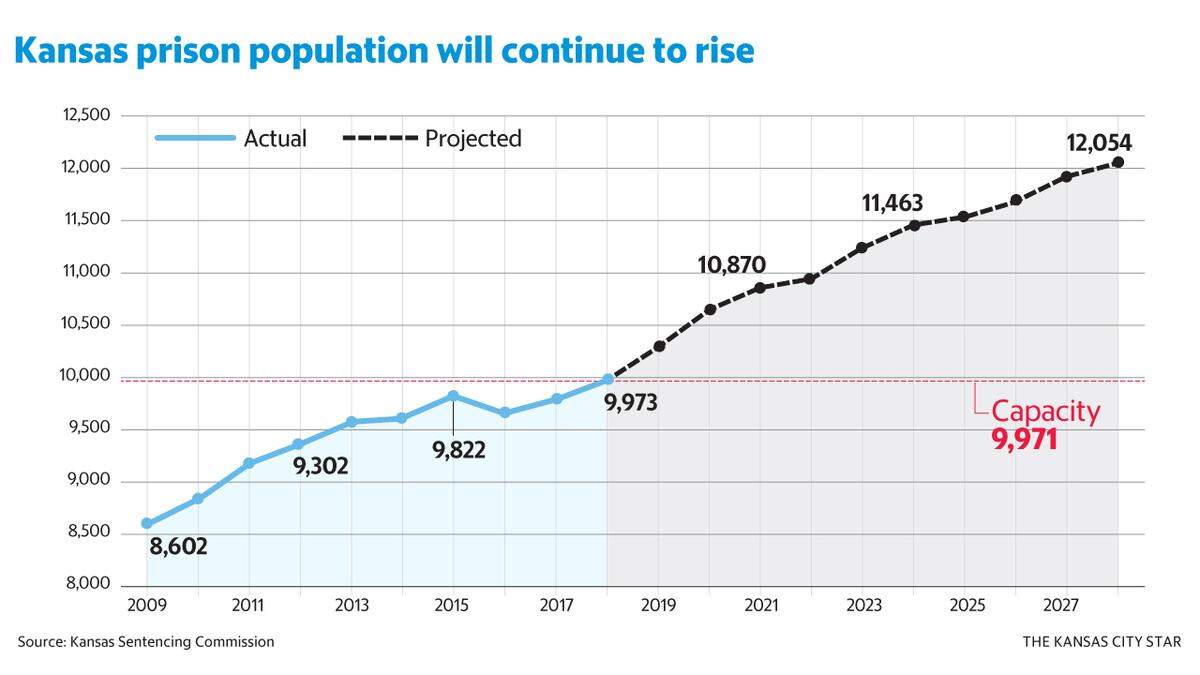
For years, the prisons have struggled with staff shortages. Recent pay increases have helped fill some vacancies, but inmate population growth is expected to continue, straining facilities.
Kelly and her aides have said they don’t like the idea of turning to private prisons. But with the system operating above capacity, they see few other immediate options.
The governor said she came into office in January with a “mess” and a crisis in corrections.
“The decision to send some of our inmates to a private prison wasn’t made lightly. I’ve been on the record as being against private prisons and I share a number of concerns that have been raised by anti-private prison advocates,” Kelly said in a statement.
Acting Corrections Secretary Jeff Zmuda, who was appointed by Kelly, said last week that sending inmates to Arizona “is an option we wish we could avoid.”
Inmate families fear Arizona move
In the wake of the Arizona announcement, fear is running high among both inmates and family members. Little information has gone out about who will go and who will say, family members say.
“I think that could be viewed as too much of a security risk, so I’ve kind of gotten used to not being informed,” Masterson said.
Any one inmate has good odds of not going. Six hundred inmates – the most that could be sent to Arizona under the CoreCivic contract — account for about 7 percent of the state’s male prison population.
Zmuda told lawmakers this week the agreement covers medium and maximum security beds. Masterson’s son, 39, is in minimum security according to the Kansas Department of Corrections, but she said he had recently been living in medium security.
Randy Bowman, a KDOC spokesman, said officials will look at the inmates’ classification level and their length of sentence when determining who goes and who stays. For instance, the agency doesn’t want to send inmates close to finishing their sentences to Arizona and then have to quickly bring them back.
Inmates with significant medical needs also are unlikely candidates for transfer.
And visitation also will come into play.
“Ideally, those persons who are getting regular visits from family members, if everything else pans out and then we can keep them here in Kansas,” Bowman said. “But we’ll look at those and other factors.”
For inmates and their loved ones, visitation is an important part of maintaining a relationship.
Like all aspects of prison life, visitation is closely supervised. But it’s one of the few ways inmates have of experiencing and showing affection physically.
Masterson, who works as an executive assistant at a Topeka church, vividly recalls the first time she and her now-deceased husband visited their son after he entered prison last year. The visit began with a hug.
“They both had tears in their eyes because it meant so much,” Masterson said, her voice growing emotional. “And then it was my turn, and that was great. We loved to just be able to sit across the table from him and just have a quality time as a family. And in the process we showed our son unconditional love and we strongly believe that as people of faith.”
A Lansing woman who regularly visits her husband at the state prison there ruled out traveling to the CoreCivic site. Her name is being withheld over fears of retaliation.
“I’m 68 years old and I’ve had two strokes and for me to make the trip to Arizona is going to be impossible,” she said.
The CoreCivic contract requires the company to provide free video visitation services. But unlike in-person visits, which in some cases can last for hours, the contract says video visits are capped at 30 minutes a day.
The woman with a husband and a son at El Dorado said she uses video visits. She lives in the Kansas City area and the video conferences help her stay in touch between trips.
But it’s definitely not the same as coming to the prison.
“If that’s all I had, I would be devastated,” she said.
Prison visits help inmates
Norris Henderson, the director of the New Orleans-based group VOTE, which advocates for criminal justice reform, spent 27 years in prison for murder before his sentence was overturned.
“A phone call never took the place of that in-person visit. Never,” Henderson said.
Research backs up the importance of flesh-and-bone visits.
A 2011 Minnesota Department of Corrections study of inmates in that state found that “prison visitation can significantly improve the transition offenders make from the institution to the community.”
Any visit reduced the risk of being re-convicted of a felony by 13 percent, the study said. More frequent and more recent visits were also associated with less recidivism, according to the study.
Bernadette Rabuy, a senior policy analyst at the Prison Policy Initiative, which advocates against mass incarceration, said some jails have eliminated in-person visits altogether, but the results from Rabuy’s perspective have not been good.
Rabuy said video calls should be a supplement to visitation, not a replacement.
“Usually when a jail replaces regular visits with video calls, there’s an increase in disciplinary infractions and assaults,” Rabuy said.
Visitors will be allowed to travel to the CoreCivic prison in Arizona to meet with inmates, but the distance means fewer relatives are likely to make the trek.
A 2015 analysis of government data by the Prison Policy Initiative found that nearly half of all inmates who were incarcerated less than 50 miles from their home received at least one visit a month. But for those 501 to 1,000 miles from home, only 14.5 percent received a visit a month.
The Arizona prison is about 600 miles from the southwest corner of Kansas.
“I just think it’s cruel and unusual that people would even think of sending people outside of their state line to serve time in another place,” Henderson said.
Kelly faces calls for reform
The CoreCivic contract has come under fire from a new group pressuring the Kelly administration over the decision. The Kansas Coalition for Sentencing and Prison Reform has been active on social media since the beginning of summer, urging the governor and lawmakers to change the system.
When the contract was announced, the group said the governor had broken “all promises” on prison reform. Some of the relatives of inmates interviewed for this story said they are involved in the group.
The ACLU of Kansas also criticized the choice to use a private prison, calling it in a tweet “disappointing & shortsighted.”
In a statement, Kelly said the state has an obligation to provide both inmates and corrections workers with safe conditions.
“It’s a constitutional right, not an option. My administration takes this very seriously,” the governor said.
She noted that the contract provides for an on-site monitor who reports directly to KDOC. The agency also has unrestricted access to the facility to ensure conditions are up to standards. Officials can inspect the prison at any time.
Kelly has called for criminal justice reform in the past. In December before she took office, she said the state needs to figure out a way to divert non-violent drug offenders out of prison. Roger Werholtz, who led the state’s prison systems for the first six months of her administration, has also voiced support for sentencing reform.
“I urge the legislature to pursue long-term solutions to prison overcrowding – and I look forward to working together on reforming our criminal justice system,” Kelly said in her statement this week.
Lawmakers this spring created a criminal justice reform commission. The group will meet over the next year and deliver final recommendations by December 2020.
Leoti Masterson, whose son is incarcerated at El Dorado, never paid much attention to the prison system before he was sentenced. But she now says the whole thing needs to be examined.
“I’m not pointing fingers at anybody in leadership,” Masterson said. “But the time is now that I think things could be done.”
This story was originally published August 16, 2019 at 3:07 PM with the headline "Families of Kansas inmates fear losing touch if loved ones are sent to Arizona prison."