
Here’s Sly James’ bucket list in his last year as mayor. And how he’ll be challenged
Mayor Sly James knows the clock is winding down. Less than a year from now — next Aug. 1 — he’ll be a private citizen again for the first time since 2011.
He also knows that two-term incumbents usually lose influence as they enter their final year in office. The power to persuade — and twist an arm when necessary — tends to erode as the next election nears.
Nine candidates for his job, including five on the City Council, are ramping up campaigns to tell voters about the changes they would bring.
And he knows there isn’t much he can do about it, except to keep moving.
James’ mayoral bucket list includes a sales tax hike to expand pre-K, an initiative to bring racial equity to public policy, and a renewed push to curb rising pension costs.
The first two initiatives are attempts to address root causes of the gun violence that have roiled the city this summer. They would also add flesh and blood to a legacy heavy on brick and mortar.
James has been the principal voice and face of successful campaigns for a new airport terminal, the downtown streetcar and an $800 million bond package for upgraded flood control, improved streets and a new animal shelter. He helped close the deal for a long-sought convention hotel near Bartle Hall.
The final-year agenda is defined by longer-term propositions, about laying groundwork for the mayors who will follow.
“Just because you’re in your last year doesn’t mean your job is over,” he said on a recent morning behind his desk on the 29th floor of City Hall.
“If that’s the case, go ahead and pay me my salary for the next 12 months ($129,000) and I’ll go sit on the beach or something.”
There are moments when James sounds like he can’t wait. In recent days, he has sounded weary and frustrated.
Speaking last week at a panel on how to grow opportunities for freelance work, James allowed that the gig economy sounded pretty good to him.
“This kind of work allows people to take control of their lives,” he said. “And Lord don’t you know that’s exactly what I crave right now.”
The first four days of August saw six dead or dying and 22 wounded in the city. That weekend, James said, he consulted with Chief Rick Smith by phone but was mostly focused on time with his 7-year-old grandson.
“I was busy trying to reconnect with my family,” he said, almost wistfully. “I missed my grandson’s birthday. I’ve missed a lot of stuff because of work.”
Those around James, who turns 67 in December, said he remains gung-ho for the final months. His challenge will be to keep the city’s attention.
“I think there’s typically a diminishing interest in what the outgoing mayor is working on,” said former Mayor Kay Barnes. “The general public is already moving ahead, particularly if there is a hotly contested mayor’s race occurring.”
Early childhood education
Just 35 percent of the city’s 4-year-olds are enrolled in quality early childhood education programs.
A body of research shows that children who attend pre-K are more likely to be prepared for kindergarten. Kids from poor or disadvantaged families tend to benefit the most.
Under the proposal, a five-member board appointed by the mayor would oversee distribution of the estimated $30 million a year in new revenue from a 3/8-cent sales tax increase. Families would be eligible for tuition discounts based on household size, income and quality of the public, charter or private program they want to attend.
An early piece of “Pre-K for KC” literature is dominated by James’ image — and no mention of a sales tax hike. Aides hope to raise about $750,000 for the effort, which will again be headed by the Dover Group, the Philadelphia political firm that has handled his election campaigns and the KCI ballot question.
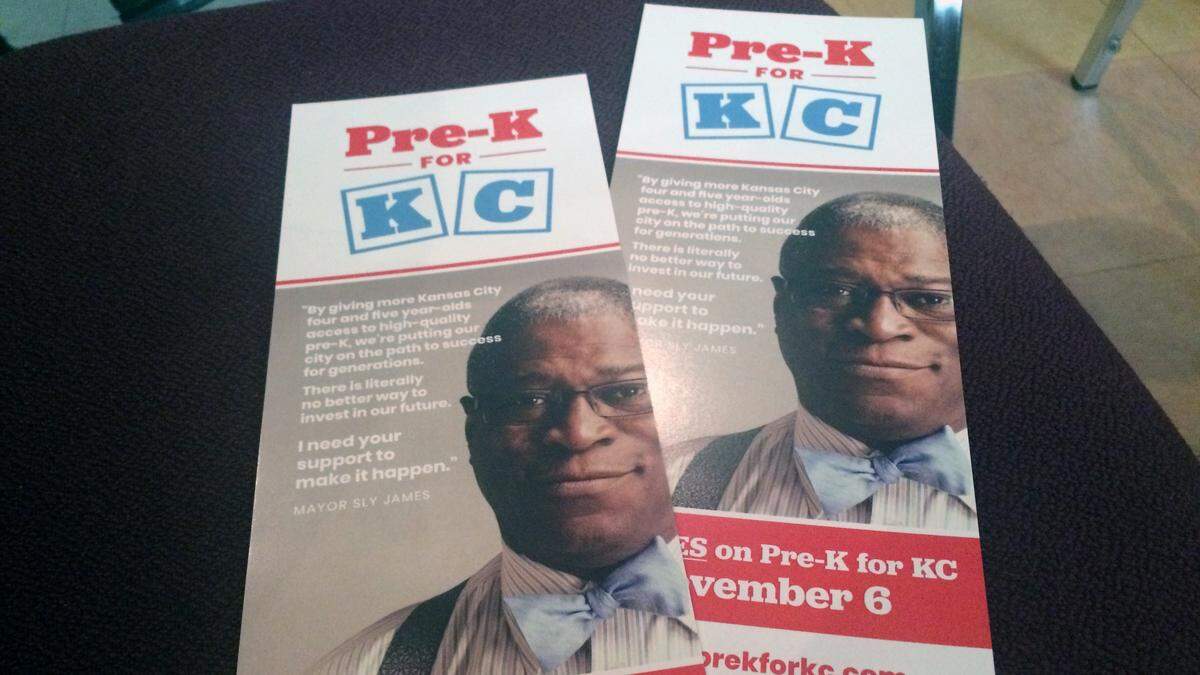
His advisers said polling (details of which they don’t share) shows heavy voter support for expanded pre-K. But some political pros see it as a tough sell after a steady stream of tax increases.
While the combined state and city sales tax rate is 7.225 percent, a lengthy menu of special taxing district levies for transportation and economic development have pushed the sales tax burden over 10 percent in some areas of the city.
The city’s minority communities, which got behind the KCI plan because of the potential for job creation, might be less supportive of the pre-K proposal because the regressivity of the sales tax hits low-income residents hardest.
“I think what the challenge will be for him is to do another sales tax for a purpose that is not specifically the role of city government. That’s a big hurdle,” said City Councilwoman Katheryn Shields.
The council could be another hurdle.
Some members persistently complain of the mayor trying to go it alone on big projects, excluding them from the planning of major initiatives like the new KCI terminal.
For the pre-K sales tax, James and his supporters decided to pursue a spot on the November ballot by petition rather than council ordinance. Last month, they collected 1,984 valid signatures, more than the required 1,708.
The council must still vote to formally place the question on ballot and has 60 days (from July 19) to act. To get it before voters in November, however, the council has to give final approval by Aug. 23.
That’s not a given.
Some of the 15 school districts that serve Kansas City children have raised concerns about ceding control of funding to an outside board. Others call the measure a voucher system, a claim James vehemently contests, he said, because it is injecting new funds into schools, not siphoning off existing dollars. Some council members want to hear more details about how the system would work.
“It would be be a lot easier for all of us on the council if the mayor’s office and his advocates included the school districts and elected representatives in the conversation,” said Councilman Quinton Lucas, a 2019 mayoral candidate. “We all recognize the importance of early childhood education. But how $300 million in public money (the tax would be authorized for 10 years) is being spent is a big deal.”
James deflects these concerns by calling them “adult issues,” as if those with questions are indifferent to the needs of four- and five-year-olds. He said he’s open to a better idea.
“So people call me, write me, bitch at me, complain at me. What are you doing about crime?” he said. More officers on the streets, he contends, would have done nothing to head off this month’s torrent of deadly violence.
“If you’re going to do something about crime you have to attack the root problems,” he said. “You have to attack poverty, you have to attack racism and segregation, you have to attack educational deficits. We have to make investments in our children, and in doing so we make investments in our city. We have more people with hope.”
Race & inequity
The upcoming race and equity initiative is aimed at attacking disparities embedded in the city’s long-term problems.
These include ZIP codes where the highest rates of poverty exist alongside the lowest life expectancies; rates of black infant mortality double that of white babies; schools where black students are suspended at five times the rate of white students.
“These inequities will continue to persist unless we as a community are willing to talk about how race impacts every aspect of an individual’s life,” James wrote on his official blog late last month.
James is collaborating with a consortium of groups that have come together as the Community Alliance for Race and Equity (CARE) to run a series of events. The program will kick off on Aug. 29 at the Kauffman Foundation Conference Center.
At the same time, an internal City Hall task force with members across all departments will meet to examine how city policies and practices need to change.
Some African-American leaders are skeptical, and wonder why he waited until year eight to begin.
“It is a noble effort, the kind of thing that has to happen,” said Gwendolyn Grant, president and CEO of the Urban League of Greater Kansas City. “I wish he had started this conversation in his first term. This is difficult work.”
James is under no illusion that a few panel discussions will reverse decades of policies.
“We’re starting to build a spider web a few strands at a time,” he said.
Funding pensions
James hopes make one more attempt to roll back rapidly escalating pension obligations to current and future retirees.
In December 2013, after three years of negotiations, its four unions (police, fire, municipal workers and police civilian personnel) agreed to some of the recommendations of a task force formed by then-Mayor Mark Funkhouser.
Union members agreed to contribute a higher percentage of their pay to retirement funds. New hires agreed to work longer to receive full benefits. Cost of living adjustments also shrank.
But the city’s unfunded pension liabilities grew from $587.6 million in 2014 to $811.7 million.
The pension programs have never fully recovered from the recession. In 2008, the four funds were able to cover, on average, 89.3 percent of future costs. That has dipped to 75 percent.
They have also been hurt by overly rosy forecasts of investment returns, predicting annual gains of about 7.5 percent. Over the last four years, returns have averaged around 6.4 percent.
In May, City Manager Troy Schulte reopened negotiations on pensions, as provided for under collective bargaining agreements. At the same time, James has put together another citizens’ task force, headed by attorney Herb Kohn, to study the issue and come up with a new set of recommendations.
“We need some concessions and we need to work on it at the earliest opportunity,” James said.
What history shows
The record is mixed for outgoing Kansas City mayors.
Emanuel Cleaver II (1991-99) successfully pushed for charter changes that strengthened the mayor’s office.
But he stumbled in an attempt to exert more control over Kansas City public schools and failed to secure voter approval for a half-cent sales tax to finance flood control measures along Brush Creek.
By year eight, Barnes (1999-2007) was focused on making sure that important final details of her signature projects, Sprint Center and the Power and Light District, were in place. Her attention was also turned to what became an unsuccessful Congressional campaign, losing to 6th District incumbent Sam Graves in 2008.
“All office holders lose a little influence at the end,” said former City Councilman and State Rep. John Sharp. “People no longer have to worry about their reactions if they opposed him.”
That said, Sharp added, good ideas well presented can prevail.
“If you have a good idea, it doesn’t matter whether you have four years or four weeks left,” he said.
This story was originally published August 13, 2018 at 5:30 AM.