
Brownback health insurance tax hits trouble in Kansas Legislature amid Aetna opposition
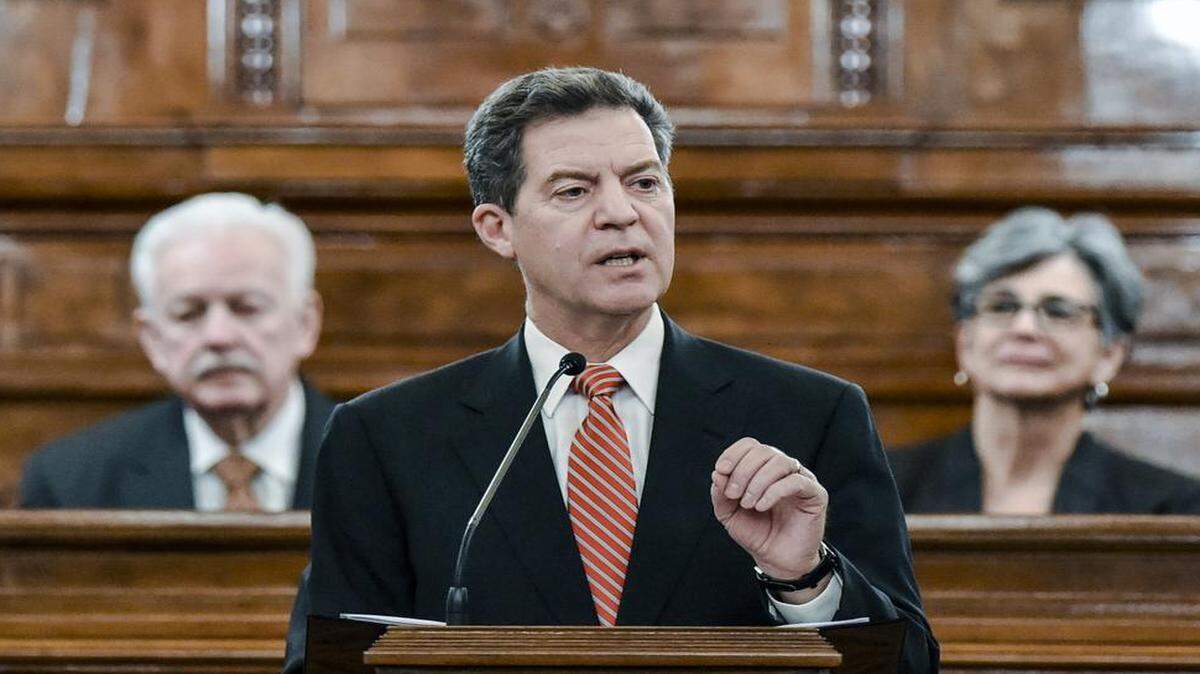
A battle quietly brewing in the Kansas Statehouse over taxing health insurance could blow an even bigger hole in Republican Gov. Sam Brownback’s proposed budget.
The governor proposed $136 million in new taxes on health maintenance organizations, a measure now in deep trouble because one powerful insurer would be hit with millions more in new taxes.
Failure to get the new insurance taxes passed could mean deeper budget cuts or lead to even higher tax hikes in other areas to balance the state’s budget.
The problem was compounded by new revenue estimates released Monday showing the state in a $400 million deficit for fiscal year 2016 that would grow close to $500 million if the bill fails.
Already, Brownback is struggling to push through $108 million in tax hikes on cigarettes and alcohol in a hunt for more revenue to patch a gaping budget deficit that has largely been blamed on income tax cuts.
“This is a big deal for the administration,” state Rep. Jim Ward, a Wichita Democrat on the House health committee.
The health insurance bill, already passed by the Kansas Senate, aims to attract matching federal Medicaid dollars that would, in turn, free up about $80 million for the state to plug a massive hole in its 2016 budget.
The measure quietly cruised through a committee and passed overwhelmingly in the Senate before it started to bog down in controversy.
In a letter in mid-March, insurer Aetna warned lawmakers that the bill would hit the company with $12 million in new taxes that it said could add $206 per person to the average HMO insurance policy.
Aetna is the biggest and most vocal among eight insurers that would be affected by Brownback’s tax on HMOs.
The tax increase also extends to the three managed-care companies that provide Medicaid services in the state’s KanCare program.
But those KanCare providers will get their money back after paying the fees because that money is funneled back into Medicaid to get the federal matching funds.
“That bill is inequitable and not delivering on a level playing field,” said Aetna spokesman Rohan Hutchings.
Aetna executives contend the bill unfairly makes them bear the cost of balancing the state’s budget.
They said that the current proposal — now awaiting action in a House-Senate conference committee — would eliminate much of the insurance cost savings enjoyed by many of the company’s 52,000 customers drawn to HMOs rather than more traditional insurance policies.
Company executives said the HMO tax would potentially drive customers to more expensive preferred provider organization plans that give patients more choice about choosing their physicians.
Some businesses, they said, also might move to self-funded insurance plans, which would not be subject to state insurance premium taxes and could put providers at risk if claims couldn’t be paid.
Brownback administration officials say they continue to talk to Aetna about its concerns about the HMO tax.
Lawmakers, meanwhile, are working to find a solution that would raise the money needed to balance the budget without singling out one class of insurer.
“As the bill stands, it’s very, very bad for Aetna,” said state Rep. Scott Schwab, an Olathe Republican and chairman of the House Insurance Committee. “We’re going to do everything we can to take care of Aetna.”
Schwab said he is afraid that imposing a heavy burden disproportionately on Aetna could drive the company out of the state.
Some Democrats think the whole idea is bad. They accuse Brownback of using an accounting trick to avoid the revenue problem caused by the income tax cuts that the governor pushed through the Legislature in 2012 and 2013.
“The governor’s budget is as solid as a house of cards,” said Sen. Laura Kelly, a Topeka Democrat who sits on the Senate health committee. “The HMO tax is a vital part of its foundation. Remove that part and it all falls down.”
At issue is what is known as a privilege fee, a 1 percent tax levied on an HMO’s annual premiums.
The state wants to raise that fee to 5.5 percent, which would bring in about $136 million in new money.
That new revenue would be used to attract matching federal money, which would replace about $80 million in general state tax dollars that now go toward Medicaid.
State officials say the fee increase has to be applied to all HMOs, including the private companies running KanCare.
Federal law, they said, does not allow the fee increase to be applied just to the KanCare companies that serve Medicaid users.
Lawmakers have been kicking ideas around in recent weeks and will be confronted with the issue when they reconvene at the end of April. So far, they’ve been struggling.
“At best, this thing is difficult,” said state Rep. Dan Hawkins, a Wichita Republican and chair of the House health committee.
Hawkins said lawmakers have looked at a broader approach, possibly by increasing the 2 percent tax paid on all insurance premiums collected in Kansas.
But Hawkins said that was a non-starter because it would touch every policy sold in the state, including coverage for homes and automobiles.
Blue Cross and Blue Shield of Kansas already indicated it would oppose increasing the state’s premium tax on insurers, a market where the company would stand to see substantial tax increases.
Just a half-percentage-point increase in that tax would cause the company’s tax to rocket to $26 million from $18 million, a company spokeswoman said.
Blue Cross spokeswoman Mary Beth Chambers said the company was supportive of the HMO tax increase because the new revenue was going to services provided by the companies in that particular market.
Blue Cross only has about 9,000 HMO customers. Raising the privilege fee to 5.5 percent would cost the company about $2.5 million more in taxes.
“A higher privilege fee on those companies that are in that segment of the market is more appropriate than increasing the premium tax on all health insurers,” Chambers said.
Brownback’s budget director, Shawn Sullivan, said legislative leaders want to fill the $80 million hole — short of raising more taxes or cutting the budget further — either with the governor’s plan or some alternative.
“If you don’t pass this bill,” Sullivan said, “that means you’re adding that in taxes or having to find that somewhere else in the budget.”
To reach Brad Cooper, call 816-234-7724 or send email to bcooper@kcstar.com.
INSIDE
A tax to support schools comes up short. | A4
This story was originally published April 21, 2015 at 7:00 AM.