
GED tests become tougher for Kansas students
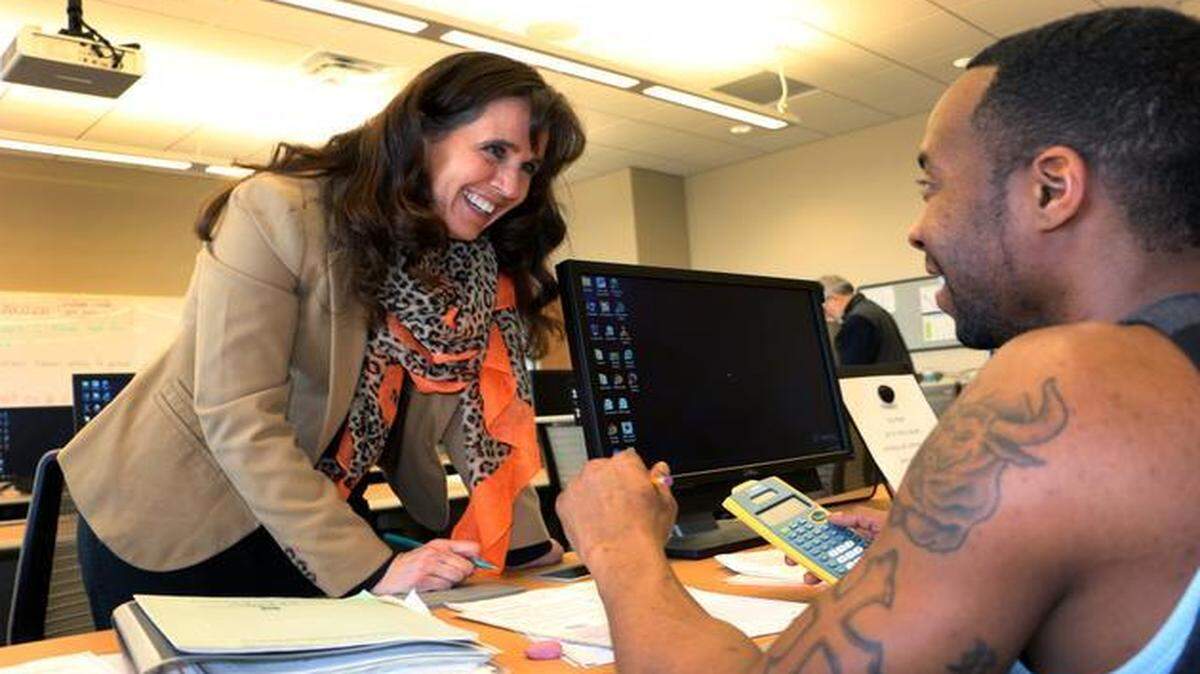
One of Linda Kozacek’s proudest accomplishments is helping a once-homeless single mother named Ada reach her full potential.
After Ada passed the General Educational Development (GED) test to earn her high school diploma, Kozacek helped her find grants for community college. Now, while working full-time and raising her children, Ada is exploring MBA programs.
But a year after major changes to the GED test, Kozacek is worried that there are fewer success stories.
The number of people who passed the GED exam in Kansas last year is the lowest it’s been in decades. And adult education centers, which for years have helped ensure that students are ready for the test, have been cut out of the process.
Kozacek, an adult education coach at Johnson County Community College (JCCC), has a lot of stories of adult learners overcoming obstacles to pass the GED test. It’s a first step for many immigrants and those who didn’t finish high school to get a good job.
The new version of the GED was rolled out at the beginning of 2014. It costs students more than its predecessor, is aligned with the K-12 Common Core education standards and can only be taken on a computer at a Pearson testing center.
Critics say the new test unfairly affects thousands of economically disadvantaged adults trying to get their high school diploma.
The changes resulted from a new partnership between the private company Pearson and the nonprofit American Council on Education, which had been the sole administrator of the GED in the U.S. since its creation in 1942. In 2011, the council and Pearson formed GED Testing Service LLC to overhaul the GED.
Many adult educators think the test needed to be updated to fit the demands of higher education and the workforce. But they also question how students are adjusting given that many face major economic and language barriers.
Amid concerns, other testing companies created alternatives to the GED test and began offering them to states, which are each responsible for administering their own high school equivalency standards.
Kansas adopted the new GED test and Missouri chose the HiSET test, which is administered by the nonprofit Educational Testing Service.
Thirty-four states, including Kansas, decided to offer only the new GED test.
In state after state, fewer people are taking the tests, and those who do are failing at much higher rates. In Rhode Island and Wisconsin, the number of people who passed the test dropped more than 90 percent.
In Kansas, only 807 people passed the GED in 2014, compared with 3,617 in 2013 and 2,806 in 2012.
According to GED Testing Service and the state of Kansas, the pass rate in the state is about 66 percent.
Michele Buescher, a lead instructor for Adult Basic Education at Johnson County Community College, said that although she can help students adjust to different curriculum and computer-based test-taking, the cost of the new test has had an impact.
The total cost of the test in Kansas has increased from $85 to $132. But test-takers can opt to take and pay for each of the test’s four sections separately, and section retakes cost $10.
“I hear more students that have to spread it out,” Buescher said.
Susan Fish, director of adult education for the Kansas Board of Regents, acknowledges that, although she and others were concerned about how a private entity would affect the test, she thinks the jury is still out.
“This is a change that will take time to adjust,” Fish said. “I don’t think that fewer test-takers or test-passers is a way to judge the test itself.”
But for critics of the new GED, the number of people passing the test has everything to do with the test’s legitimacy and fairness.
David Spring, an educational researcher with a specialty in math, began checking into the new test because his wife is an adult educator. She was concerned when students were struggling to pass the test. So Spring began looking at the math section, which he says contains problems that most high school students could not answer.
Spring, who runs the website restoregedfairness.org, thinks Pearson and GED Testing Service created an unfairly difficult test.
Last March and again in January, Spring asked Pearson for the norming study of the test, which would show what percentage of actual high school graduates could pass the test.
C.T. Turner, senior director at GED Testing Service, said in an email that the service will publish its norming study this month.
He emphasized that changes to the GED will help adults succeed in college and a job market needing more highly skilled workers.
“Too many educators are content for their adults to work in fast food, but this isn’t what adult learners want — they’ve told us so,” Turner said. “So repeating a test that is aligned with or easier than the old GED test will result in the same results.”
Turner also criticized the HiSET test as being too easy.
Spring said of the GED: “People are desperate to pass the test. Particularly for low-income young adults, this is their last chance for a successful life.”
Spring is based in Washington state and has been lobbying for the state to switch from the GED to the HiSET test, which he believes is a fairer exam.
Missouri is one of 14 states that uses the HiSET as its high school equivalency exam.
“A lot of states have been very happy with the amount of connection that we have with them and how we approach this as a partnership,” said Jason Carter, HiSET’s national director.
In Missouri, the change to the HiSET seems to have been an easier one, although there was a drop in the number people earning their high school equivalency.
According to the Missouri Department of Elementary and Secondary Education, 8,513 Missourians passed the HiSET in 2014, compared with 11,755 GED passers in 2013 and 9,411 in 2012.
Bonnie Endicott, coordinator for adult education and literacy at North Kansas City Schools, said the transition to the HiSET has been smoother than she thought it would be. The HiSET test has five sections, which cost $95 total. Although HiSET allows two individual section retakes for free, test centers in Missouri charge $7 for retakes.
Endicott thinks the student pass rate has remained high in Missouri, in part, because, unlike the GED, the HiSET test is gradually transitioning to the Common Core.
Adult educators in Kansas say these curriculum changes mean students may need more help, but it’s harder to connect with students. Janice Blansit, Johnson County Community College Adult Education Program director, said that before the changes, adult education programs administered a required practice test and helped ensure student success.
“In the past, we knew who was testing, and we could ensure that those students received the support they deserve,” Blansit said. “But now that GED Testing Services and their for-profit parent hold the data, our access is blocked.”
KCPT’s Hale Center for Journalism is an open-source, digital forum producing stories and conversations about Kansas City issues.