
Police chief joins exodus of officials in Ferguson, Mo.
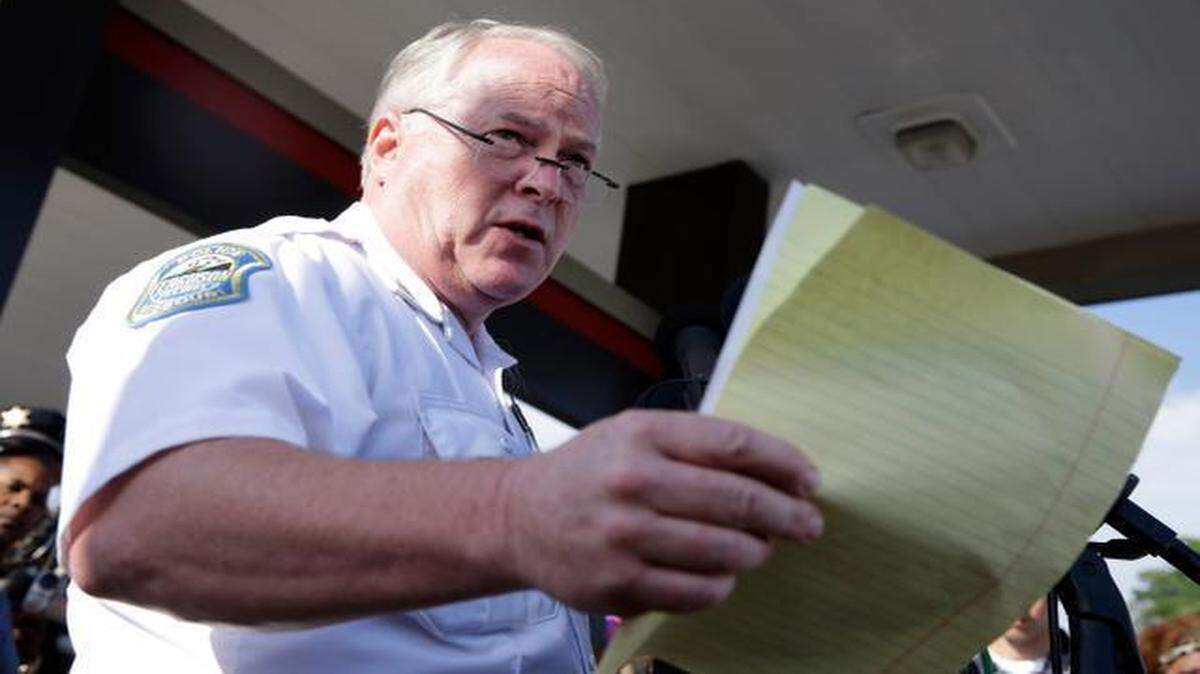
The embattled police chief of Ferguson, the focus of bitter complaints of racial discrimination within his department that turned into national protests after one of his white officers fatally shot an unarmed black teenager last August, has stepped down, Mayor James Knowles III said Wednesday at a news conference.
The resignation will be effective March 19, Knowles said, and the job will be filled temporarily while a search is conducted for a successor.
The chief, Thomas Jackson, who took over the Ferguson Police Department five years ago, becomes the latest high-ranking city official to fall in the wake of a scathing Justice Department report that accused the city of using its Municipal Court and police force as moneymaking tools that routinely violated constitutional rights and disproportionately targeted blacks. The municipal judge and city manager, as well as the top court clerk and two police supervisors, have stepped down in the wake of the report’s release last week.
Jackson will receive a severance payment of about $96,000 along with health insurance for a year, Knowles said. Lt. Col. Alan Eickhoff, who joined the force in August, will serve as interim chief, the mayor said.
Questions, however, remain over the future of the city’s Police Department. Some residents and political leaders have said that it should be dissolved and that the St. Louis County Police Department should take over, as it has with other surrounding municipalities. Four of Ferguson’s 54 police officers are black.
Ferguson officials must still decide whether they will reach a settlement with the Justice Department or go to court to challenge some of the reforms that federal officials have requested be made to the Police Department and Municipal Court.
From the time Officer Darren Wilson fatally shot Michael Brown, Jackson has been under intense scrutiny.
He said in the early days of unrest that he felt his department had a good relationship with the community.
But many residents of Ferguson and surrounding communities used the killing as a springboard to raise larger issues of discriminatory policing and judicial actions that they said had been rampant in Ferguson and nearby towns for years.
Last year, after the Missouri Highway Patrol took charge of the city’s policing during the sometimes violent demonstrations and calm returned briefly to the city’s streets, Jackson released surveillance footage that appeared to show Brown robbing a convenience store shortly before he was killed.
That revelation reignited tensions, and new clashes between police and protesters ended with clouds of tear-gas.
About a month and a half after the shooting, Jackson tried to calm tensions when he released a videotaped apology to Brown’s family. That same night, he attempted to join demonstrators in the streets, but only worsened tensions.
In the months following Brown’s death, local and federal officials tried to get Jackson to step aside, but he refused.
The chief’s reputation was dealt another blow in the Justice Department report, which said that, at the urging of Ferguson’s manager and finance director, Jackson sought to meet revenue goals through increased ticketing.
Data cited in the report said that black motorists and pedestrians received a disproportionately high number of those tickets.
“City and police leadership pressure officers to write citations, independent of any public safety need, and rely on citation productivity to fund the City budget,” the report said. The Justice Department also said that Wilson broke no federal crimes in the shooting.
In an email from March 2010, the year Jackson took his post, Jeffrey Blume, the city’s finance director, wrote to the chief that “unless ticket writing ramps up significantly before the end of the year, it will be hard to significantly raise collections next year. What are your thoughts?” according to the report.
The chief responded that fines would increase once the city hired more officers and that he was considering a different shift schedule that would put more officers on the street to increase traffic enforcement.
The following year, when Jackson reported to John Shaw, then the city manager, that court revenue for February 2011 was more than $179,000, the highest monthly total in four years, Shaw responded in an email, “Wonderful!” the Justice report said.
On the day the Justice report came out, the city fired its Municipal Court clerk for having sent racist emails that were outlined in the report; two police supervisors later resigned for also having sent racist emails.
A few days later, the municipal judge, Ronald J. Brockmeyer, resigned as the state moved all of Ferguson’s cases to be handled by a state appellate judge.
And on Tuesday, the City Council voted 7-0 in favor of a “mutual separation” with Shaw, who as manager was the city’s chief executive for eight years.
This story was originally published March 11, 2015 at 9:13 PM.