
Your block may say a lot about your politics
It is no accident that Kyle Russell’s family lives in one of the most Democratic enclaves in Johnson County.
Twelve years ago, when Russell and his wife were searching to settle within the Shawnee Mission School District, Russell figured that the farther northeast they could land, the better.
“I wasn’t going to be living in a sea of conservative Republicans who don’t think like me,” he said.
Social scientists call it sorting.
And as political engines rev louder for midterm elections, a growing number of experts say that sorting factors into the deep crux of America’s partisan divide.
A flurry of research in the last few years has illuminated what we’ve long known: People tend to live among like-minded neighbors, whether it’s intentional, unconscious or strictly a matter of economics.
But the charged nature of today’s politics adds voltage to what “like-minded” means, researchers say. Some are concluding that partisanship helps drive our decisions on where to call home, making Republicans and Democrats less likely to live among one another than was the case 30 or 40 years ago.
Red states and blue states? Yeah, heard that.
Zoom the microscope and what analysts now see are red neighborhoods and blue neighborhoods, and seldom any that are 50/50.
A study published in June by political scientists at Stanford and Princeton universities went so far as to assert that “polarization based on party is just as strong as polarization based on race.”
Another research team led by Matt Motyl, a University of Virginia doctoral candidate in psychology, tapped several sets of data to conclude that Americans increasingly are moving away from communities where they don’t sense an “ideological fit” and into politically “homogenous enclaves” more agreeable to their worldviews.
“This ideological clustering is a recent phenomenon of the last few decades,” said Motyl’s study, published this year in the Journal of Experimental Social Psychology. The findings suggested that geographic sorting “is a likely contributing factor to the partisanship and rancor … paralyzing the United States government.”
Really? Politics determine where we live?
When ReeceNichols real estate agent Scott Lane, at The Star’s request, posed the question last week at a meeting of 20 colleagues, “at first they just looked at each other like, what?” he said.
Hardly anybody searching for a home inquires about a neighborhood’s political hue, they shot back.
But as the agents discussed the topic, the consensus shifted.
Folks who move are sometimes attracted to lower taxes — what’s more political than that?
At least one agent at the meeting had dealt with clients looking to live where they could legally carry firearms.
Others knew of house shoppers trying to find an area where they could successfully run for public office.
After Russell moved to Roeland Park, he became active in Johnson County politics. He’s now the county chairman of the Democratic Party and, when canvassing neighborhoods, he recognizes what some scientists say is one result of sorting:
Neighbors in the minority party often keep quiet about their political views.
“They assume they’ll upset their neighbors” by planting a campaign sign, Russell said. But often there are more neighbors of their own party than they think because those people are just as quiet.
Chicken or egg?
The theory is easy to pick apart.
Even its believers concede that jobs, home values and family considerations outweigh ideology when we choose where to reside.
In two decades of being a real estate agent and broker, Steve Banks has not once been asked by a prospective homebuyer whether a neighborhood is mostly Democrat or Republican, he said.
Of course, Banks added, you want to live where you feel you fit in. It might be the kind of community in which you grew up.
Nothing new or very political about that.
And yet, while the nation as a whole can cast a razor-close decision in a presidential contest, precinct-by-precinct tallies across the Kansas City area (and throughout the country) usually are lopsided.
“I wonder if it’s a chicken-or-egg thing,” said Banks of Lee’s Summit. “Do people cluster together because of their political leanings? Or do they just have similar interests that somehow fall along party lines at election time?”
Few home-hunters are going to swing by an election office to check into a precinct’s voting patterns before moving there, acknowledged Bill Bishop, author of “The Big Sort: Why the Clustering of Like-Minded America Is Tearing Us Apart.”
“They don’t have to,” he said. “They can tell by looking.”
The types of cars, ethnic mix, shops, access to bike trails, mass transit and country clubs — all offer clues to the political flavor of a place.
“The distance between homes is one indicator,” Bishop said. “As places get dense, they get more Democratic. Where you see more space between houses, you get more Republicans.”
Bishop’s book puts forth that our “way-of-life segregation,” most pronounced in the political split between urban and rural areas, began to intensify in the 1970s.
In 1976, only a quarter of the nation’s voters lived in what he called “landslide counties,” where the gap between Republicans’ and Democrats’ votes for president exceeded 20 percentage points. In 2012, more than half of Americans lived in such counties.
As mobile as society has become, “people today will go to an area and look at the signs and bumper stickers and know they don’t belong,” Bishop said.
“For some it’s more rational to move away than to vote. What’s your one vote going to do in a place where you’re clearly outnumbered?”
Rutgers University political scientist Lilliana Mason examined a matrix of surveys from the American National Election Studies data file, dating back to 1972. In a paper published earlier this year, she concluded that geographic sorting has emboldened both the political left and right.
When people surround themselves with those who reinforce their beliefs, it leads to “the intensification of partisan bias, activism and anger,” Mason wrote in the American Journal of Political Science.
Comparing the effects of clustering to a form of “team spirit,” she said: “The outcome is a nation that may agree on many things, but is bitterly divided nonetheless.”
Politics is local
When politics drive a person’s choice of neighborhood, usually the issues are local, said Brian Icenhower, chief executive for Keller Williams Realty in the Northland.
“Are the county prosecutors and judges seen as conservative or liberal? For a lot of people, that’s huge,” Icenhower said. “Are the sales taxes lower in one town than the other?
“It may not be Republican versus Democrat … but it’s still politics, absolutely.”
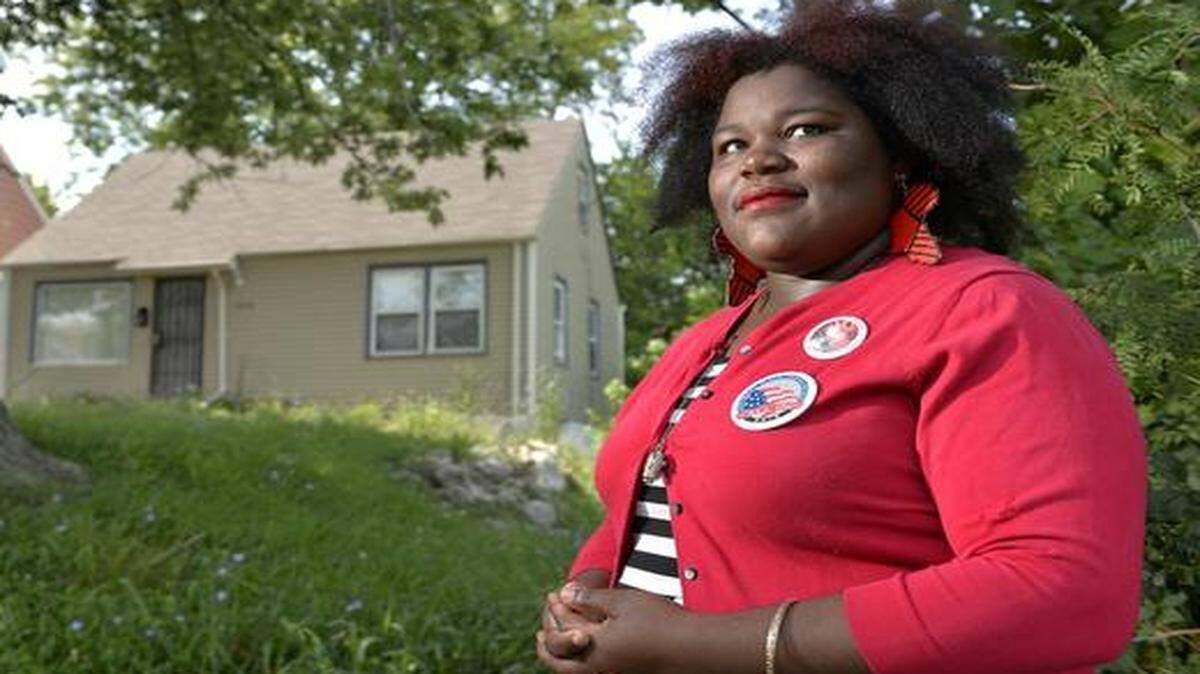
It’s mostly economics for Cecilia Johnson.
She is founder of a Kansas City club called Hood Conservatives, “empowering those living in the inner city for a better life through core conservative beliefs,” according to its website.
“If I could afford a home out where more of my conservative friends tend to live, I’d probably live with them,” said Johnson, 26. “To be where my vote really counts, that would be my main motivation.
“Where I live now, my vote gets watered down by the votes of my neighbors.”
Still, Johnson enjoys the challenge of getting her mostly Democratic precinct-dwellers to hear her out or to accept brochures pitching Republican candidates.
“If I can change hearts and minds and make conservatism work in my own neighborhood? I’d love that,” she said.
Johnson has learned she need not be confrontational. The more residents she gets to know while canvassing, the more she finds herself in “civil conversation” than arguments, she said.
She’s a neighbor, after all.
To reach Rick Montgomery, call 816-234-4410 or send email to rmontgomery@kcstar.com.