
Baghdad on the brink: Control of Iraq is at stake as militants advance on the capital
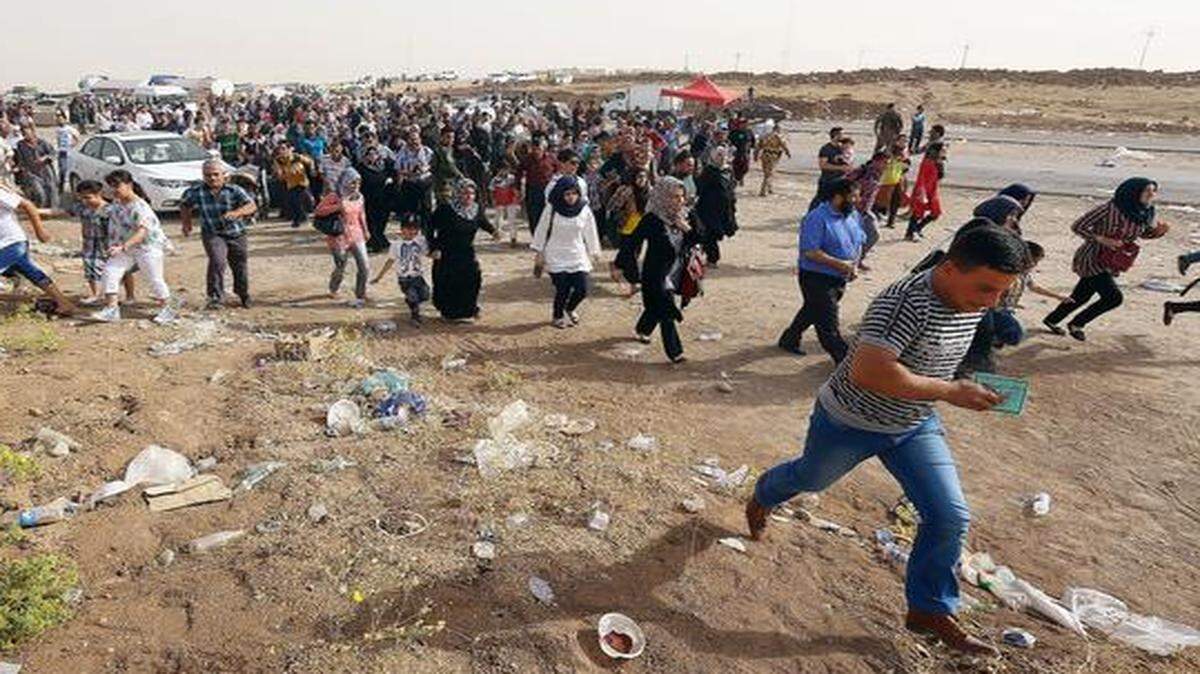
The dissolution of a centrally controlled Iraq ruled from Baghdad appeared closer to reality on Thursday as radical Islamist fighters advanced through the country with little interference from what remained of Iraq’s disintegrating security forces.
Only militias tied to Iraq’s feuding religious and ethnic groups mounted serious resistance to the southward push by fighters of the Islamic State of Iraq and the Levant, an al-Qaida-inspired militant group that now appears to be supported by an ad hoc coalition of Sunni Muslim tribes and militant groups opposed to the Shiite-dominated central government. With the lone exception of a helicopter assault on an insurgent position north of the central city of Tikrit, Iraqi army and security forces continued to abandon their posts whenever confronted by the Islamic State.
Kurdish forces exploited the mayhem, seizing complete control of the strategic northern oil city of Kirkuk.
Advancing Sunni militants, who pressed their advance southward toward Baghdad, warned officials of occupied Mosul to renounce allegiance to the central government and threatened to destroy religious shrines sacred to all Shiites.
President Barack Obama indicated Thursday that he may order direct military action in Iraq, a step he has ruled out since the United States ended its long war there.
Several former administration officials and private analysts have been urging drone or airstrikes on the Islamic State. In an Oval Office appearance, Obama said the militants’ gains indicated “Iraq’s going to need more help” from the United States and other nations.
Asked whether he would consider airstrikes, Obama said “I don’t rule out anything,” adding that in the continuing U.S. collaboration with the Iraqi government “there will be some short-term immediate things that need to be done militarily.”
Other U.S. officials have said they do not foresee combat troops returning to Iraq.
An order of U.S. airstrikes would mark a dramatic shift for the administration, which has insisted for years that Iraq has been capable since the 2011 U.S. military departure of guaranteeing its own security.
But in Baghdad, the Iraqi Parliament failed to muster a quorum to consider a request from Prime Minister Nouri al-Maliki for a declaration of a state of emergency. Al-Maliki responded in a statement read on state television by accusing Sunni political parties of conspiring to destroy the state. In recent days, al-Maliki, who also serves as the defense minister, has blamed the same parties for the army’s massive desertion in the face of the Islamic State’s offensive.
“Iraq’s future at this point is being shaped by conflict rather than by a viable political system. No one really knows where it’s going,” Salman Sheikh, the director of the Brookings Doha Center in Qatar, said in a telephone interview from Beirut. “The long-term impact could be quite cataclysmic, not just for Iraq, but for the entire region.”
The prediction that Iraq would one day descend into an ungovernable space of feuding ethnic and religious groups was first made when U.S. forces toppled dictator Saddam Hussein in 2003. Now that it seemed to be happening, many found it difficult to grasp the unfolding reality.
Meanwhile, the Pentagon announced that civilian contractors in Iraq as part of the U.S. military assistance program had been evacuated. The announcement said staffing remained unchanged for U.S. government employees at the U.S. Embassy.
The Kurdish Regional Government in Irbil announced that its highly trained militia, the peshmerga, had taken complete control of Kirkuk, which has long been a point of competition between its Arab and Kurdish residents, after the mostly Arab government security forces had fled. The move makes the Kurds’ long-sought goal of control over the city a reality.
In Mosul, Iraq’s second-largest city, whose fall late Monday was the beginning of the Islamic State’s rapid march, fighters held a parade to show off the military equipment they’d seized when they captured military bases and weapons storehouses, according to residents who spoke with Reuters.
The news agency said residents reported that the parade included Iraqi tanks and American-made Humvees as it passed through what had been the main government complex in western Mosul. Unconfirmed reports from the scene said two Iraqi Army transport helicopters overflew the city — apparently piloted by Islamic State fighters.
The parade was followed by the distribution of an Islamic State leaflet that proclaimed that a new form of government had come to Mosul.
“Who are we? We are the soldiers of (the Islamic State of Iraq and the Levant),” said the leaflet, whose grandiose title mimicked the declaration of the Prophet Muhammad that is considered the beginning of Islamic history. “We took on our shoulders bringing back the glories of the Islamic caliphate and stop oppression against our brothers and to cut the Shiite snake that reached the necks of the people.”
The leaflet outlawed unauthorized gatherings under penalty of death, ordered people not to communicate with the government in Baghdad, and warned women to dress modestly and stay at home.
“You have tried secular rule: monarchy, republic, Baathist, Safavids,” the leaflet said, referring to the Baath party of Saddam Hussein and the Safavid dynasty that ruled Iran, Iraq and other areas from the 16th to the 18th centuries. “Now is the era of the Islamic State and the reign of Imam Abu Bakr al Quraishi,” an alternative name for Islamic State leader Abu Bakr al Baghdadi.
There was speculation that an Islamic State capture of the Sunni Muslim town of Samara and a threat to the al-Askari mosque, one of Shiite Islam’s most sacred shrines, would prompt Iran, which has been an ally of the Maliki government, to send troops. Iranian President Hassan Rouhani, in a nationally televised speech on the situation in Iraq, raised the possibility of intervention to defend the Iraqi government.
“For our part, as the government of the Islamic Republic of Iran … we will combat violence, extremism and terrorism in the region and the world,” he said. The Islamic State “is an extremist, terrorist group that is acting savagely.”
The New York Times and the Tribune Washington Bureau contributed to this report.
This story was originally published June 12, 2014 at 11:10 PM with the headline "Baghdad on the brink: Control of Iraq is at stake as militants advance on the capital."