
Friendly fire may have caused Moscow refinery blast, video suggests
EDITORS NOTE: With: UKRAINE-RUSSIA-ASSESS, RUSSIA-BANKER, UKRAINE-BALLISTIC-MISSILES); Alina Lobzina contributed reporting.
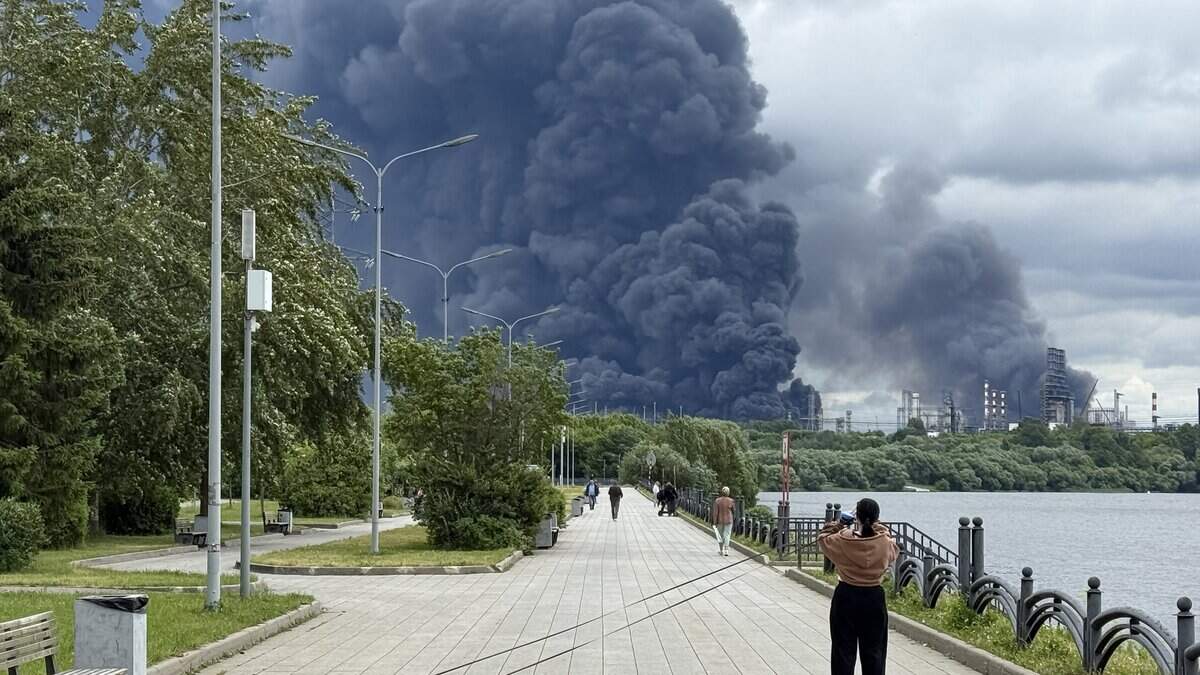
The dramatic explosion of a fuel storage facility in Moscow on Thursday may have been caused not by a Ukrainian drone but instead by a Russian air defense missile, an analysis of social media videos verified by The New York Times indicates.
The blast became the defining image of Ukraine’s largest-scale drone attack on the Russian capital since the start of the war. Russian authorities said they had shot down 992 Ukrainian drones across the country Thursday, in addition to those that reached their targets.
The roof of the storage silo flew high into the air, appearing to surf atop a plume of black smoke before plummeting to earth as the installation in southeast Moscow became engulfed in fire.
The possibility that the explosion was a self-inflicted “friendly fire” incident highlighted the difficulties that Russian air defenses are facing as Ukraine increases the scale of its drone attacks to break through a layered shield of systems designed to protect the capital.
A video verified by the Times and originally shared on the Chinese social media site Douyin shows traces of two air defense missiles being launched from the ground in what appears to be an attempt to intercept Ukrainian drones flying near the Kapotnya oil refinery.
A missile travels in a low-flying trajectory toward the fuel silo, which erupts in an explosion around the time of its arrival at the facility. Experts said the missile looked consistent with a projectile fired from a portable air defense system, commonly called a MANPAD, that soldiers use like guns to down incoming threats.
“The video strongly supports the supposition that this is a MANPAD launch, in its origin, low trajectory and thin contrail with no accompanying launch smoke in its early moments of flight,” said Michael Clarke, a British security expert and professor of defense studies.
Several other social media videos, also verified by the Times, show uniformed men on the side of a road Thursday firing MANPADs near the Moscow refinery in an attempt to take down Ukrainian drones flying overhead.
Alistair Saddington, a professor of defense aeronautics at Cranfield University in England, said the footage “does indeed appear to show the exhaust plumes from short-range missiles.”
“Whether they are MANPADS or not, we don’t know for sure, but the balance of probability suggests that they are,” Saddington said, citing the other footage circulating on social media showing people firing such weapons.
Thursday’s attack and others like it are part of an effort by President Volodymyr Zelenskyy of Ukraine to bring the war home for Russians and pressure President Vladimir Putin of Russia into negotiating an end to the conflict. They come amid a broader Ukrainian onslaught against oil and fuel facilities that has caused lines and rationing at Russian gas stations.
Putin has not spoken publicly about the Thursday attack, which did not result in any deaths, or about continued Ukrainian attacks in the Moscow area Friday. The governor of the Moscow region, Andrei Y. Vorobyev, said that an 8-year-old girl had died in the attacks Friday.
Dmitry Peskov, the Kremlin spokesperson, said Friday that Putin was receiving updates throughout the day and that “air defense systems are performing at a high level, despite everything.”
The Russian Defense Ministry did not immediately respond to a request for comment from the Times.
The wars in Ukraine and the Middle East have demonstrated that defending against large swarms of cheap drones is one of the most difficult tasks in modern warfare.
Old-school air defense systems, like the ones that protect the Russian capital, are expensive and were designed to shoot down incoming aircraft or missiles. Such systems were never expected to be used against the drones that Russia and now Ukraine are firing in such large quantities.
On Friday, Russia appeared to have bolstered its defenses by placing a vehicle-mounted Pantsir missile defense system near the same highway where the military fired MANPADs during Thursday’s attack, according to footage verified by the Times. The systems can shoot down drones but struggle to counteract large swarms.
Ukraine has only recently begun producing longer-range drones at a large scale, enabling Kyiv to launch the sorts of drone attacks numbering in the hundreds that Russia has been directing against Ukrainian targets for some time. Ukraine still lacks the ballistic missiles that Russia regularly fires at Ukrainian cities.
“Russia is likely struggling with intercepting hundreds of drones in just the same way that Ukraine is,” Saddington said. “Intercepting them with large air defense missiles designed to shoot down combat aircraft is very expensive and will quickly reduce stockpiles, and so low-cost alternatives need to be sought.”
He said MANPADs were not necessarily a great alternative, noting that “firing them at low altitude in an urban environment” was an indication of the desperation of the situation, possibly, “in this case, with unintended consequences.”
This article originally appeared in The New York Times.
Copyright 2026 The New York Times Company