
Man decapitates venomous snake, then head still bites him in India, report says
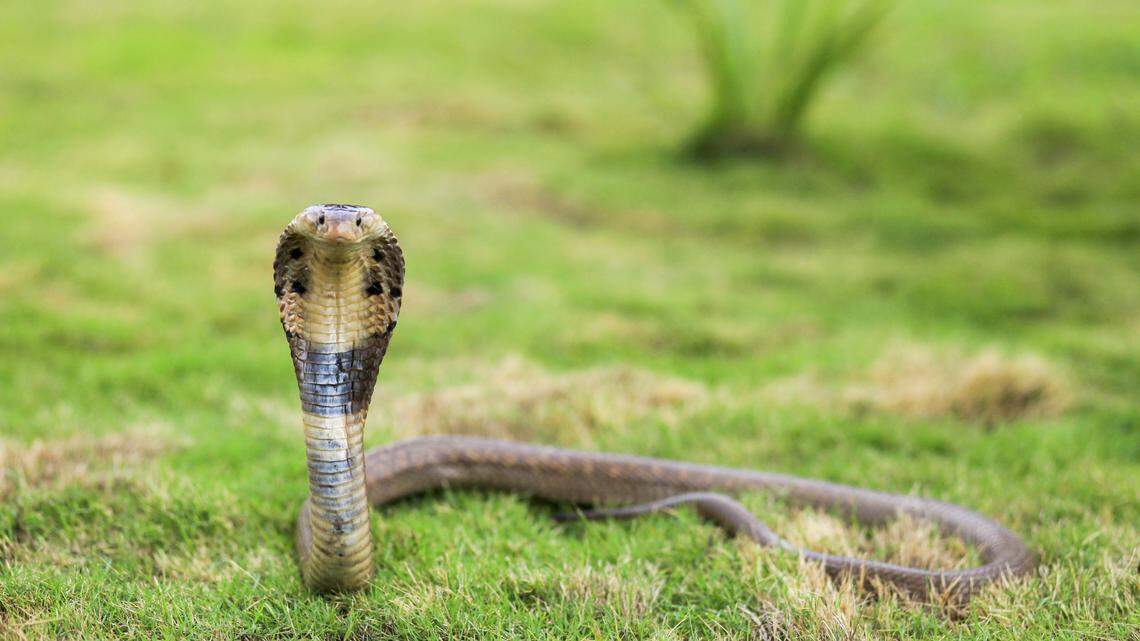
As darkness descended on a man’s chicken coops in Sivasagar, India, he noticed something inside that shouldn’t be there.
A black-colored snake was in the coop, the 45-year-old said, and hoping to save his chickens, he quickly decapitated the animal.
But then, as he went to move the snake’s seemingly lifeless body, its head bit down and injected its venom into the man’s finger.
The Sivasagar man is just one of three cases of reported bite-after-death phenomena happening with venomous snakes in northeastern India, according to an Aug. 18 report in Frontiers in Tropical Diseases.
The man went to the hospital within the hour and was soon experiencing “unbearable pain” up to his shoulders with repeated vomiting and blackening of the skin around the bite site, according to the report.
The snake was identified as a monocled cobra, and a physician “immediately” administered an antivenom that saved the man’s life, researchers said. Over the course of a month, the man stayed at the hospital as doctors treated his “profound wound” left behind from the bite.
The man wasn’t alone.
Three different cases
In another case, a farmer, also from Sivasagar, was working in a paddy field on his tractor when he ran something over, according to the report.
It was a snake that had been crushed in the wheels of the tractor.
“Upon dismounting his vehicle at the end of his work, the farmer was bitten by the snake on his foot at approximately 7:30 a.m.,” according to the report. “He observed that it was a monocled cobra (known locally as “feti”), which he presumed to be dead.”
He started experiencing pain shortly after and was rushed to the hospital, researchers said.
Antivenom also saved this man from what would have likely been a grisly death, and 25 days after his admittance, he was sent back home.
In a third case, a man was envenomed by a snake hours after it was killed, according to the report.
“A black-colored snake entered a household at 6:30 p.m. in a village in Kamrup, Assam. The owners killed the snake and discarded the dead body in the backyard of the house,” researchers said. “Due to curiosity, one of their neighbors visited the household to see the dead snake at approximately 9:30 p.m.”
The neighbor, assuming the snake was long dead, picked up the animal and tried to hold its head. Then, he felt a fang go into his little finger on his right hand.
He and his family ignored the bite initially since there weren’t any symptoms and the snake was dead, according to the report, but later in the night the man became restless, had drooping eyelids and started having difficulty swallowing.
He sought help from a “faith healer,” but when that didn’t help, he went to the hospital, researchers said.
Doctors administered the antivenom, but his condition quickly deteriorated and he was quadriplegic, unable to move and unresponsive. He was attached to respiratory support, and with the help of the antivenom, he eventually recovered.
How are dead snakes biting?
Snakes are “mostly shy creatures and avoid human interaction while hunting for their prey,” researchers said.
“However, frequent encounters with farmers do happen during rainy seasons when the digs and burrows are flooded with water,” according to the report.
Monocled cobras are the most common cobra found in northeastern India and are responsible for the highest number of envenomings in that region and Bangladesh, researchers said.
How they are able to bite after their death, however, comes down to their biology.
“The potential to bite even after death and decapitation lies in the structural organization of the venom apparatus and fangs of front-fanged snakes (like the cobra),” according to the report. “The venom gland consists of a large basal lumen for storage of secreted venom, which is connected to a long hollow fang. Venom is rapidly injected into the target, either like a hypodermic syringe or via the groove of the fang by contraction of the compressor muscle.”
Researchers believe that by pressing the venom gland while handling a dead snake, it can trigger a reflex to bite down and then inject the entirety of the venom stored in the basal lumen.
While living snakes can control how much venom they release on a bite, dead snakes cannot, and when the bite is triggered, more venom than a normal bite is released, making reactions to the venom even more deadly, according to the report.
“Accidental envenoming may occur while handling the corpse or the severed head of a snake. Such envenoming can lead to clinical complications similar to those caused by live snakes requiring antivenom therapy,” researchers said. “Such cases of envenoming by a dead venomous snake or its severed head highlight the critical necessity for utmost care while handling the snake, whether dead or alive.”
Assam is a state along the northeastern border of India, just south of the eastern Himalayas, Bhutan, Tibet and China.
The research team includes Susmita Thakur, Surajit Giri, Gaugav Choudhary, Hemen Nath and Robin Doley.
This story was originally published August 21, 2025 at 3:06 PM with the headline "Man decapitates venomous snake, then head still bites him in India, report says."
