‘Territorial’ creature — with ‘amber’ crown — found in Brazil trees. See new species

Wandering the forested savannas of eastern Brazil, it may feel like you are being watched.
Looking side to side, you are alone. But above you, on the tops of the trees, a small bird sits on a branch and watches your every move, ready to defend his home.
The bird, adorned with a crown of amber feathers, is a northern silvery-cheeked antshrike — and a new species.
During expeditions to the Caatinga, a patch of seasonally dry tropical forest in northeastern Brazil, researchers noticed some differences between antshrike birds, according to a study published June 17 in the journal Zoologica Scripta.
The birds had a large range, stretching the entire eastern half of the country, researchers said, but the range was nearly split in half by the São Francisco River.
Birds on the north side of the river had a smaller crown, or the feathers on the top of the head, and stripes down the tail feathers. The birds south of the river had a darker “cinnamon-brown” color of feathers on their backs, and their tail feathers were much darker without obvious stripes, according to the study.
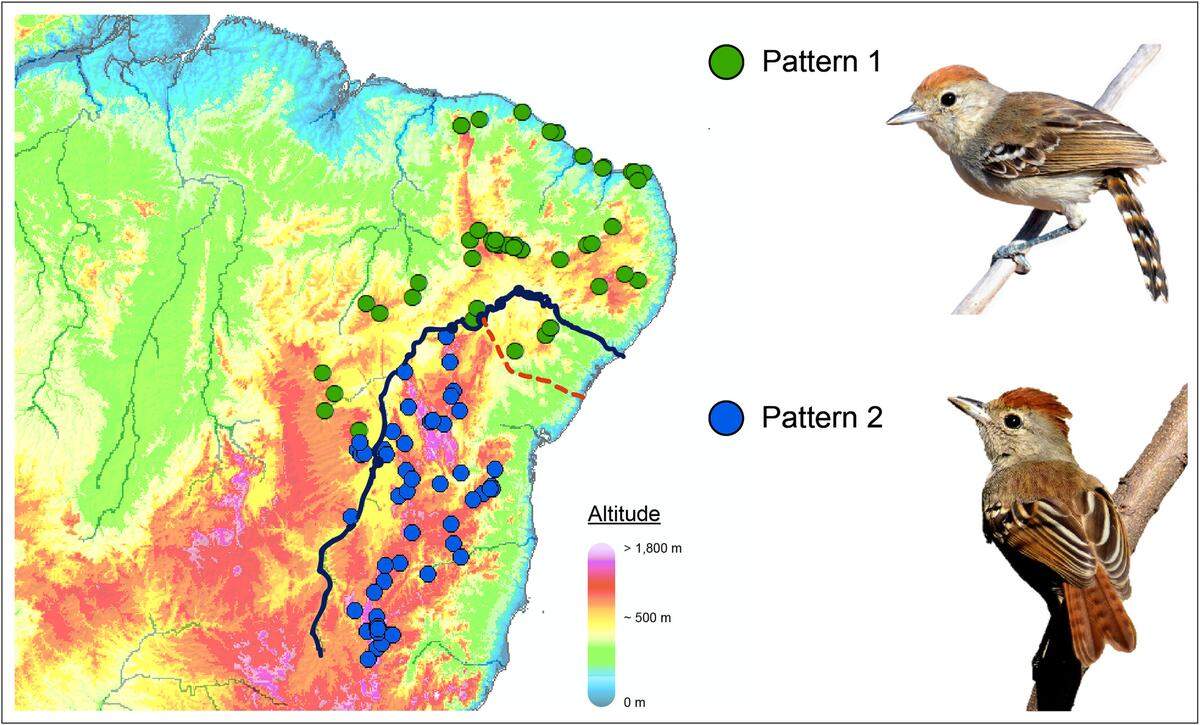
Suspecting the two groups had actually diverged into separate species, researchers analyzed their calls.
The “loudsong” of the northern birds had “a significantly greater number of notes, longer overall duration, and slower pace in total song,” according to the study.
Differing songs meant the two groups of silvery-cheeked antshrikes were not interacting with one another as members of the same species, and they were actually two distinct species.
The new species, Sakesphoroides niedeguidonae, or the northern silvery-cheeked antshrike, was named after Niède Guidon, a Brazilian archaeologist credited with exploring prehistoric sites in the Americas in the 1970s, researchers said.
Guidon was “a symbol of power and persistence in preserving the Caatinga environment not just for archaeological purposes but also considering biodiversity and local human communities, highlighting the Caatinga as a singular place in the world, which has inspired us every day,” researchers said.
The new species typically forages in pairs or mixed in with other bird species, according to the study, and will fly in short bursts from branch to branch across an open space to catch flying insects.
They also toss dry leaves on the ground to reveal ants, spiders, termites, beetles and caterpillars for their meals, researchers said.
“Similar to most antshrikes, sakesphoroides niedeguidonae is a territorial species,” researchers said. “Males were commonly observed on top of vegetation and exposed branches showing a clear territory defense behavior in response to playback.”
The females, however, take a different approach.
“Females in contrast were more secretive in low strata of dense vegetation, perching on horizontal and vertical branches when stimulated by playback or scanning for prey, with discrete tail movements,” according to the study.
Researchers said the formation of the river likely forced the birds to maintain separate populations, and over millions of years their songs and plumage changed. Since those two traits are critical for finding mates, the groups didn’t reproduce with one another.
This story was originally published June 25, 2024 at 12:16 PM with the headline "‘Territorial’ creature — with ‘amber’ crown — found in Brazil trees. See new species."