
Medieval ship sank 500 years ago off Portugal coast. Now valuable cargo is revealed
While wandering a beach in Portugal in 2014, a local sculptor stumbled upon an assemblage of wood and metal that had been thrown ashore during a recent storm.
Initially, he thought the beached objects were a collection of damaged helmets.
However, after local authorities were contacted, the strange debris was revealed to be the remains of a 16th century shipwreck, of which hundreds of associated artifacts were eventually found.
Now, over a decade later, the recovered cargo has been subjected to an in-depth analysis, revealing its high value and far-flung origins, according to a study published March 20 in the Journal of Maritime Archaeology.
The study, authored by researchers from Portugal and America, “enhances our understanding of maritime cultural interaction and exchange by tracing manufacturing influences, artistic styles, and craftsmanship techniques exchanged among seafaring communities during the sixteenth century.”
“High value” artifacts
A total of 664 cargo artifacts were found in the intertidal zone of Belinho Beach, located in the far north of Portugal. After their discovery, many of them have since been cleaned and subject to X-ray imaging.
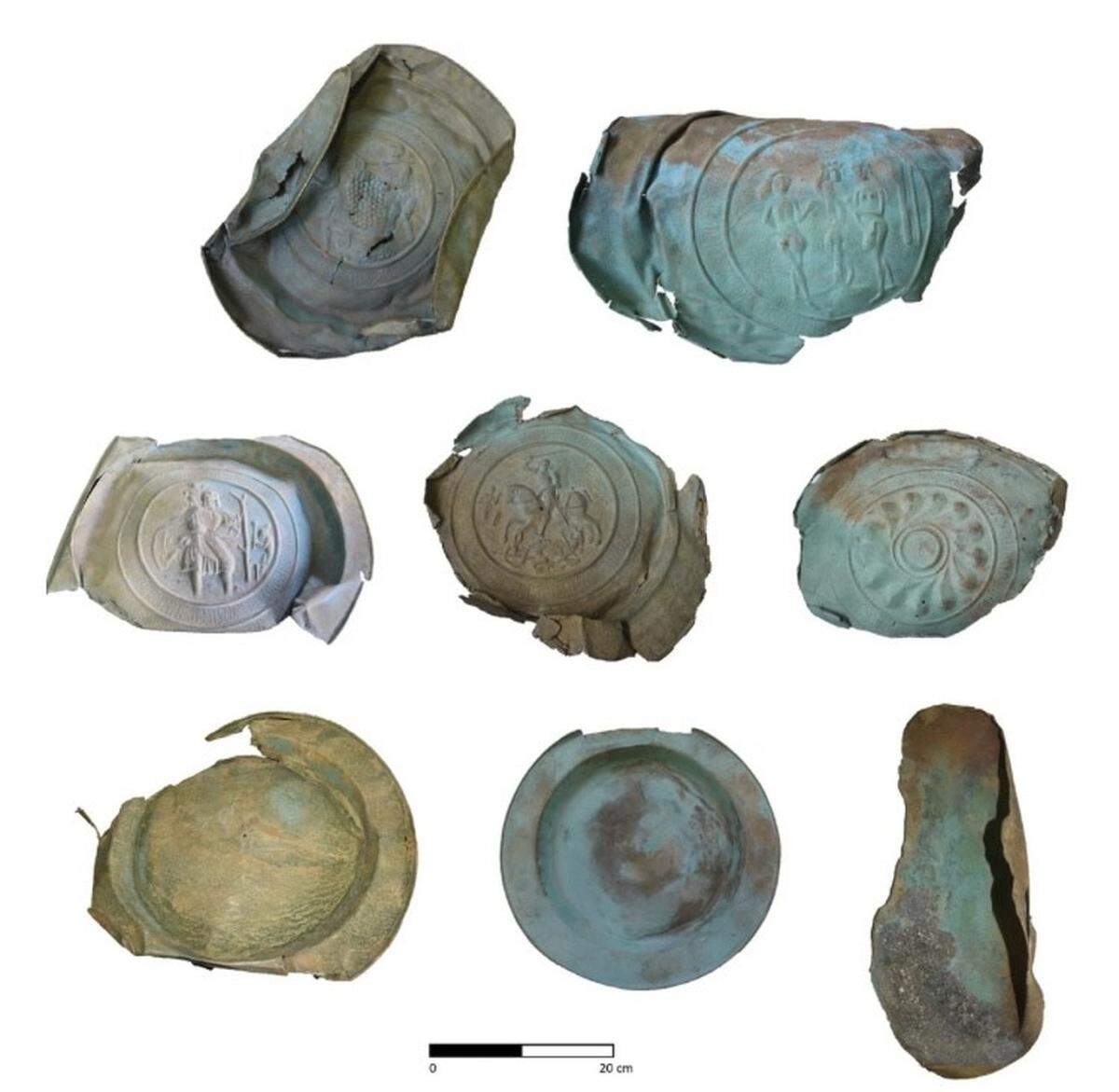
Among the artifacts found were Medieval weapons — such as cannonballs and swords — as well as ornate serving dishes decorated with Biblical imagery.
The most frequently found artifacts were pewter plates, which due to their durable material can survive for long periods of time underwater.
Fifty-eight plates displayed makers’ marks that helped place them geographically. Many of the marks were characterized by a crowned hammer — a symbol commonly used in Belgium, Switzerland and Scotland — suggesting a Northern European origin.
A smaller number of brass plate fragments were also recovered, corresponding to 34 complete plates, researchers said.
Seven of these plates are believed to be alms dishes, which display ornate decorations. It’s likely they were manufactured in Nuremberg, Germany, the Netherlands or the Low Countries.
Some depict Biblical scenes, including one portraying Adam and Eve in the Garden of Eden and another with an image of baby Jesus. One plate also depicts St. George fending off a dragon in order to rescue a princess.
These religious scenes indicate the plates may have been used in a church, perhaps for collecting offerings or for baptisms, researchers said.
These ornately decorated plates would have sold for around 60 reis — the local currency during Medieval times. By comparison, a regular ceramic plate would have cost around 5 reis or less.
The “high value” of these objects, in addition to their uniformity, indicate they were part of the ship’s cargo, and not owned by the crew, researchers said.
In addition, 32 cannonballs, two ax head pieces and the remains of two swords were found. However, their point of origin is not clear, and it’s not known whether they were part of the cargo or owned by the crew.
While much else about the ship remains unknown, “the value of these objects suggests that this ship’s wreck was a huge economic loss for someone,” the authors wrote.
This story was originally published March 28, 2024 at 5:16 PM with the headline "Medieval ship sank 500 years ago off Portugal coast. Now valuable cargo is revealed."