
Inaction by Turkey against the Islamic State upsets the U.S.
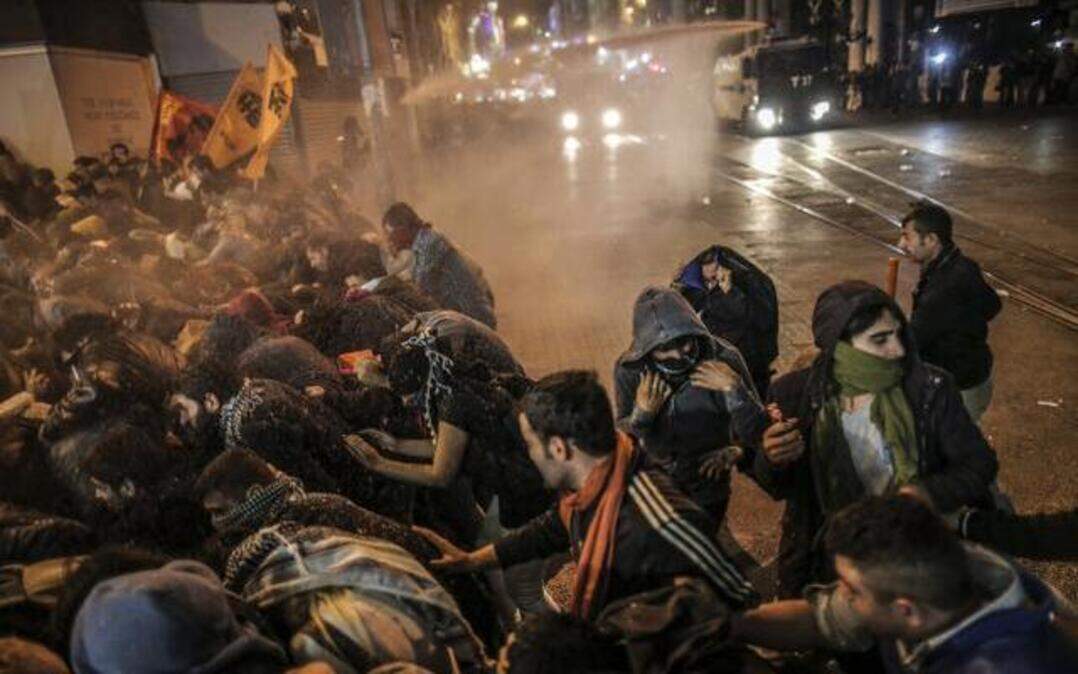
As fighters with the Islamic State bore down Tuesday on the Syrian town of Kobani on the Turkish border, President Barack Obama’s plan to fight the militant group without being drawn deeper into the Syrian civil war was coming under acute strain.
While Turkish troops watched the fighting in Kobani, Turkey’s president, Recep Tayyip Erdogan, said the town was about to fall and Kurdish fighters warned of an impending bloodbath if they were not reinforced — fears the U.S. shares.
But Erdogan said Tuesday that Turkey would not get more deeply involved in the conflict with the Islamic State unless the U.S. agreed to give greater support to rebels trying to unseat the Syrian president, Bashar Assad. That has deepened tensions with Obama, who would like Turkey to take stronger action against the Islamic State and to leave the fight against Assad out of it.
Even as it stepped up airstrikes against the militants Tuesday, the Obama administration was frustrated by what it regards as Turkey’s excuses for not doing more militarily.
“There’s growing angst about Turkey dragging its feet to act to prevent a massacre less than a mile from its border,” said a senior administration official, who spoke anonymously to avoid publicly criticizing an ally. “After all the fulminating about Syria’s humanitarian catastrophe, they’re inventing reasons not to act to avoid another catastrophe.”
Secretary of State John Kerry has had multiple phone calls in the last 72 hours with Turkey’s prime minister and foreign minister to try to resolve the border crisis, U.S. officials said.
For Obama, a split with Turkey would jeopardize his efforts to hold together a coalition of Sunni Muslim countries to fight the Islamic State, also known as ISIS or ISIL.
If Turkey remains a holdout, it could cause other fissures in the coalition. It is not only a NATO ally but the main transit route for foreigners seeking to enlist in the ranks of the Islamic State.
Ultimately, U.S. officials said, the Islamic State cannot be pushed back without ground troops that are drawn from the ranks of the Syrian opposition. But until those troops are trained, equipped and put in the field, something that will take some time, officials said, Turkey can play a vital role.
Speaking to reporters on Air Force One, Obama’s spokesman, Josh Earnest, said he was confident that the president’s recently appointed special envoy for Syria, retired Gen. John R. Allen, would be able to resolve some logistical issues regarding the Turkish military’s participation in the coalition. But he acknowledged that Turkey’s differing view of the need to oust Assad was likely to come up.
While the diplomacy went ahead, the U.S. took pains to emphasize its support for the embattled Kurds in Kobani.
The military’s Central Command confirmed on Tuesday that coalition aircraft had carried out five airstrikes against Islamic State positions in the Kobani area in the past two days, destroying or damaging armed vehicles, artillery, a tank and troop positions.
The strikes brought the total number of airstrikes in and around Kobani to 18 since the air campaign was extended from Iraq to Syria.
But Kurdish fighters in Kobani said they were running out of ammunition and could not prevail without infusions of troops and arms from Turkey. Independent analysts and some influential members of Congress concurred, deriding the airstrikes in Kobani as too little, too late.
Analysts say the Kurds of Kobani are being held hostage as Erdogan seeks to wrest concessions not only from Washington but also from Kurdish leaders, his longtime domestic foes.
The aim, said Soner Cagaptay, an analyst at the Washington Institute for Near East Policy, is to weaken Turkey’s outlawed Kurdistan Workers’ Party in peace talks with the Turkish government.
Turkey also wants the Kurdish fighters to denounce Assad and openly join the Syrian insurgents fighting him. But the fighters and local political leaders accepted control of Kurdish areas when Assad’s forces withdrew earlier in the Syrian war, and have focused more on self-rule and protecting their territory than on fighting the government. In some places they have fought alongside government troops.
The impasse leaves Kobani isolated. Some refugees are literally pressed against the fence, unwilling to cross because they cannot take their livestock, and sometimes blocked by the Turkish authorities, who have also stopped Syrian and Turkish Kurds from crossing into Syria to fight the Islamic State.
On one small stretch of the border near Kobani, a fleeing Syrian Kurd, Omar Alloush, said a Turkish soldier had looked on as an Islamic State fighter addressed Syrian Kurds across the border fence, telling them they were welcome to return as long as they abided by the group’s extreme interpretation of Islam.
“We will never trust those people,” Alloush said by telephone.
Yet another hillside spectator, Avni Altindag, a Kurd from Suruc, said the Islamic State was stronger than a few air raids.
He pointed to the men watching the smoke rising over Kobani, who were chanting for the People’s Protection Committees, a Kurdish group that is battling the Islamic State in the town’s streets. “They used to come with high expectations of strikes against ISIS, but all are disappointed,” he said.
Altindag blamed Turkey. “They don’t want to help what they say is their enemy,” he said. “This is why it is in Turkey’s favor that Kobani falls to ISIS.”
This story was originally published October 7, 2014 at 10:37 PM with the headline "Inaction by Turkey against the Islamic State upsets the U.S.."