
Is political violence increasing? Experts weigh in after Charlie Kirk’s killing
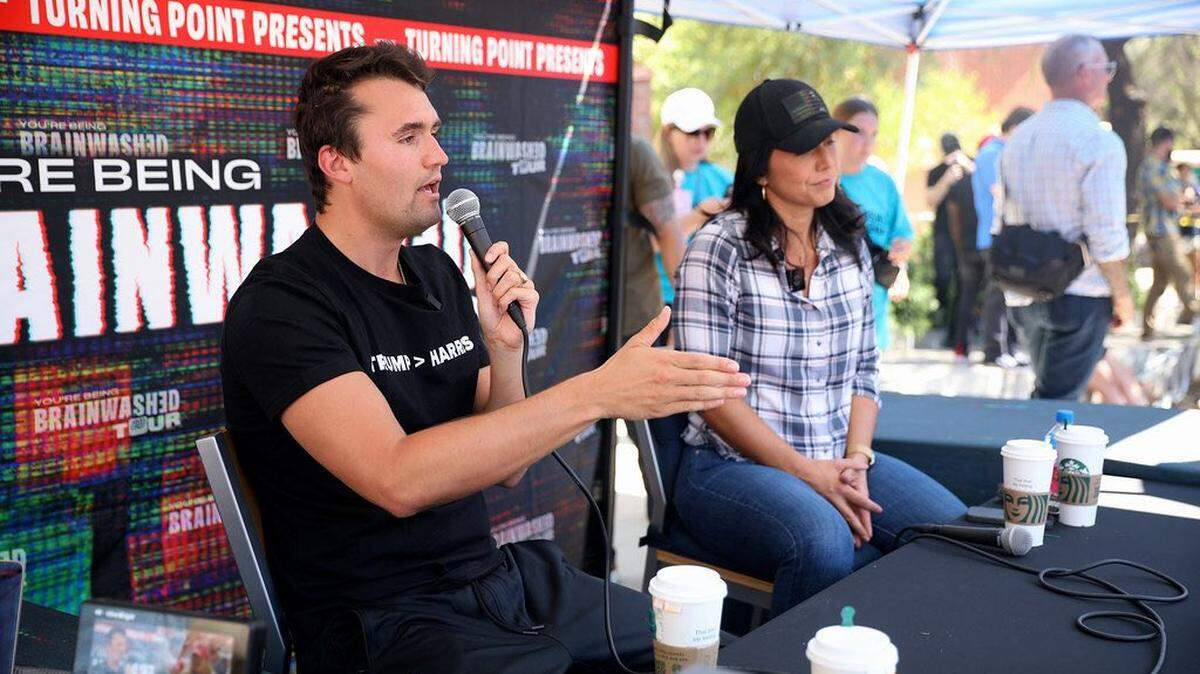
The assassination of Charlie Kirk, an influential conservative activist, sparked a wave of concern about political violence in the United States.
Kirk, 31, was fatally shot while speaking to a large crowd at Utah Valley University on Sept. 10. The shooter, whose identity is unknown, remains at large.
In response, numerous politicians on both sides of the aisle quickly condemned the killing — warning that it reflects a troubling trend. House Speaker Mike Johnson, a Republican, said such acts have “become all too common in American society,” while Rep. Joe Morelle, a Democrat, said, “We’ve got to put an end to the rise in political violence.”
Kirk’s killing, and the reaction from officials, prompts a number of questions: Is political violence indeed increasing? If so, what groups are responsible? And how can it be quelled? McClatchy News reached out to experts for their insights.
Is political violence on the rise?
Political violence — defined by the United Nations as hostile acts motivated by political objectives — does appear to be increasing in the U.S., multiple experts said.
“The idea that domestic political violence has gotten worse in the past decade or so is a common intuition, and it is generally backed up by the data, although there is debate over the exact extent,” Michael Becker, a data scientist who researches extremism and a lecturer at UCLA, told McClatchy News.
“Since the beginning of the presidential campaign of 2015, threats against political and ideological figures, local politicians such as school board members, poll workers, judges, minorities and women have all been on the rise,” Rachel Kleinfeld, a senior fellow in the Carnegie Endowment for International Peace, told McClatchy News. “While actual violence remains much lower than the threats, it has also grown considerably.”
Among the notable incidents in recent years are the 2025 assassination of Minnesota Democratic state lawmaker Melissa Hortman, the 2024 assassination attempt on Donald Trump in Pennsylvania, the 2022 attack on Rep. Nancy Pelosi’s husband and the 2017 congressional baseball shooting that seriously wounded Republican Rep. Steve Scalise. There are many more examples.
“This is a serious and dangerous trend,” Sean Westwood, a government professor at Dartmouth College and director of the Polarization Research Lab, told McClatchy News.
Jeffrey Ross, a criminologist at the University of Baltimore, told McClatchy News that changes in political violence are “extremely hard to generalize,” noting that it is “cyclical.”
Is it a partisan issue?
Shortly after Kirk was shot, President Donald Trump, in an Oval Office address, specifically called out “radical left political violence,” which he said “has hurt too many innocent people and taken too many lives.”
But experts cautioned that politically motivated attacks are carried out by individuals across the political spectrum.
“Searching for a single partisan motive among perpetrators of political violence is likely a fruitless exercise,” Westwood said. “The more salient common factors are social isolation, mental illness, and a deep-seated conviction that the political system itself is illegitimate.”
“While people like to view political violence as left or right, the reality is that it usually is perpetrated by people who are aggressive and are often mentally unbalanced, who draw from a wide range of conspiracy theories and beliefs,” Kleinfeld said.
Still, she said threats and acts of violence in the past decade have largely come from far-right individuals, though she said polling shows some liberals are becoming more accepting of violence.
In a 2023 PRRI poll, a record-high 23% of respondents — including 33% of Republicans and 13% of Democrats — said political violence is acceptable to save the country.
Westwood pushed back on the idea that politically motivated attacks are becoming more palatable, citing data from his research lab.
“There is no broad societal shift toward accepting political violence as a part of the political process,” he said. “Political violence is being imposed on the public and not demanded by the public.”
Historical comparison: rise of lone attackers
The phenomenon of politically driven acts of violence has deep roots in America, experts said.
“Political violence is nothing new in American life: we saw spikes, for example, in the 1850s and 1860s as well as the 1960s,” Becker said.
The 1960s, for example, witnessed a string of high-profile assassinations, including of President John F. Kennedy, Malcolm X, Martin Luther King Jr. and Robert F. Kennedy. But, that era, unlike today, also saw attacks carried out by well-organized groups with specific goals, such as the Weather Underground.
By comparison, “violence in America today is typically (though not always) carried out by sporadic individuals or loose groupings of people,” Becker said.
Westwood echoed this sentiment, saying “today’s violence is far more amorphous.”
In a 2021 report, the FBI reached a similar conclusion, stating that “lone offenders” — particularly those who are radicalized online — pose the greatest domestic terrorism threat.
How to stop rising political violence?
It is possible to stem the tide of rising political violence, experts said.
“Political violence is not like the weather — it is under our control,” Kleinfeld said. “In communities where politicians and people across political persuasions say enough is enough, we see violence come down.”
“Responsible rhetoric from politicians and other respected figures can be a key factor in restraining cycles of violence,” Becker said.
Experts noted that there have been encouraging signs, as numerous politicians — including every living former president — have condemned politically motivated violence of all stripes following Kirk’s assassination.
“What is crucial is to stop assigning violence to one side or another,” Kleinfeld said, “but to recognize that as political violence continues to rise in the United States, it will affect all of us, left, right, and center.”
This story was originally published September 11, 2025 at 4:55 PM with the headline "Is political violence increasing? Experts weigh in after Charlie Kirk’s killing."