
Can Congress stop Trump’s tariffs? What to know after ‘Liberation Day’ levies
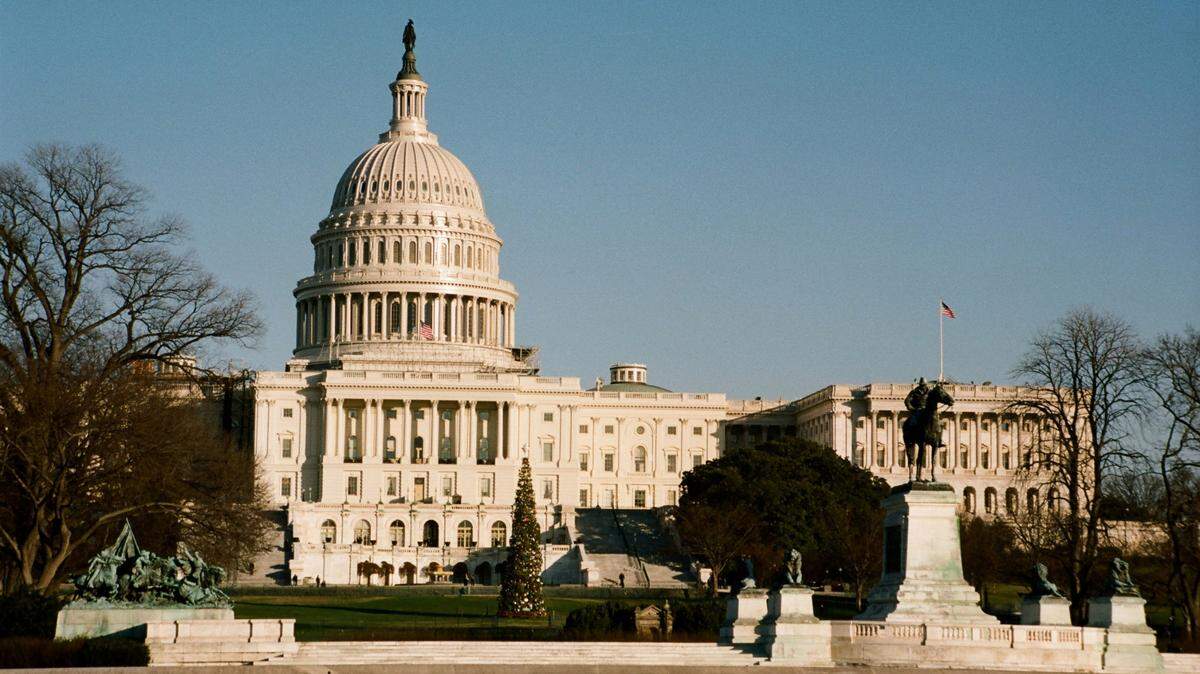
In an unprecedented move, President Donald Trump issued sweeping tariffs on goods from most of the world, sending stocks tumbling, throwing foreign leaders into retaliation mode and leaving some wondering whether Congress can step in.
During an April 2 White House address, Trump announced a 10% baseline tariff on all imports to the United States. He slapped even higher tariffs on dozens of trading partners, including a 20% levy on the European Union and a 34% levy on China.
“Our country and its taxpayers have been ripped off for more than 50 years, but it is not going to happen anymore,” the president said, claiming that his new tariffs will boost American manufacturing and reduce the national debt.
Trump justified his actions by stating the tariffs are reciprocal — meaning they are in response to tariffs imposed on the U.S. by other countries. However, the administration calculated rates based not on countries’ tariffs, but based on America’s trade deficit with them, resulting in arbitrarily high rates, according to the Tax Foundation, a nonpartisan nonprofit.
Now — after polls have shown most Americans disapprove of Trump’s tariff agenda and as fears of recession rise — some are asking: Can Congress do anything about it?
Lawmakers indeed have several options to remove Trump’s tariffs — but whether or not they will use the tools available is an open question, experts said.
Who has the power to tariff?
Article 1 of the U.S. Constitution grants Congress the power to institute and collect duties and taxes.
“But, through a number of actions, Congress has ceded much of that power to the President,” Christopher Cooper, professor of political science at Western Carolina University, told McClatchy News.
For example, the Reciprocal Trade Agreements Act of 1934 — passed during the Great Depression — authorized the president to negotiate trade agreements with the purpose of reducing tariffs and strengthening international trade.
But, most of the laws that delegate tariff authority to the president were passed during the 1970s, Sarah Binder, a professor of political science at George Washington University, told McClatchy News.
Of relevance is the International Emergency Economic Powers Act (IEEPA) of 1977, which allowed the president to regulate transactions after declaring a “national emergency.”
“The delegation regarding national security needs was broad, but motivated by beliefs about needs in case of a war,” Robert Gulotty, a political science professor at the University of Chicago, who has written a book on tariffs, told McClatchy News.
“They could not have imagined a president would use emergency authority to bypass Congress and impose tariffs on the entire world,” David Karol, a professor of government at the University of Maryland, told McClatchy News.
What Congress can do under existing law
If it wanted to, Congress could put an end to Trump’s tariff policy simply by using existing laws, though it would require large majorities in both houses, experts said.
This is because, in issuing his latest round of tariffs, Trump cited his authority under the IEEPA and the National Emergencies Act — enacted in 1976.
Both of these laws stipulate that Congress can pass a joint resolution ending a president’s declared national emergency, from which he derives the authority to unilaterally impose tariffs.
However, in order for it to pass, the resolution would need a veto-proof majority — namely, two-thirds of both the Senate and the House.
Due to this high hurdle, no joint resolution ending a national emergency has ever been enacted without the president’s approval, according to the Congressional Research Service.
The most recent attempt to terminate a national emergency came just days ago, when the Senate, with the help of four Republicans, voted 51-48 to revoke Trump’s authority to impose tariffs on Canada.
What Congress can do with new legislation
Congress could also pass new legislation to claw back its tariff powers, a method that is already being attempted.
On April 3, a bipartisan group of senators — including Iowa GOP Sen. Chuck Grassley — proposed a bill that would amend the Trade Act of 1974, which gave some tariff authority to the president. Specifically it would require Congress to approve of any new tariffs within 60 days, otherwise they would expire after this deadline.
“So rather than going through the process of trying to end an emergency, the bill provides a generic procedure for blocking tariffs directly,” Binder said.
However, given Trump would likely veto the legislation, Congress would again need two-thirds majorities in both chambers for it to pass, which at this point seems unlikely, Jonathan Hartley, a policy fellow at the Hoover Institution, told McClatchy News.
So far, a few Republicans — North Carolina Sen. Thom Tillis and Nebraska Rep. Don Bacon — have publicly signaled they would consider voting for Grassley’s bill, according to NBC News.
“I like congressional review … In trade, it’s a good example,” Tillis said. “I’ll support Grassley if it gets a vote.”
But, for it to stand a chance at passing, the bill would need far more Republican support — which is unlikely, experts said.
“The important question is whether a significant number of Congressional Republicans are willing to break with Trump on tariffs or anything else,” Karol said. “If they are, they have ways to address and reverse his actions. But given Republican voters’ loyalty to him, we haven’t seen GOP legislators willing to cross him in sufficient numbers.”
This story was originally published April 4, 2025 at 12:19 PM with the headline "Can Congress stop Trump’s tariffs? What to know after ‘Liberation Day’ levies."