
Should Statue of Liberty poem guide US immigration policy? What Americans said in poll
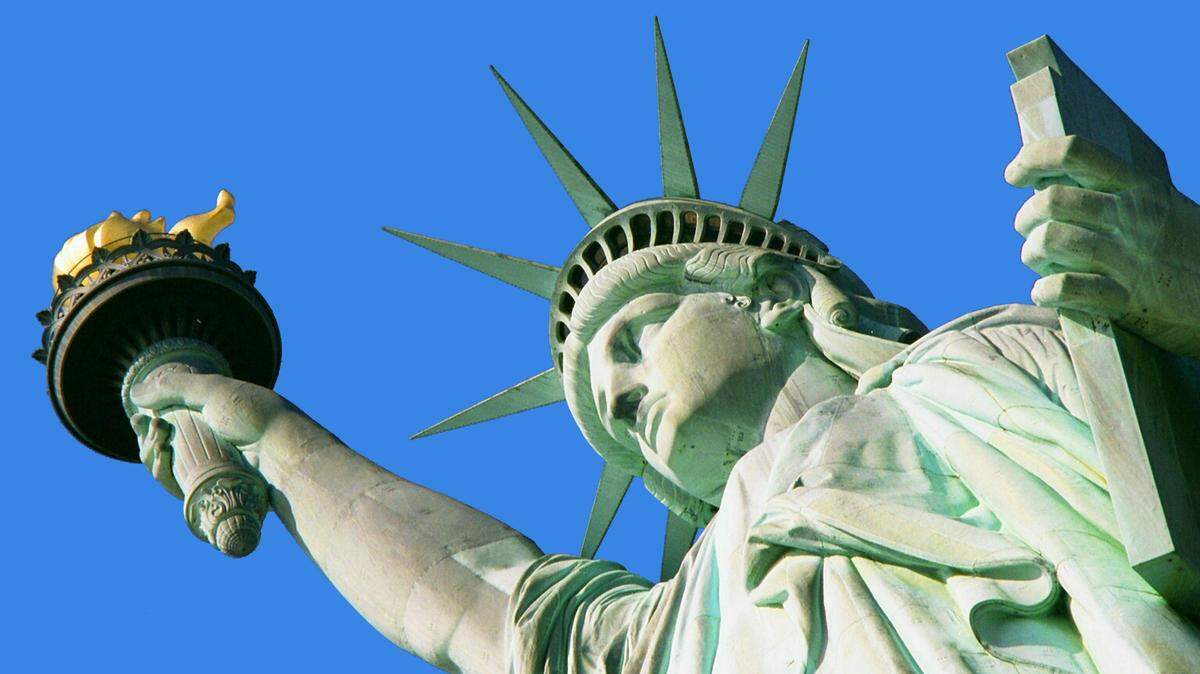
Attached to the Statue of Liberty is a bronze plaque inscribed with a poem familiar to many Americans. Written by Emma Lazarus in 1883 and hung inside the statue’s pedestal in 1903, it has long been looked to as a guiding ethos for a nation of immigrants.
It reads, in part, “Give me your tired, your poor, your huddled masses yearning to breathe free, the wretched refuse of your teeming shore.”
But, are these words more than just an ideal? Should they shape government policy? Americans are divided over the answer, according to a new poll, which comes as the towering sculpture finds itself in the global spotlight.
Should the statue’s poem guide U.S. policy?
In a March 17 YouGov poll, respondents were asked whether or not the poem should guide U.S. immigration policy.
A plurality of respondents, 49%, said it should shape government policy. Meanwhile, 23% said it should not, and 28% said they weren’t sure.
Responses varied significantly when broken down by partisan affiliation.
The vast majority of Democrats, 73%, said the poem — titled “The New Colossus” — should influence U.S. immigration policy, while just 9% said it should not.
In contrast, 31% of Republicans said it should guide government policy, while 40% said it should not factor in. Independents were somewhere in the middle, with 42% saying the poem should shape policy and 23% saying it should not.
The poll sampled 4,829 U.S. adults and has a margin of error of 1.8 percentage points.
The poem’s political significance has been subject to debate in recent years.
During President Donald Trump’s first term, Ken Cuccinelli, the acting director of U.S. Citizenship and Immigration Services, suggested a revised version.
In a 2019 interview with CNN, he said, “Give me your tired and your poor who can stand on their own two feet and who will not become a public charge.”
And in 2017, Stephen Miller, Trump’s senior policy advisor, minimized the significance of the poem.
“I don’t want to get off into a whole thing about history here, but the Statue of Liberty is a symbol of American liberty lighting the world,” Miller said during a White House press briefing, according to CNN. “The poem that you’re referring to was added later (and) is not actually part of the original Statue of Liberty.”
Should the U.S. return the Statue of Liberty?
The poll comes after a French politician called for the Statue of Liberty to be returned to France, which gifted the 305-foot sculpture to the U.S. in 1884.
“We’re going to say to the Americans who have chosen to side with the tyrants, to the Americans who fired researchers for demanding scientific freedom: ‘Give us back the Statue of Liberty,’” Raphaël Glucksmann, a left-leaning member of the European Parliament, said on March 16, according to Politico. His comments may have been in reference to Trump’s decision to pause aid to Ukraine.
A White House spokeswoman quickly fired back at Glucksmann, saying France should be “grateful” for America’s support during World Wars I and II.
Glucksmann responded on X, writing, “No one, of course, will come and steal the Statue of Liberty.” But, he added, “If the free world no longer interests your government, then we will take up the torch, here in Europe.”
When asked if the U.S. should indeed return the Statue of Liberty to France, a majority of respondents, 64%, said it should not. Just 14% said the copper-clad sculpture should be sent back, and 21% said they weren’t sure.
Here, again, there were slight differences in the responses when broken down by party affiliation.
More than three-quarters of Republicans, 76%, said it should not be returned, while 12% said it should be. In contrast, 57% of Democrats said the statue should not be sent back across the Atlantic, while 19% said it should be.
Sixty-one percent of independents said the statue should remain in the U.S., and 13% said it should be returned to France.
This story was originally published March 20, 2025 at 11:45 AM with the headline "Should Statue of Liberty poem guide US immigration policy? What Americans said in poll."