
America First to America far and wide: Historians on Trump’s ‘whiplash’ foreign policy
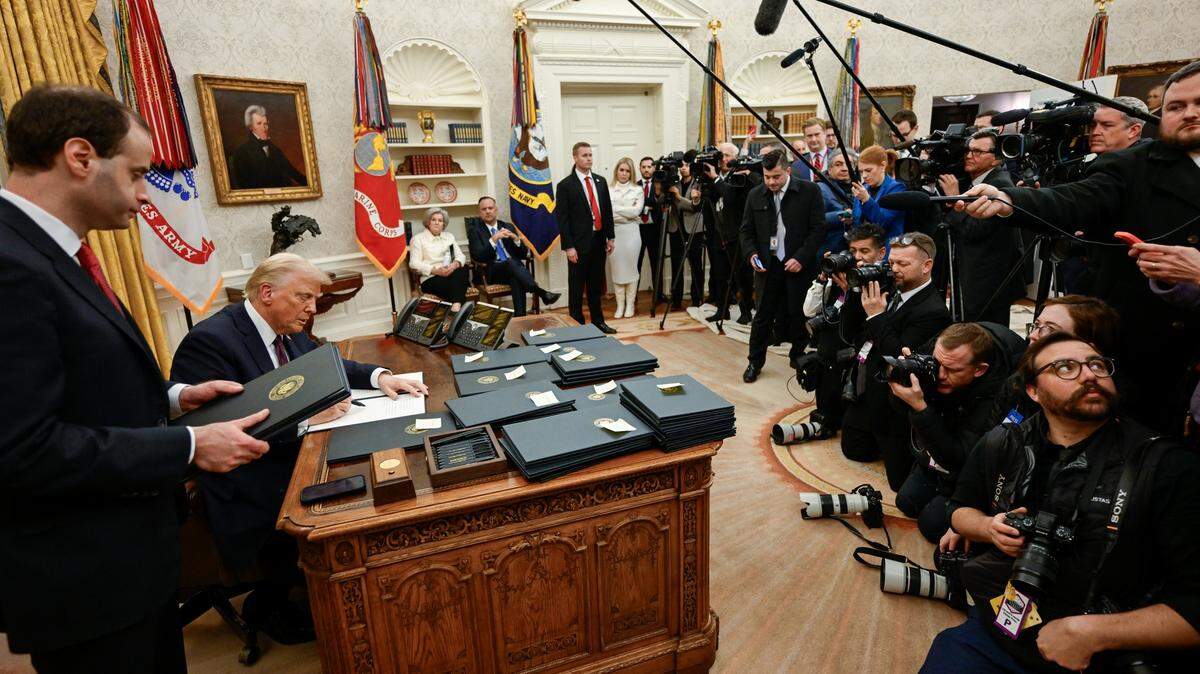
On the campaign trail, President Donald Trump’s guiding maxim on foreign policy was “America First.” But, now that he’s back in the White House, he’s adopted a dramatically different doctrine: America far and wide.
In just the first few weeks of his second term, Trump has expressed interest in large-scale territorial acquisitions, setting his sights on Canada, Greenland, the Panama Canal, and most recently, the Gaza Strip.
To realize these ambitions, he has said that a number of options are on the table, including economic leverage and — at least in some cases — military force.
This rhetorical shift has left even some of Trump’s allies in a state of perplexion, with Republican Sen. Rand Paul — in response to Trump’s comments on Gaza — writing on X, “I thought we voted for America First.”
How do these developments fit into the context of American history? Are they unprecedented? It’s complicated, according to historians.
Trump changing his tune after the election is hardly unique — as many of his predecessors have recast their foreign policies over time. Even so, his newfound taste for territorial expansionism is unparalleled in the modern era.
‘Whiplash foreign policy isn’t new’
“This kind of whiplash foreign policy isn’t new,” Taylor Stoermer, a historian at Johns Hopkins University, told McClatchy News. “Many presidents have changed course on foreign policy — sometimes dramatically.”
“There is often a situational shift between what a candidate promises and what a president does,” Daniel Immerwahr, a history professor at Northwestern University, told McClatchy News. “I think there’s a kind of adjusting to the realities of the audacious world ordering mission that the U.S. has ascribed to itself.”
One doesn’t need to look back too far into the past to find examples of presidents whose stance on international relations clashed with their campaign platforms — with non-interventionalism giving way to intervention.
“George W. Bush campaigned on a ‘humble foreign policy’ and then gave us Iraq,” Stoermer said. And in 1916, “Woodrow Wilson won re-election on ‘He Kept Us Out of War’ and then threw the U.S. into World War I.”
But the best comparison to Trump might be in a figure the president himself has taken to lionizing: William McKinley.
When he was first elected in 1896, McKinley was largely occupied with domestic affairs and expressed no interest in expansionism, Thomas Balcerski, a presidential historian at Eastern Connecticut State University, told McClatchy News.
But, within a few short years, following a series of unexpected events, he declared war on Spain and annexed two of its colonial outposts: Cuba and the Philippines, making him America’s “first modern imperialist president,” Balcerski said.
“When I next I realized that the Philippines had dropped into our laps, I confess I did not know what to do with them,” McKinley said in 1899. But after pacing the floors of the White House one evening, he made his decision: “The next morning I sent for the chief engineer of the War Department (our map-maker), and I told him to put the Philippines on the map of the United States…”
Unprecedented talk of expansionism
What sets Trump apart from all of his recent predecessors is not that his professed policies have shifted, but that they have shifted in favor of an expansionism associated with the 19th century.
“I think it is impossible to find an example of a post-1945 U.S. president exhibiting nakedly annexationist and expansionist ambitions in public,” Immerwahr said.
While 20th and 21st century presidents have embarked on numerous foreign wars — including in Korea, Vietnam, Iraq and Afghanistan — these were not fought with the intention to acquire land.
“Sometimes there was talk about oil fields we should control,” Immerwahr said. “But no one in the Bush administration was saying that the U.S. should permanently annex Iraq.”
Instead, these conflicts were entered into under the pretense of strengthening national security or spreading democracy.
“While the U.S. has expanded influence through economic pressure, military interventions, and proxy wars, outright land grabs haven’t been on the table in a long, long time,” Stoermer said. “What’s unusual isn’t just that Trump is floating these ideas — it’s that he’s doing so without even pretending there’s a greater cause behind them.”
“He’s doing things that I cannot imagine anyone in the situation room is recommending,” Immerwahr said.
However, some have questioned just how serious Trump is when he speaks about expanding America’s borders.
“Don’t mistake rhetoric for policy,” Michael Kazin, a history professor at Georgetown University, told McClatchy News.
“That talk about taking Greenland, the Canal, or Gaza is mainly a way to command the attention of the world,” he said, “and to be the unconventional performer who defied conventional political wisdom.”
This story was originally published February 7, 2025 at 8:26 AM with the headline "America First to America far and wide: Historians on Trump’s ‘whiplash’ foreign policy."