
Dead whale on California beach leads to stomach-churning find: Large clusters of lice
Much about whales is a mystery, but among the more bizarre facts we know is whales have a lice problem big enough to match their robust size.
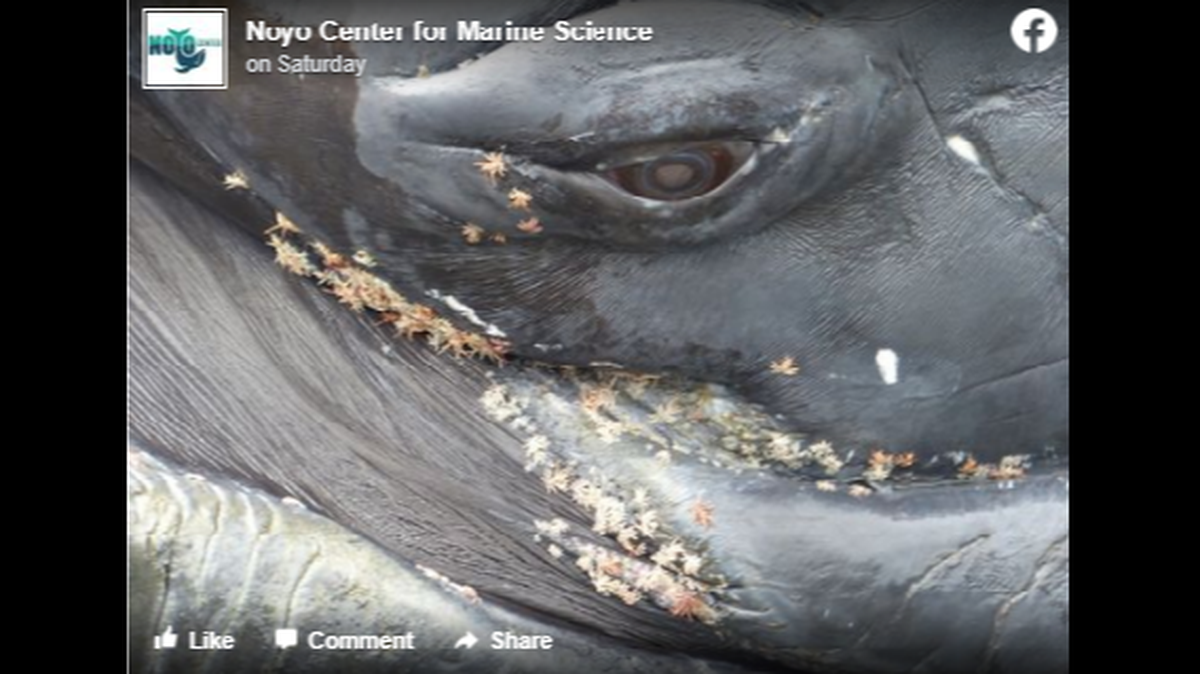
The phenomenon was illustrated when a dead humpback washed up on a California beach, and it was found to be covered in pink and red ”whale lice.”
Some “were still moving,” too, according to the Noyo Center for Marine Science.
“Imagine your skin’s constantly crawling with helpful, but horrifying crustaceans,” center officials wrote in an Oct. 1 Facebook post.
“This is how pretty much every whale lives its life. They’re covered with helpful hitchhikers called whale lice. They’re actually crustaceans that eat algae off the whale’s skin folds.”
The center shared multiple photos that showed the parasites resembled a cross between scorpions and ticks. They appeared in clusters — like a pink rash — inside “skin lesions, genital folds, nostrils, eyes & other external orifices.”
Once tucked in the right spot, whale lice feast “on host tissue or fluid secretions,” experts say.
“Whale lice spend their entire life cycle on the body of whales, being transferred from whale to whale by touch, but they never swim through the water or free float to their next host,” the center wrote.
There are 20 known whale lice species, but only one, Cyamus boopis, is attracted to humpbacks, experts say. The boopis has a taste for the humpback skin near “the blowhole, wounds, around barnacles and in the ventral grooves.”
Noyo Center researchers reported Sept. 12 that “a juvenile male humpback” washed ashore near downtown Fort Bragg, on California’s Mendocino Coast. Fort Bragg is about 190 miles northwest of Sacramento.
Investigators have yet to say what killed the whale, which measured at 26.5 feet.
The center studies stranded marine mammals “under authorization by the National Marine Fisheries Service through a Stranding Agreement with the California Academy of Sciences.”
This story was originally published October 10, 2022 at 1:41 PM with the headline "Dead whale on California beach leads to stomach-churning find: Large clusters of lice."