Dinosaur species more than 70 million years old discovered in New Mexico, museum says
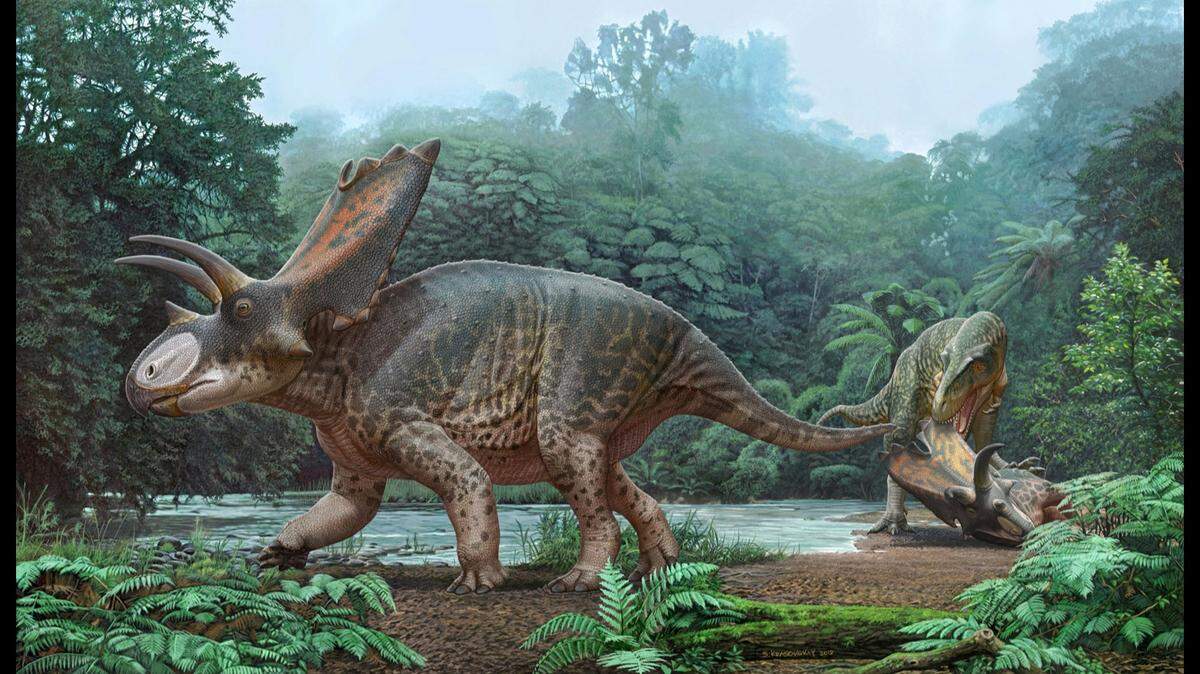
A team of paleontologists have identified a new species of horned dinosaur in New Mexico from more than 70 million years ago.
Given the name Bisticeratops froeseorum, it is considered a “new genus and species of horned dinosaur,” according to an Aug. 22 news release from the New Mexico Museum of Natural History & Science.
The species’ name is derived from the “Bisti/De-na-zin Wilderness area where the fossil was collected,” as well as after the Froese family of Tangerine Dream, one of researcher Sebastian Dalman’s favorite bands.
“Bisticeratops adds to the diversity of Late Cretaceous horned dinosaurs from New Mexico,” museum curator Spencer Lucas said in the news release.
The Bisticeratops, which had “an estimated body length of about 18 feet,” was part of the ceratopsian family, which also included the tricerpatros, according to the museum officials.
The horned dinosaur lived in what is now the southwestern United States about 7 to 8 million years before its better-known cousin the Triceratops, according to a news release from Harrisburg University.
“This plant-eating dinosaur lived in the jungles and swamps near the seacoast that submerged what is now northwestern New Mexico 74 million years ago,” the museum said.
The dinosaur specimen was first found in 1975 as a field team from the University of Arizona was working in the San Juan Basin in New Mexico and “came across a bone sticking out of the ground,” according to the university.
“Further digging revealed the nearly complete skull,” the university researchers said.
While the specimen was eventually transferred to the New Mexico Museum of Natural History & Science, “it took decades before the skull was completely cleaned and prepared and more in-depth research was conducted on it,” according to the university.
Researchers’ renewed efforts to look back at existing fossil specimen and recent discoveries “revealed it to be a distinct dinosaur,” the university said.
“While only the skull of Bisticeratops was recovered, this fossil gives us a lot of information about horned dinosaurs at a time and place that was unique,” Steven Jasinski with Harrisburg University said in the news release.
The Bisticeratops shows the evolution of these horned dinosaurs in the region, Jasinski added.
The new species identification “shows that the last few million years of ceratopsian evolution were more complex than previously known,” according to the museum.
Along with the Bisticeratops, other recently discovered dinosaurs from New Mexico include the Navajoceratops, Terminocavus and Sierraceratops, the museum said.
This story was originally published August 25, 2022 at 3:09 PM with the headline "Dinosaur species more than 70 million years old discovered in New Mexico, museum says."