Is your water safe to drink? Scientists create new device that’ll tell you in minutes
A team of biologists at Northwestern University in Illinois has created a device that could let users know if their water is safe to drink, a news release says.
Rosalind 2.0, a device that fits in your hand, could test your water and let you know, in minutes, whether it is contaminated.
How does it work?
The unique instrument is equipped with eight small test tubes that glow if they come in contact with a contaminant, according to a Feb. 17 news release. The “number of tubes that glow depends on how much contamination is present.” The more tubes start to glow, the more the water is contaminated.
The biologists “engineered cell-free molecules into an analog-to-digital converter,” a circuit type found in most electronic devices. The circuit processes an analog input — the contaminants — and generates a “visual signal to inform the user,” according to the release.
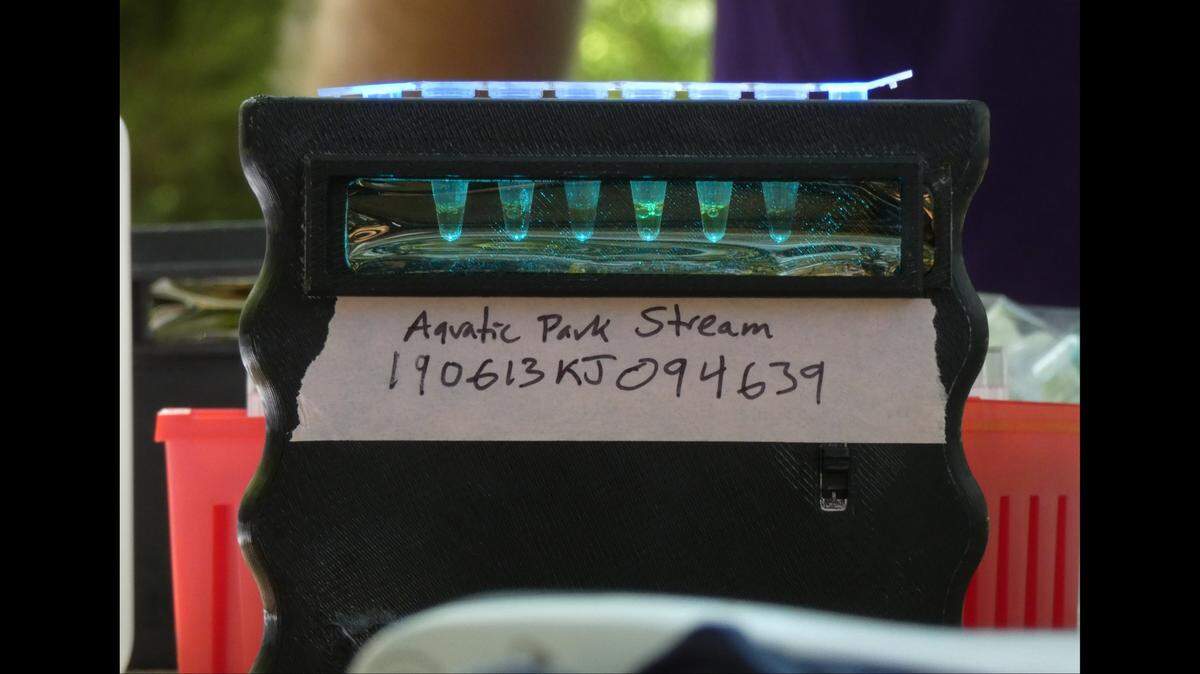
During their years of research, Julius B. Lucks, a professor of chemical and biological engineering at Northwestern, and his team were studying how biological organisms like microbes sense their environments, Lucks told McClatchy News.
Microbes can detect things in their environments, process information and make decisions about it, he explained. While humans can’t smell or taste contaminants in water, they discovered microbes could fill that gap.
“We don’t have taste buds that can taste this,” he said. “But microbes do. So we’re re-purposing them for our purposes.”
Lucks and his team used cell-free synthetic biology to take these “taste buds” and put them into test tubes, the release explains.
“We can then ‘re-wire’ them to produce a visual signal. It glows to let the user quickly and easily see if there’s a contaminant in the water,” Lucks said in the release.
Where did Rosalind 2.0 come from?
The new device is born out of a first version that Lucks and his co-researchers imagined in 2020, according to the release.
The earlier version was as straightforward as a pregnancy test: With a single drop of water, the platform could provide a positive or negative result, a July 2020 release says. The tests could detect “17 different contaminants, including toxic metals such as lead and copper, pharmaceuticals, cosmetics and cleaning products,” according to the release.
In the latest version, the researchers added a “molecular brain” to the device.
“The initial platform was a bio-sensor, which acted like a taste bud,” Lucks said in the release. “Now we have added a genetic network that works like a brain. The bio-sensor detects contamination, but then the output of the bio-sensor feeds into the genetic network, or circuit, which works like a brain to perform logic.”
Lucks told McClatchy News that his team has already done field trials of the device in Costa Rica and California. They are now currently doing their first trial with people outside of the research team in Kenya.
The company Stemloop, co-founded by Lucks, is now in the process of manufacturing the device so that it becomes accessible to anybody, anywhere, he said. It’s described as a “low-cost” and “easy-to-use” device.
According to the release, the study, “Programming cell-free biosensors with DNA strand displacement circuits,” was supported by the U.S. Department of Defense, the National Science Foundation, the Crown Family Center for Jewish and Israel Studies and the Searle Funds at The Chicago Community Trust. It was published Feb. 17 in the journal Nature Chemical Biology.
The paper’s co-authors include Jaeyoung Jung, Chloé Archuleta and Khalid Alam — all from Northwestern, the release states.
This story was originally published February 18, 2022 at 4:41 PM.