How big is the political divide over COVID-19? Even AI can sense it, study says
The coronavirus pandemic has become more than just a debilitating disease affecting millions, it has morphed into a political scramble that has often led to confusion about how to behave during unprecedented times.
Now, even artificial intelligence can tell what political party members of the U.S. Congress belong to based only on the text and date of their messages on Twitter.
The algorithm developed by researchers at The Ohio State University was able to correctly identify a member’s political affiliation 76% of the time, according to the study published Wednesday in the journal Science Advances.
The tweets revealed that Democrats discussed more frequently “threats to public health and American workers, while Republicans placed greater emphasis on China and businesses.”
“It is remarkable that we could identify partisanship even when members have only 280 characters to send their messages on Twitter,” study co-author Skyler Cranmer, the Carter Phillips and Sue Henry Professor of Political Science at Ohio State, said in a news release.
“The severity of this crisis is particularly sensitive to public opinion given that behavioral change at the individual level is integral to successfully slowing the spread of the virus,” the researchers said in the study. “Given the high levels of polarization in the American electorate, citizens are less likely to change their behavior in ways that correspond to the consensus of public health experts if there is not a political consensus that such changes are necessary.”
One example of such consensus, the researchers point out, is the terrorist attacks on Sept. 11, 2001, “when Republican and Democratic lawmakers issued joint statements reassuring Americans they were safe and promising rapid retaliation.”
For the current pandemic, there is a great divide. But it didn’t occur right away.
The algorithm, with resources from the Ohio Supercomputer Center, analyzed all 30,887 tweets that current members of the U.S. House and Senate wrote about COVID-19 from Jan. 17 to March 31, the study said.
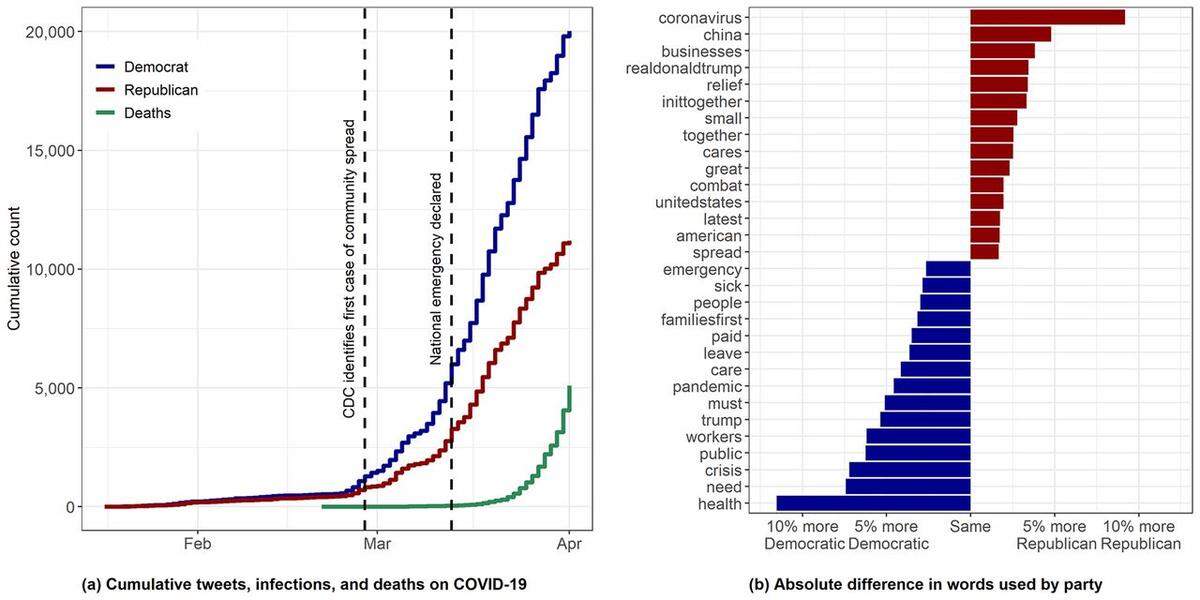
The AI was slow to accurately determine if a Democrat or Republican wrote a tweet during the first week, which “indicates there was little polarization,” but the algorithm started hitting the jackpot as soon as the first coronavirus case tied to community spread was confirmed in the U.S. in California, the researchers said.
The divide between members’ messages grew larger after President Donald Trump declared the pandemic a national emergency on March 13, which is around the time when “parties debated the various relief packages designed to mitigate the economic damage caused by” COVID-19, the study said.
Democrats sent “significantly” more coronavirus-related tweets than Republicans: 19,803 compared to 11,084, respectively.
“This suggests Democratic members were sending earlier and stronger signals to their constituents that they should be concerned about the crisis,” Cranmer said in the news release.
Democrats frequently tweeted out the words “health, leave” — in reference to aid for workers — and “testing,” while Republicans mostly sent words such as “together, United States, China and businesses,” emphasizing “a general need for national unity” and “(framing) the pandemic as a war,” according to the researchers.
For example, Democrats wrote the word “health” in 26% of their tweets, while Republicans mentioned it in 15% of their messages.
About 31% of members fell into a “partisan overlap” category, meaning the algorithm could not decipher which party they represented from their tweets alone, the release said.
“That means for 69% of members, their tweets are more partisan than the most similar member of the other party,” Jon Green, co-author of the study and doctoral student in political science at Ohio State, said in the release.
“In democratic countries, the public is highly responsive to cues sent by political elites whose messages can encourage unity or deepen social cleavages,” the researchers said in the study. “Because the public relies on these cues for reliable information, it is especially important that elites present a unified message during a crisis.”
This story was originally published June 26, 2020 at 11:45 AM with the headline "How big is the political divide over COVID-19? Even AI can sense it, study says."