Great white sharks are hunting for meals in unexpected places, stomach contents show
Chilling sights of shark fins slicing the water’s surface usually signal that the predator is hunting for its next meal, but new research suggests that might not tell the full story.
Found inside the bellies of great white sharks off the east Australian coast were significant amounts of bottom-dwelling organisms such as stargazers, stingrays and eels, meaning sharks feed closer to the seafloor than previously thought.
That’s according to a peer-reviewed study published Sunday in the journal Frontiers in Marine Science.
The finding can inform policies on which parts of the ocean to protect in order to save sharks from overfishing and accidental catchings, and how to best prevent human-shark conflicts.
“Within the sharks’ stomachs we found remains from a variety of fish species that typically live on the seafloor or buried in the sand. This indicates the sharks must spend a good portion of their time foraging just above the seabed,” lead author Richard Grainger, a Ph.D. candidate at the Charles Perkins Centre and School of Life and Environmental Sciences at the University of Sydney, said in a press release.
“The stereotype of a shark’s dorsal fin above the surface as it hunts is probably not a very accurate picture.”
Scientists often tag sharks to measure their movement and travel behaviors, but it’s difficult to follow them to great depths without disrupting their natural behavior, Gregory Skomal, a fisheries biologist with the Massachusetts Division of Marine Fisheries who was not involved in the study, told Live Science in 2016.
“We have plenty of data on white sharks that show that some of them go out to the middle of the Atlantic Ocean, wander around and dive down to depths as great as 3,000 feet every day,” said Skomal. “But we don’t have any clue what they’re actually doing there.”
So researchers from the University of Sydney, the New South Wales Department of Primary Industries and the Sydney Institute of Marine Science set out to find some answers.
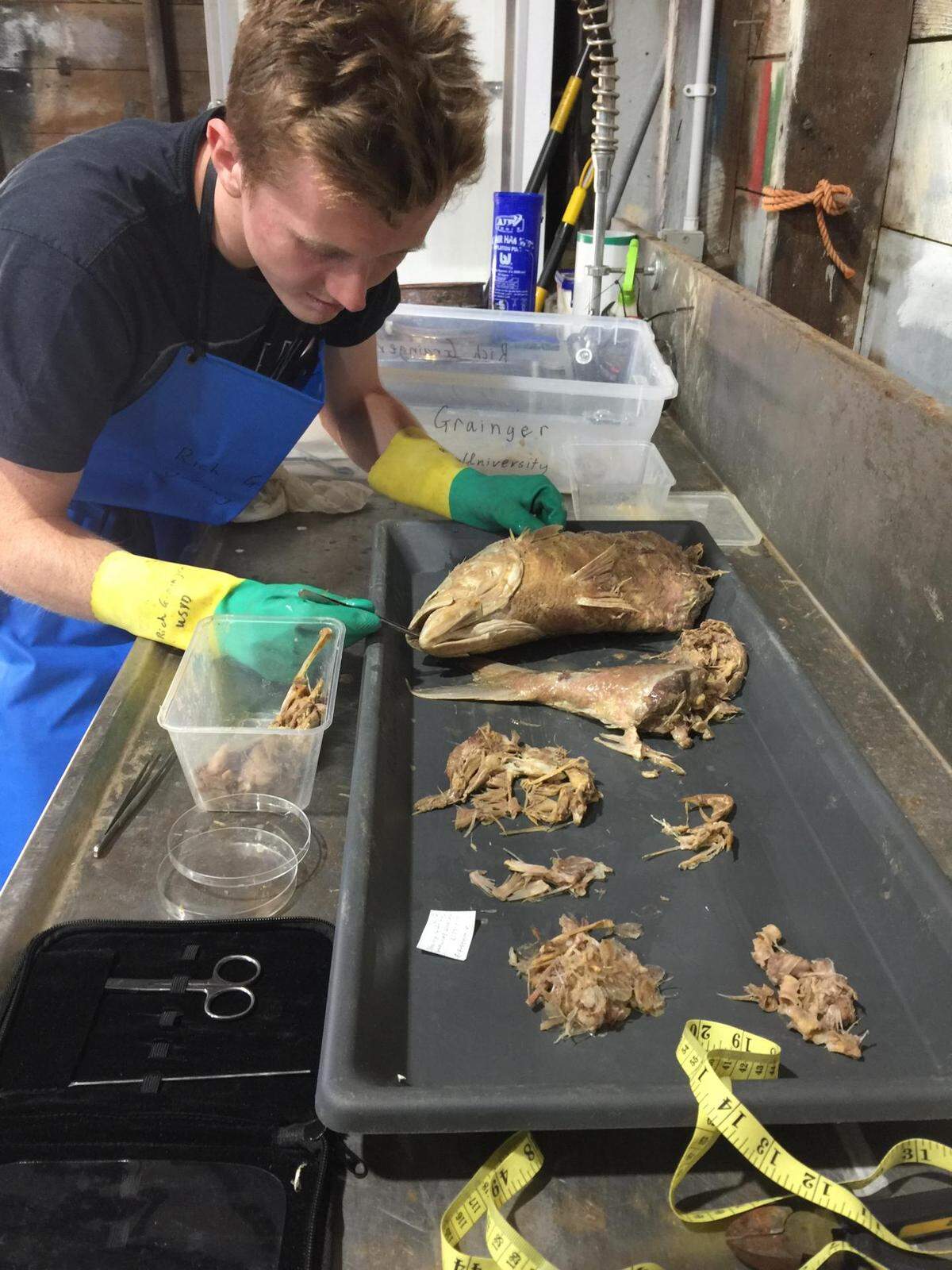
The team analyzed stomach contents of 40 deceased juvenile white sharks caught in the New South Wales Shark Meshing Program, and compared their findings with published global data on great white shark nutrition.
About 32% of the sharks’ preferred meals included mid-water swimming fish such as Australian salmon, while the remainder of the contents consisted of bottom-dwelling fish such as stargazers (17%), flat boneless fish such as stingrays (15%) and reef fish (5%).
“This evidence matches data we have from tagging white sharks that shows them spending a lot of time many meters below the surface,” Grainger said.
The rest of the meals consisted of “less abundant prey” such as marine mammals, other sharks and cephalopods such as cuttlefish and squid, which “were eaten less frequently,” according to Grainger.
But squid-hunting sharks are rare, experts say, and add to the mystery of sharks’ that is a shark’s behavior in the deep ocean blue.
Shark versus giant squid
Last week, the first scientific evidence of a shark interacting with a giant squid was published in the Journal of Fish Biology after photographer Deron Verbeck captured photos of a 7-foot whitetip shark with golf ball-sized suction marks on its skin.
Giant squid can live as deep as 2,000 feet in the cold, dark area of the ocean called the twilight zone, so the photographic evidence might reveal battle scars from an accidental bump-in, or the aftermath of a hungry shark going after the creature, study co-author Heather Bracken-Grissom, a biologist at Florida International University, told National Geographic.
“It is more likely this squid was being attacked by the shark and defending itself,” Bracken-Grissom said.
“This finding about oceanic whitetips is significant and goes along with what we are thinking about white sharks,” Shaili Johri, a postdoctoral research fellow at the Hopkins Marine Station of Stanford University in California, told the magazine.
Great whites are commonly found swimming in what Johri believes to be an empty part of the ocean she calls the “white shark café.” Now, one of her theories that the predators are hunting for giant squid down there seems more realistic.
Both studies highlight how connected marine food webs are, and how those webs can be used to protect many species of shark from hunting and entanglement in netting.
This story was originally published June 8, 2020 at 1:23 PM with the headline "Great white sharks are hunting for meals in unexpected places, stomach contents show."