Rock-breathing aliens? NASA researcher says we must think beyond anything we know
Any place where there is water on Earth, scientists say they have found life — even in the most inhospitable environments. A Rutgers University professor says in the search to find extraterrestrial life, the focus should be not on planets but rather on moons in our galaxy where there’s evidence of water.
But alien life could survive in ways you never imagined possible.
Nathan Yee is a NASA-funded researcher at Rutgers and is teaching a new class on astrobiology, the study of alien life, the university said.
“In science fiction, there is a lot of effort put into searching for signs of life like plants, animals and organisms that look like us. But there is a higher probability that alien life will be at the microscopic level. That fact is so much more interesting when you consider what the earliest lifeforms on Earth were capable of doing,” Yee said in a Rutgers press release.
“All things eat and breathe, and when you remove oxygen, like on ancient-Earth or Mars atmospheres, there are microbes that have figured out ways to breathe other things, like iron found inside of rocks,” he said.
Yee is a co-investigator at the NASA-funded ENIGMA project at Rutgers and a professor of geomicrobiology and geochemistry. The team at ENIGMA is trying to figure out how proteins, which the researchers describe as “sophisticated nanomachines,” evolved to create life on earth.
Yee has also been involved with NASA on panels and workshops about Mars and the Mars 2020 mission.
“They wanted someone with expertise about microbes interacting with minerals and the biosignatures that ancient Earth microbes left behind in rocks after they died and went extinct, which happens to be my area of expertise,” he said.
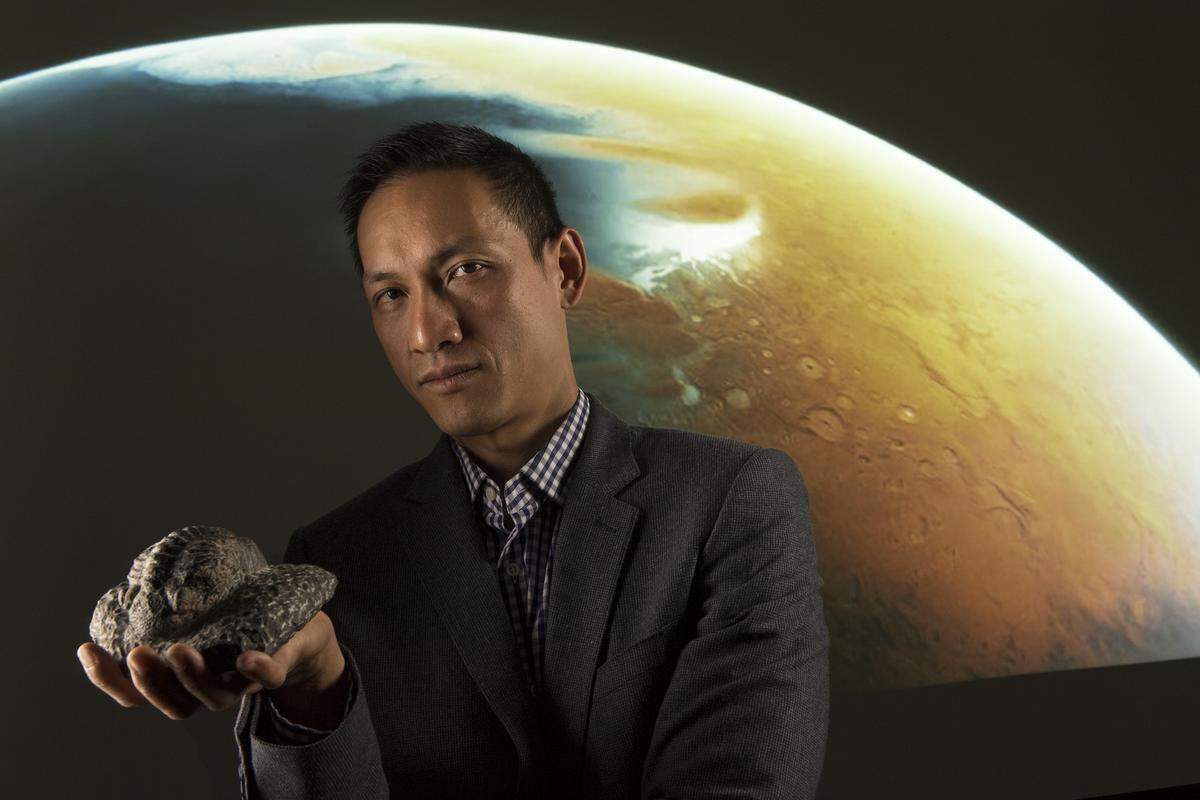
Yee’s astrobiology course started this semester at the university in New Jersey. It “covers the origins of life on Earth and what this has to do with life on other planets,” the university said.
“In time, I hope the course and minor grow into undergraduate and graduate programs of astrobiology because I predict astrobiology will become one of the most important fields of science in the future,” Yee said.
Yee said new missions to outer space and new telescope technology are making it easier to find the building blocks of life on other planets and moons.
“Everywhere there is liquid water on Earth, we’ve found microbial life. We are smart enough to know that if a world has oceans, then we should look there for alien microbes. Europa, which is one of Jupiter’s moons, has what appears to be global oceans under sheets of ice. Saturn’s moon Enceladus has geysers and hot springs spewing from its south pole,” Yee said.
“That points to the possibility of volcanoes and hydrothermal vents, which on Earth harbor ancient life forms and may have contributed to the origin of life here. Now, do I think there’s going to be a whale on these moons? Likely not, but it is possible that alien microbes have evolved and continue to live there,” he said.
This story was originally published October 28, 2019 at 12:42 PM with the headline "Rock-breathing aliens? NASA researcher says we must think beyond anything we know."