
Rare fossil of newborn ‘T Rex of the seas’ discovered in Kansas, researchers reveal
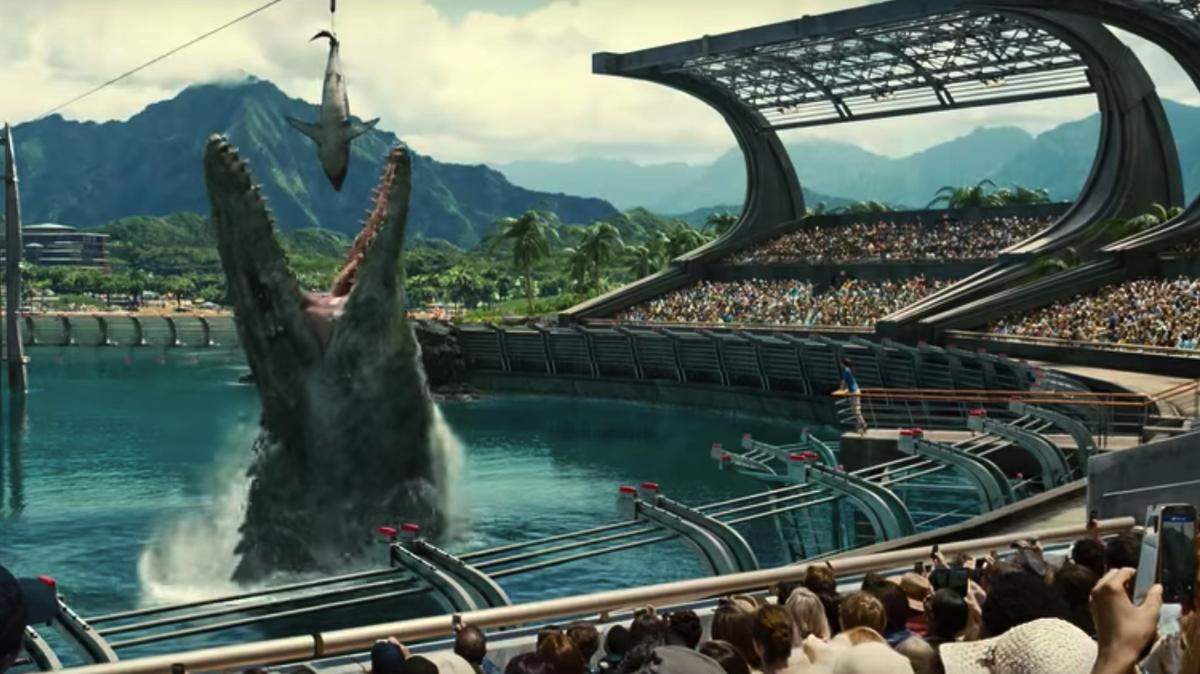
Fossils discovered in Kansas nearly 30 years ago are 85-million-year-old remnants of a newborn “T Rex of the seas,” researchers have revealed.
Fans of the movie “Jurassic World” will recognize the giant, whale-like mosasaur, the predator featured in the 2015 film.
In findings published online Thursday, researchers say that a new analysis of fossils discovered in 1991 concluded that “it’s the smallest Tylosaurus — a type of mosasaur, a fearsome marine reptile that lived during the dinosaur age — on record,” Live Science reported.
“Despite its short life, this newborn, which head to tail was as long as André the Giant was tall (well, it was tiny compared to its parents) is making waves today.”
Mosasaurs gave birth to live young and the tiny size of the fossils suggest this young one didn’t live long, according to Live Science.
“I’m thinking that this came out and somehow, miraculously, it got preserved and then discovered,” the study’s lead researcher, Takuya Konishi, an assistant professor-educator in the Department of Biological Sciences at the University of Cincinnati, told the science publication.
The findings were published by the Journal of Vertebrate Paleontology.
Mosasaur, which lived during the Cretaceous Period, had a body shaped like today’s orca whales, but some “grew bigger than orcas to nearly the size of a school bus,” writes Science Daily. “Like orcas, they were the apex predators of the seas. The only thing mosasaurs had to fear were bigger mosasaurs.”
The skull fragments Konishi studied were discovered by paleontologist Michael Everhart, according to Science Daily. They came from a well-known honey hole of marine fossils in western Kansas - the Smoky Hill Chalk Member.
Everhart is the author of “Oceans of Kansas, A Natural History of the Western Interior Sea” and creator of the Oceans of Kansas website.
The mosasaur has been in Kansas headlines in recent years as Kansas fossil hunter Alan Detrich and officials at the Natural History Museum and Biodiversity Institute at the University of Kansas championed the idea of making the mosasaur the state fossil.
They based their support on its “monstrous qualities and the abundance of fossils in the western part of the state,” the Lawrence Journal-World reported in 2013.
“When it comes to mosasaurs, Kansas certainly has the goods,” museum director Leonard Krishtalka told the Journal-World. “Other museums, from the United States and other countries, have collected mosasaurs from (Kansas).”
And then it happened.
In 2014, then-Governor Sam Brownback signed a law designating the mosasaur called Tylosaurus the Kansas marine fossil, and the winged Pteranodon as the Kansas flight fossil, according to KU’s news service.
“What dinosaurs are to Wyoming and Montana, mosasaurs and pterosaurs are to Kansas,” Krishtalka told the university’s news service. “For scientists and the public at large, Tylosaurus and Pteranodon represent Kansas science and paleontology worldwide better than any other fossil animal.”
According to KU, the most compete Tylosaurus have been found in the chalk beds left behind by the prehistoric ocean in western Kansas.
Konishi first studied the newborn’s fossils in 2004, and they were originally identified as a Platecarpus, a medium-sized mosasaur, according to Live Science.
The only pieces he and his colleagues had were broken bits of the reptile’s snout, upper jaw and braincase, according to the study abstract published online.
Since that first examination, Konishi “has become an expert on these seagoing lizards, including the largest of them called Tylosaurus,” wrote Science Daily. “This was the creature that inspired ‘Jurassic World,’ a meat-eating monster capable of hunting other mosasaurs and marine reptiles.”
The Platecarpus “had a short, rounded snout and could grow to almost 20 feet long,” a midget compared to the Tylosaurus, which “could grow up to 42 feet in length, or nearly as long as a semitrailer,” wrote Live Science.
“It didn’t hurt that Konishi had done his dissertation on the Platecarpus, so he knew the beasts’ anatomy inside and out.”
Finding any baby dinosaur, “or marine reptile in this case, is extremely rare for the simple reason that baby animals often end up as someone else’s dinner,” wrote Science Daily.
“But in this case, bones that weren’t chewed up reached the ocean floor where they were covered in sediment and remained for millions of years until the seas receded and the former ocean floor became the wheat fields and farmlands of today’s Kansas.”
This story was originally published October 16, 2018 at 3:36 PM.