
Red Planet Mars will soon approach its closest point to Earth
The Red Planet is more of a salmon color these days.
That’s because a global dust storm has enveloped Mars.
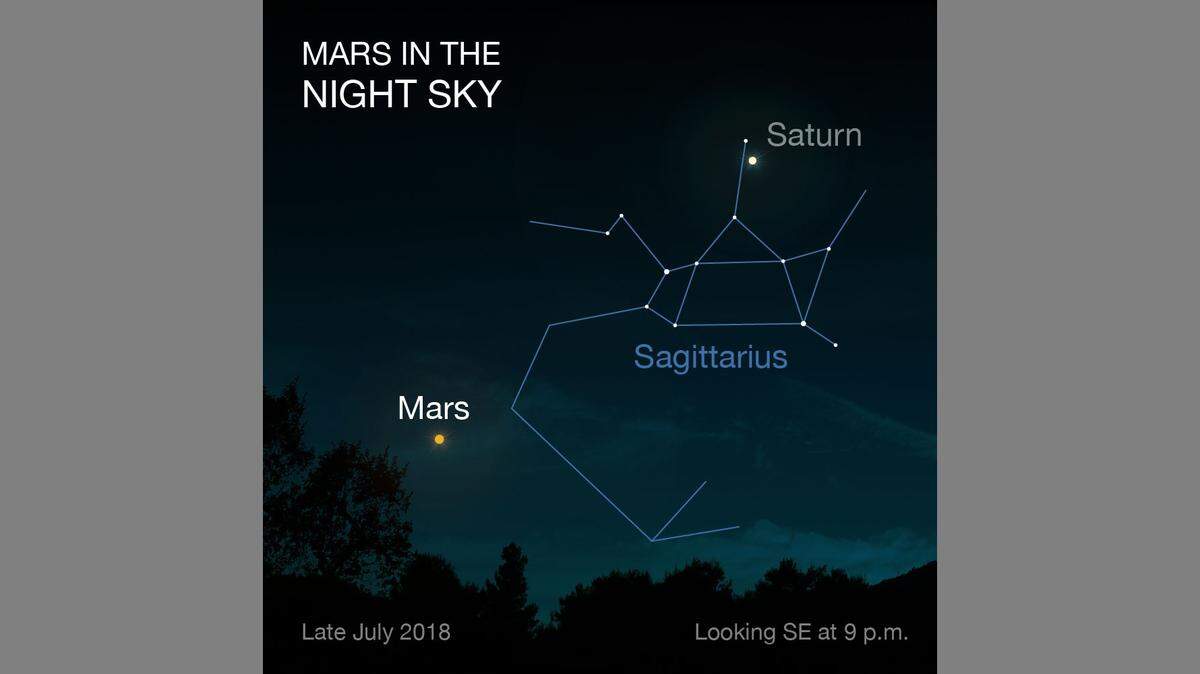
But our solar system neighbor still is brighter and larger in the night sky this summer as it approaches perigee — its closest proximity to Earth. On July 31 it will be just 35.8 million miles away, the nearest since 2003. The next closest approach won’t be until 2035.
You can look for it in the southeast sky after 10 p.m. Or you can visit the Astronomical Society of Kansas City’s Powell Observatory in Louisburg, Kan. The observatory will stay open later with extra telescopes on July 21 and 28 and on Aug. 4.
Mars will also be in opposition on July 27, meaning it and the sun be will on exact opposite sides of Earth.
The dust storm on Mars is a particularly strong one and has caused the rover Opportunity to put itself in sleep mode.
Roger Venable, coordinator of the Association of Lunar and Planetary Observers, tells Sky and Telescope it is “unique in the history of Martian dust storms.”
But commenter Anthony Barreiro posted: “I am less distressed at not being able to see the surface features than I am entranced that we are witnessing a global weather event from a distance of 0.41 AU (astronomical unit).”
As you look toward Mars, keep in mind that more space craft — extensions of human endeavor — are hurtling toward it.
The InSight and MarCO missions launched May 5 and are due to arrive Nov. 26. MarCO are two briefcase-sized instruments that NASA says are designed to “demonstrate the ability of small satellites to explore deep space....”
InSight will study the deep interior of Mars to learn more about how rocky planets were formed. NASA calls it “a Mars lander designed to give the Red Planet its first thorough checkup since it formed 4.5 billion years ago.”
This story was originally published July 12, 2018 at 1:28 PM.