
Bourbon flavored with beaver butt secretions? It's 'bottoms up' at this NH distillery
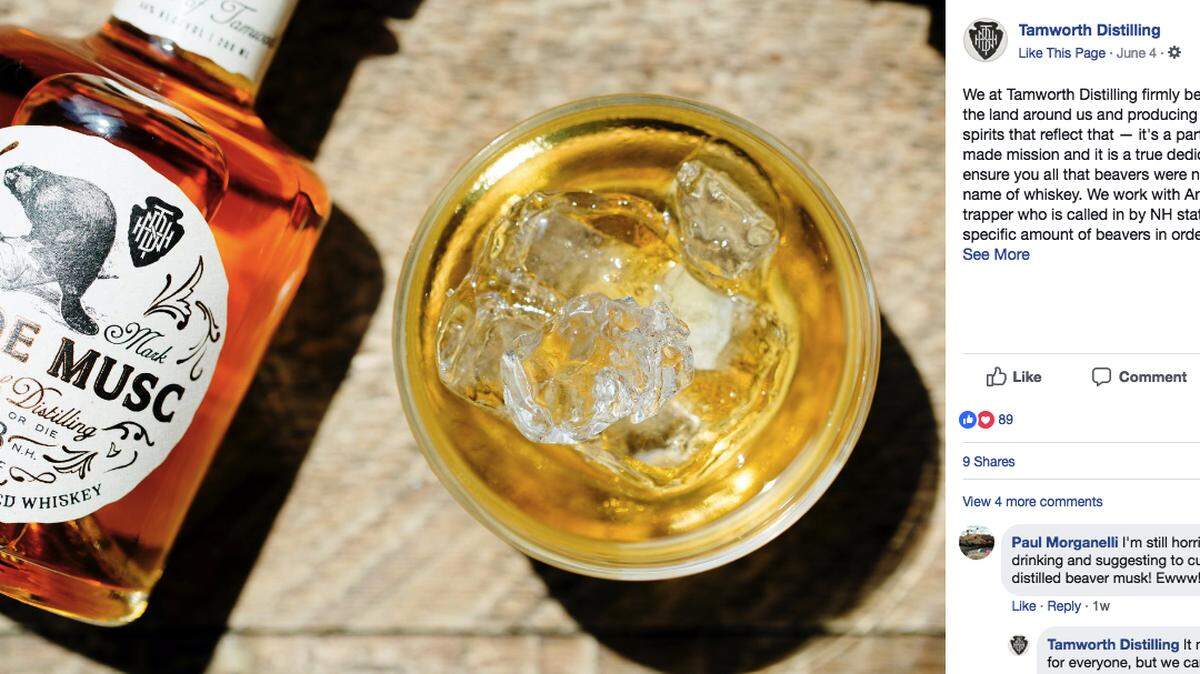
The newest limited-edition bourbon from Tamworth Distilling in New Hampshire has a special ingredient that apparently has a high "ick" factor.
Here's one man's comment on the distillery's Facebook page: "Ewww!"
The bourbon is flavored with secretions from New Hampshire beavers, which is no secret given that the label has a drawing of a beaver on a log proudly showing off its fat little bottom.
The whiskey is called Eau de Musc and it's made with castoreum, the scientific-sounding name for the stuff that beavers use to mark their territory.
According to The Union Leader in Manchester, N.H., the specialty distillery launched this "high-end, 88-proof bourbon" on Monday.
That's when Facebook interactions like this began.
Sammy: "So, this is made from beaver parts?"
Distillery: "Yes. We blend the bourbon with castoreum, which comes from the beaver's castor sacs. We add birch oil and wild ginger to balance the prominent vanilla notes in castor. The result is quite spectacular!"
“It’s aromatic, very distinct. It’s leathery, rich, slightly fruity in a non-traditional sense. With the whiskey, it really works in quite well,” Matt Power, one of the two distillers at Tamworth, told the Union Leader.
The distillery, also home of a spruce-tip gin and a tumeric cordial, is known for its unique twists, the newspaper reports. Power said the distillery is toying with goat milk and insects for future spirits.
"While it might sound rather unappetizing to drink alcohol with beaver secretions," writes Fortune, "it’s actually not so unorthodox.
"In fact, castoreum has found its way to perfumes, and some food products have included castoreum in their products."
Fortune points to the "deep dive" that the myth-busting website Snopes did on castoreum in 2013, which dispelled rumors that the substance is harmful to humans. Snopes determined that "alarmist warnings" about beaver-derived castoreum were overblown.
"Due to the beaver’s typical diet of leaves and bark, castoreum doesn’t 'stink' as other similar animal secretions do, but rather has a musky, vanilla scent described at the perfume site Fragrantica as a 'sharp spreading tar-like note that reminds one of the odor of birch tar or Russian leather' that when diluted in alcohol picks up 'more pleasant, musky and fruity nuances.'"
Whether consumers realize it or not, Snopes wrote, castoreum has long been used in perfumes, and processed forms have been used in foods including ice cream, ice tea, yogurt and fruit-flavored drinks, though it is rarely found in food today.
The distillery discovered castoreum on a list of ingredients deemed safe by the Food and Drug Administration, according to the company's website.
"The information on this old timey ‘natural flavoring’ sparked some intrigue and further discovery of the castoreum’s use as a spirit ingredient," the distillery website says.
According to The Drinks Business, the two-year bourbon is also flavored with raspberry, Canadian snakeroot, fir needles, birch bark and maple syrup. A bottle of Eau De Musc costs $65.
People on the distillery's Facebook page have expressed concern for the beavers, prompting the company to explain its source.
The castoreum, in dried form, came from local beaver trapper Anton Kaska, who according to the Concord Monitor "teaches trapping for the New Hampshire Fish and Game Department and is often hired to remove troublesome beavers."
"We want to ensure you all that beavers were not killed in the name of whiskey," the distillery writes on its website. "We work with Anton, a beaver trapper who is called in by NH state, to remove a specific amount of beavers in order to restore balance.
"We New Englanders find pride in re-using and recycling whenever the opportunity presents itself. This is no exception in the case of Eau de Musc and castoreum.
"Anton uses every part of the animal like any good trapper. The fur is sold, the meat is eaten, and some of the castor sacs are re-used as bait. We obtain the leftover castor sacs to aid in creating this unique product."
In the last three years, Kaska told the Union Leader, "the price of a beaver pelt has plummeted to $12 or less." He can get $72 for a pound of dried and frozen castoreum from two beavers.
“I’m sure you’ve had castoreum, you just didn’t know it," Kaska told the Union Leader. "When you eat something good and you see ‘natural flavors,’ a lot of time you can thank a trapper."
This story was originally published June 15, 2018 at 11:36 AM with the headline "Bourbon flavored with beaver butt secretions? It's 'bottoms up' at this NH distillery."