Shawnee Mission cracks down on cellphones in school, following Johnson County trend
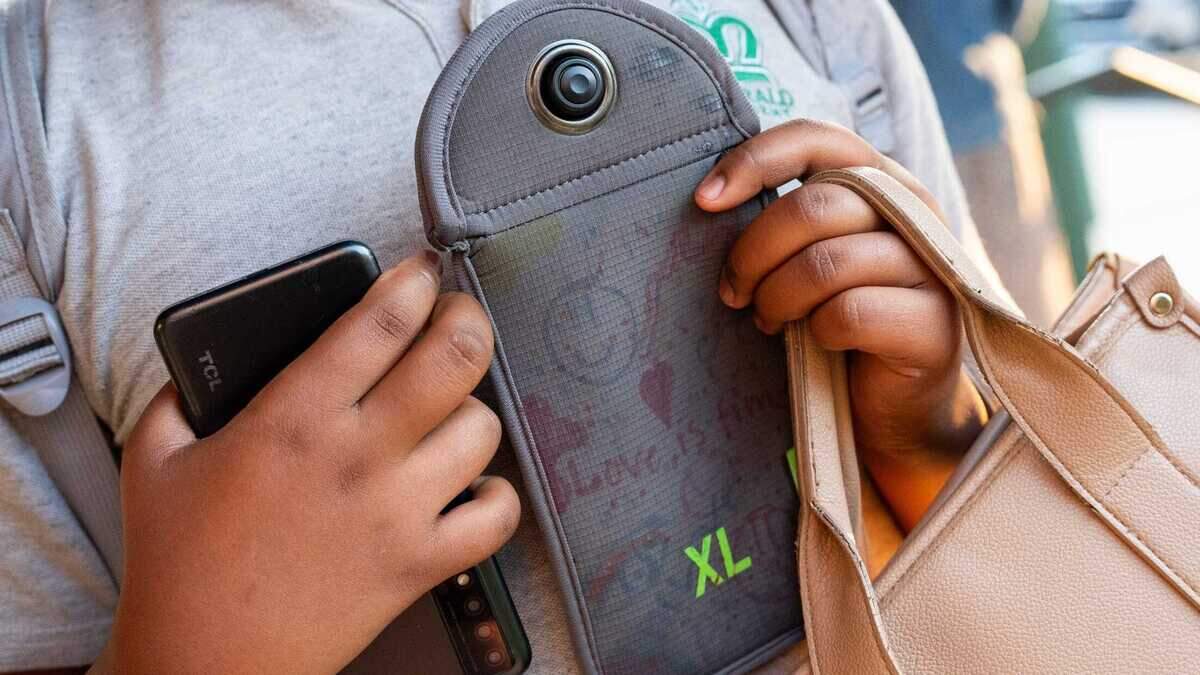
Shawnee Mission School District teachers and staff will have a new set of rules to enforce after the district’s school board voted 7-1 during its Jan. 13 meeting to approve a new cellphone policy.
The new rules vary by grade level but generally prohibit most headphone use and require students’ phones to stay in their lockers throughout most, if not all, of the day. Several other Johnson County districts approved similar rules in the fall.
School board member David Westbrook abstained from the vote, which counts as a ‘no’ vote for the Shawnee Mission school board.
“We have 35 or so hours a week that we’re with our students… It’s about 20 percent of the time in a week, we are with our kids in school. I just think sometimes we make these things more complicated than they really are,” Westbrook said during the meeting. “I’d like to think that we can set an expectation in our society for the 35 hours we have our kids, their primary purpose is to partner with us to help in their social, emotional and educational development.”
The board first heard the policy in December, but requested changes to the definitions of electronic devices and instructional time; adjusted the discipline matrix for students who violate the new rules; updated the student handbook to include the cellphone policy; and established a communication plan for staff and families in the district.
With board approval, schools will have a three-week grace period before full implementation by Feb. 3.
At the elementary level, all personal electronic devices will stay in students’ backpacks for the full duration of the school day. Middle schoolers can check their phones in their lockers, but the devices must remain in the locker throughout the day. Both elementary and middle school students can’t use headphones during the day except when they’re allowed for learning.
The district’s Technology Action Team had a difficult time coming to an agreement for the policy at the high school level — with five supporting no phones during school hours and six in favor of “solely protecting instructional time,” Superintendent Dr. Michael Schumacher told the school board.
“There’s just not consistency across our community, it’s not surprising that our team was unable to come to an agreement for high schools,” he said. “An approach for a kindergartner should not be the same as a senior. … We should approach our policy with that consideration.”
The board decided that high schoolers could use their phones and headphones during passing times and lunch, but they’d need to be stowed away during class time. While there will be growing pains trying to enforce a new policy halfway through the school year, Schumacher said this policy will ultimately support teachers and staff.
“Our teachers have been asking for a policy for a while. This will give us the teeth to enforce this,” he said.
Students who break the rules for the first time will have an “informal talk” with their teacher, according to Schumacher’s report to the board. The second time will result in a formal conference between the student, teacher and other personnel and an assigned action plan for the student.
If a student breaks the rules multiple times, they will speak with a school administrator, and parents will be contacted. Administrators can give the student detention or they can create another action plan. Continued offenses will ultimately result Cin a one- to five-day suspension.
Shawnee Mission is the last of five school districts in Johnson County to adopt a cellphone policy. Blue Valley, Olathe, and Gardner-Edgerton established their policies earlier this school year. De Soto and Spring Hill schools established theirs in 2022, and made some amendments this school year.
Each district approaches device use differently, with Blue Valley and Olathe following an age-based approach, similar to what the Shawnee Mission school board ultimately decided to follow.
Shawnee Mission East High School Principal Jason Peres told the school board that cellphone use currently depends on the classroom, and it’s up to the teacher to enforce their own rules.
“At a high school level, we would have to be clear and precise with our implementation plan, communicate that with our students, staff members, and families, help coach our students where it would be a change midyear,” Peres said. “A second set of expectations.”
Trail Ridge Middle School Principal Matt Engler told the board that his school has already been practicing similar rules to those the board approved after transitioning to a more restrictive policy in August, and that they’ve been working well so far.
“We were really nervous going into August with these tougher shifts, but what I was blown away by was how our students responded to it,” Engler said. “Also, personally I think it’s going to be freeing for them to be able to get to their classrooms and to focus on what’s happening there without the constant buzz or whatever notification might be coming across that device.”
Shawnee Mission parent Kim Whitman said that she didn’t think this policy went far enough.
“I was hoping for a true bell-to-bell policy where phones are inaccessible throughout the school day, so I was disappointed in the outcome for both middle and high school,” Whitman told The Star after the Jan. 13 meeting.
Whitman served on the school district’s action team and is co-founder of the Phone-Free Schools Movement — an organization that advocates for cellphone restrictions that stand throughout the school day. She’s also the parent of two high school students enrolled at Shawnee Mission South.
“By making procedure into a policy, I don’t see the outcome changing. I hope it does, I hope I’m wrong, I hope it’s successful,” she said.
Despite the disagreement between community members who say the policy “doesn’t go far enough” or “it goes too far,” school board member Jessica Hembree supported the policy change.
“I’ve heard so much from teachers who want help and guidance from this board. They’ve had to make it up as they go and it’s up to us as a standard, I think that’s our job,” Hembree said. “We can’t dump this on our teachers and hope for the best; we’ve done that [for] too long.”
This story was originally published January 15, 2025 at 11:12 AM.