Johnson County chose conservatives for school boards. Here’s how districts may change
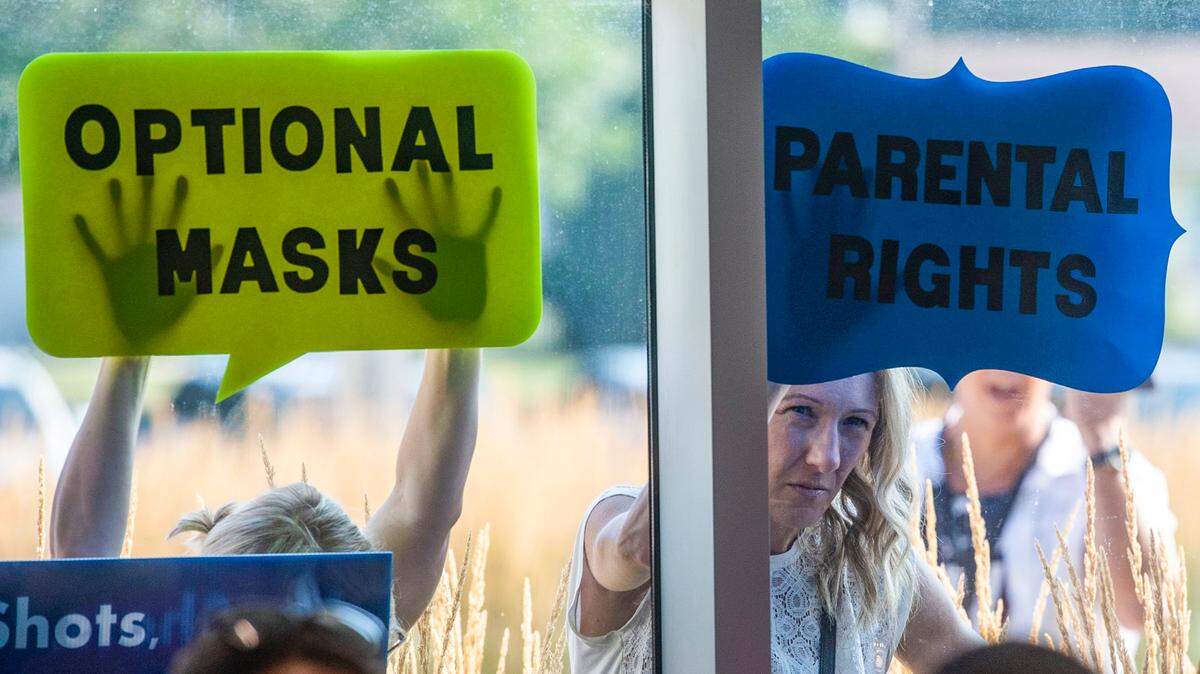
Conservative candidates didn’t win all of their races for Johnson County school boards this month. But they may have gained enough seats to have greater influence over key decisions like COVID-19 policies and how race and diversity are taught in schools.
In both Blue Valley and Olathe, two out of the three conservative newcomers running in each district won the Nov. 2 election, bolstered by support from energized parents, frustrated over mask mandates and the idea of critical race theory. Conservatives won’t necessarily hold a clear majority on either board, and some of the races were too close to call until the end, but some said voters still sent a clear message.
“It shows that parents are out there, and they do pay attention now,” said Robert Kuhn, who defeated incumbent Kristin Schultz in Olathe. “Parents have opened their eyes throughout Johnson County, that there are people who don’t have their best interests in mind, and then there are people who ran who do have their best interests in mind.”
Across the country, schools this election season have been a cultural battleground. Perhaps most notably, Republican Glenn Youngkin won the Virginia governor’s race after vowing to ban “critical race theory,” rebuking COVID-19 school closures and promising to give aggrieved parents more control. Johnson County, like other suburbs that have been shifting more blue in partisan elections, has in recent months been home to some of the loudest debates over COVID policies and diversity initiatives.
When new board members take office, it’s likely those arguments will move out from behind protest signs to more prominent positions behind the dais.
Emboldened parents and candidates already have made waves, protesting masks and the cancellation of sports during the pandemic. Parents in Olathe successfully pushed the district to retract a worksheet given to some high school students that asked questions about gender identity, which officials said was not part of the curriculum. And parents have argued that the content of some library books discussing the LGBTQ community is too graphic, so officials in some Kansas City area districts pulled the books from shelves. Students have protested the move as censorship.
Across the country, some are wondering whether the results of school elections will have a chilling effect on teachers and staff as they grapple with how to honestly teach difficult subjects on history, race and discrimination without being stifled and criticized for being divisive.
Johnson County school districts, which are seeing more diverse student populations, are at a critical time in their diversity and equity work. In recent years, they have hired diversity coordinators, formed work groups, implemented more staff training and taken other steps to try to ensure all students and staff feel welcome and safe at school.
Many educators have said recent incidents of racism and LGBTQ hate across the Kansas City metro have shown that those efforts need to be accelerated, not stymied.
“There is a lot of misinformation surrounding what is actually happening in classrooms versus the impression of what is happening,” said Julie Steele, a Democrat who eked out a victory from a conservative challenger in Olathe.
In Johnson County, 25% of registered voters cast ballots, a record for an off-year local election. The school board results were a mixed bag.
In Shawnee Mission, more progressive candidates, including two incumbents, decidedly won their seats.
Elsewhere, some races were nail-biters, with candidates leading by fewer than 100 votes.
In Blue Valley, conservative Jim McMullen defeated Lindsay Weiss, a moderate Republican, by 51 votes, according to the official results following Tuesday’s canvass.
In Olathe, as more mail-in ballots were counted, one race flipped. Conservative Jennifer Gilmore was in the lead on election night, but Steele ended up winning by 65 votes after all of the ballots were tallied.
Gilmore did not call for a recount by the deadline on Wednesday, but she said, “I believe we should have confidence in the integrity of our votes as they are all important and I will seek to make sure we have voter confidence in Johnson County within the time frame allowed following my election.”
Steele contended, “I trust this democratic process very much, and the election commissioner has a staff that is following procedures with great integrity. Being the certified winner, I am moving on and looking forward to the opportunity to serve. … I’m ready for the role and responsibility, and I’m ready to start.”
With official results certified, in Shawnee Mission, incumbents Heather Ousley and Mary Sinclair, plus newcomer April Boyd-Noronha, have won seats on the board.
In Blue Valley, McMullen won, along with conservative newcomer Kaety Bowers, plus Democrat Gina Knapp, who defeated Christine White, a pediatrician who dropped out of the race after receiving backlash over her opposition to mask mandates.
In Olathe, conservatives Kuhn and Brian Connell defeated incumbents to win seats on the board, joining Steele.
The push for “parent choice”
Kuhn sees the conservative victories as a call from parents.
“I think the message from the voters obviously is COVID opened our eyes up as parents to issues that we didn’t know were out there,” Kuhn said. “We were all helping teach our children from home, and when we realized there were these issues, we stepped up to get in there and change things.”
The winning conservatives all fought for “parent choice” on COVID masks.
“A lot of candidates who have run off the idea of not masking won,” Kevin Riemann, executive director of the Kansas National Education Association, said during last week’s virtual meeting of the state’s Safer Classrooms Workgroup. “I think we’re going to see some of those masking mandates change and we have to be able to track that.”
With COVID-19 cases dropping in Johnson County, both the Olathe and Blue Valley school boards agreed to drop their mask mandates in high schools. But they continue to require them for younger students, following a county health order.
As younger children line up for the vaccine, the new school board members will have a say on other important decisions as districts continue to manage and recover from the pandemic.
The candidates also represented parents who have fought to have a greater say in school curriculum and what their children are learning in class, including about race and identity.
They were all endorsed by the 1776 Project PAC, a New York-based political action committee, aimed at abolishing critical race theory — which is not taught in Kansas K-12 schools.
Educators across the country await the ripple effects of election results on diversity, equity and inclusion, or DEI, initiatives.
Ballotpedia, a website that tracks U.S. politics, found 96 school districts where COVID-19 policies, such as mask mandates, and social issues, such as how race is taught in classrooms and the rights of transgender students, were campaign issues. It found that out of 284 elected school board members across the country, about 28% ran against critical race theory, while the majority of winners, 53%, did not.
While some of the candidates acknowledged that critical race theory, or CRT, is not taught in their districts, they worry that the concept has seeped into diversity initiatives, although administrators say there is no proof of that.
Progressives have argued that the messaging on critical race theory focuses discussions on the white perspective, rather than emphasizing the need for curriculum to include the voices and experiences of people of color and others who have long been underrepresented or erased from American history lessons.
Blue Valley officials said in a statement that CRT “is distinctly different from the guiding tenets of educational equity with which it is regularly confused.”
The Kansas Board of Education in July issued a statement calling CRT an “advanced and complex concept” that is often misunderstood and not a part of the state’s education standards. Scholars who study it say it is not a specific curriculum or ideology but a legal framework for examining how institutional racism and inequality impact criminal justice, law, health care, housing and other institutions.
CRT has now become a catch-all term for schools’ teachings on race, diversity and equity and the target of parents and conservative politicians who say the concept itself perpetuates racism and division.
In Blue Valley, Bowers previously argued that “some tenets of critical race theory are creeping into our schools hidden within (diversity, equity and inclusion work).”
“Please let racism die the death it deserves. Racism has no place in our schools, our lives, our businesses or anywhere else,” she told The Star. “People want to insist that CRT is not being taught in our schools with an inference that it’s terrible but also that if you oppose it that you are racist. In the same breath, it’s also regarded as a great option. Why the circular argument? CRT is here, dressed in different forms.
“CRT does not belong in our schools. CRT is a movement that is divisive by skin color. It is anti-American at its core. This programming is so far from where we have come as a country that it echoes back to the days of segregation.”
Some of the candidates have said they are not against diversity or inclusion in schools, but question the professional development training and other equity programs used, and whether they stoke division.
Connell argued the Olathe district has not been transparent enough with its diversity initiatives.
“I believe in uplifting and encouraging every person to be fully aware of and truly be valued for the person God created. I do not want anyone to tell or make anyone feel lesser for skin color or any other reason,” he previously told The Star. “DEI at the base premise is not terrible. The devil is in the details and execution. And so far the district has not chosen to be 100% transparent with its intentions, actions and plans.”
McMullen said that from his own experience raising children in the Blue Valley district, he has been “generally pleased with the curriculum,” although he believes history lessons could have more depth, especially on the founding of the United States, the Civil War, the Holocaust and other genocides around the world.
“The concern of parents in this community and others is that history will be turned into ‘historical narrative,’ which is a distortion of the facts and analysis of those facts and deviates into storytelling to advance a political agenda,” he previously told The Star. “I don’t see it much here in our schools, but people are on guard because it absolutely exists around the country.”
McMullen and Bowers both have questioned the promotion of “equity” in schools, and have instead argued for “equality” to be the goal — an argument that has been met with pushback from election opponents and others in the community, who say the concept of equity has been misrepresented.
Shawnee Mission school board president Ousley, who defeated a conservative challenger, contended that debates around critical race theory and the term itself have “been weaponized to attack all diversity, equity and inclusion efforts, in an attempt to stop or discredit efforts to ensure equitable access for all students.”
“There are anti-public education lobbyists who have for years created wedge issues with which to encourage families to leave public school and demand vouchers for private schools, in order to profit off of public education dollars,” she said. “These same privatizers have misused CRT to increase outrage with public education, to promote their own agenda of dismantling public school.”
Steele is adamant about the importance of teaching diversity.
“We are under-selling the future of our nation greatly if we are afraid to teach historical facts to our students,” she said. “The whole point of educating them is just to give these bright, great minds with facts they can take upon themselves and develop their own thought process on where they want to see the future of our country. It does not mean we are indoctrinating our children or teaching revisionist history. When we stick to the facts, they’ll learn what we don’t want to repeat in history, and that’s important.”
She said that while winners in the school board races represented starkly different views, she remains optimistic they will be able to work together.
“I truly believe there are no limits to what our community can do when we come together for the sake of our children.”
The Star’s Katie Bernard contributed to this report.
BEHIND THE STORY
MOREThe Bigger Picture: Critical Race Theory
Until recently, critical race theory was a body of advanced study discussed primarily in law schools beginning in the 1970s.
Developed by a group of Black legal scholars led by Harvard’s Derrick Bell and Kimberle Crenshaw, critical race theory is a response to what they perceived as the failure of the 1960s civil rights movement to bring about the kind of structural change it promised. CRT examines how racism and white supremacy remain embedded in essential institutions such as education, criminal justice, real estate and finance.
Nothing approaching the complexity of critical race theory is taught in most public elementary or secondary schools. Over the last couple of years, however, a network of conservative think tanks, activists and wealthy donors have seized on CRT and depicted it as an attempt by liberal educators to indoctrinate schoolchildren in an ideology of hatred for the U.S.
CRT has evolved into an umbrella term to denounce any attempt by schools to introduce more context to the uglier chapters of American history, such as slavery, Jim Crow and the treatment of Indigenous people. This distortion has spawned dozens of bills in state legislatures to eliminate an essentially nonexistent threat.
This story was originally published November 11, 2021 at 3:08 PM.