Thousands demand that Shawnee Mission North drop its ‘degrading’ mascot: The Indians
Hunter Hawkins thought he was doing the right thing when he applied to be the Shawnee Mission North Indians mascot his senior year. But years later, he said it remains one of the biggest regrets of his life.
“I saw all the types of people who were applying to be the mascot, and I knew I didn’t want them wearing it and doing the tomahawk chop or making racist noises while wearing it. So I applied, knowing that I wouldn’t do those things, thinking that I could give it the respect it required,” said Hawkins, who wore Native American-inspired regalia and a feather headdress as the mascot costume in 2013.
“But what I’ve come to discover over my years of research and conversation is that there is no respect to begin with in the practice of degrading a whole race of people by boiling their culture and history down to a bare caricature.”
He is now among thousands of former and current students and Johnson County residents petitioning for the Shawnee Mission school district to change the mascot. It’s not the first time there has been a push to change it, and many argue the move is long overdue.
“I felt a huge sense of pride for being a quote-unquote SMN Indian. And now 10 years later, I am fully aware that I was complicit in the oppression and mockery of Native Americans and their culture,” 2010 graduate Melissa Arroyo said at a school board meeting this month.
This recent effort began over the summer, when more than 3,300 people signed a Change.org petition urging the district to change the mascot by the school’s 100th anniversary in 2022. And there have been protests ever since, including several marches near the high school, on Johnson Drive in Overland Park.
Progress has stalled during the pandemic. But earlier this month, district officials said during the board meeting that a committee will take some first steps to review how other districts have implemented mascot policies. The district’s policy committee meets on Thursday.
School board president Heather Ousley said it goes beyond just Shawnee Mission North. Other district schools have names or mascots based on Native American culture, such as Belinder Elementary in Prairie Village, whose moniker is the Belinder Braves. Like North, it uses the face of a Native American wearing feathers on its school website.
“I have reflected a lot back on our own nondiscrimination (policy) language, and a part of me feels like some of the mascots we have is already a violation of our own policy,” school board member Jessica Hembree said during the meeting. “I think there’s a case to be made that we’re already in violation of some of our own policies.”
Glenna Wallace, chief of the Eastern Shawnee Tribe of Oklahoma, also said that the imagery the Shawnee Mission district uses when depicting Native Americans does not accurately reflect the cultures of the Shawnee Tribe, for which many institutions in Johnson County are named.
“It is simply inaccurate history,” she told The Star. “What was intended as an honor is no longer considered to be an honor. And I think it’s time they recognize that.”
‘It’s an epidemic’
Changing any mascot would be costly, requiring new signs, uniforms and branding. But it’s a decision being made across the country, by organizations big and small, as the nation comes to terms with how it has glamorized its dark history of colonization and mistreatment of Indigenous people.
In major league baseball, the Cleveland Indians stopped using their wide-eyed, grinning Chief Wahoo logo last year. In the National Football League, Washington’s team in June dropped its “Redskins” moniker. That left the Kansas City Chiefs as the only NFL team whose name evokes Native American imagery. The Chiefs this year prohibited fans inside Arrowhead Stadium from wearing headdresses or painting their faces to depict Native American cultures. Yet Native Americans have shared mixed views on whether the Chiefs’ name should stay or go.
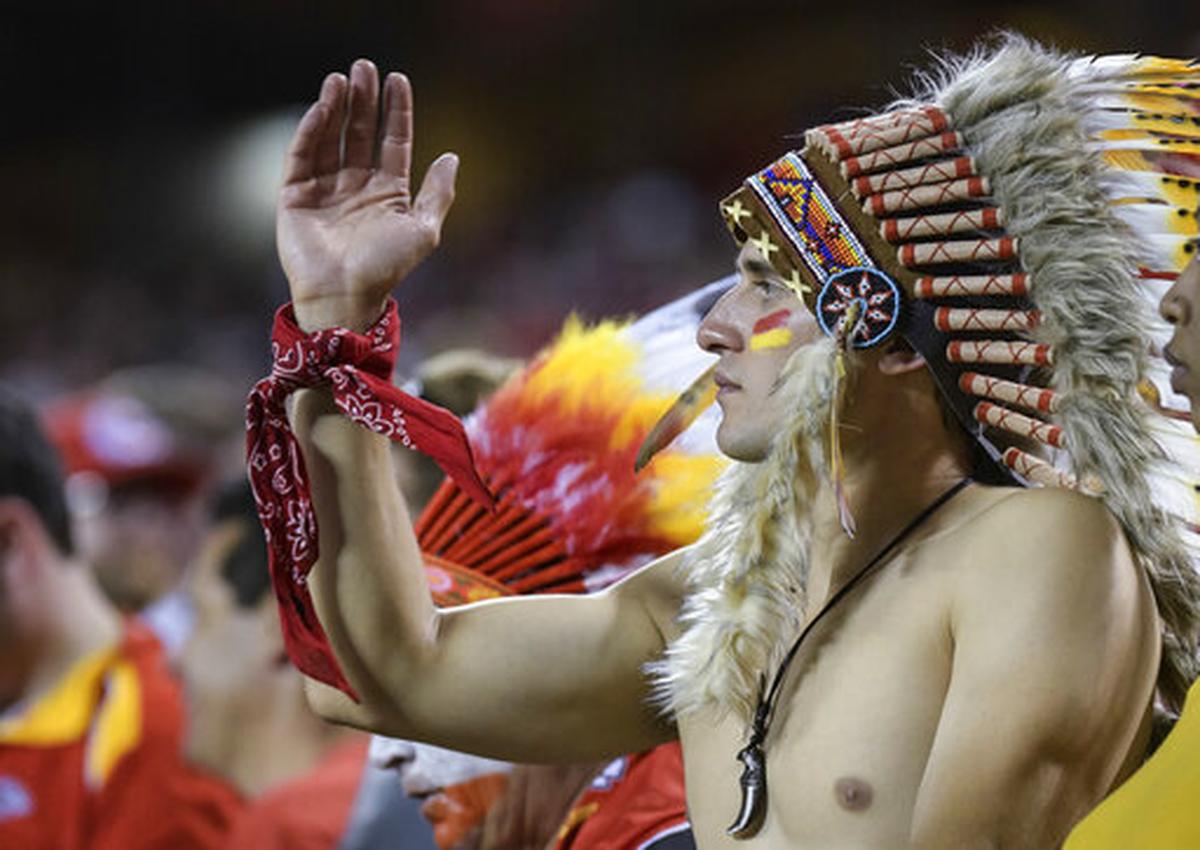
Thousands of schools still have Native American team names. An hour’s drive north of Kansas City, the Missouri town of Savannah has been thrown in the spotlight due to controversy over its high school mascot, the Savages.
“It’s an epidemic. It’s not easy to change overnight,” said Kent Blansett, a professor of Indigenous studies and history at the University of Kansas. He is a Cherokee, Creek, Choctaw, Shawnee and Potawatomi descendant.
Changing mascots is usually an uphill battle. Sports are rooted in longstanding and cherished academic and athletic traditions, that many see no harm in honoring. In Shawnee Mission, another 2,400 people have signed a petition in favor of keeping the North mascot. The counter petition was created by Emmitt Monslow, a North alumnus.
“I want to keep the value of Native Americans in the forefront of people’s minds, in the Midwest especially,” he told The Star. “It’s educate, not eradicate. And there’s a whole lot of eradicating.”
But Blansett argued that such mascots are not only dehumanizing but also represent the myriad of systemic injustices facing Indigenous people. He argued that the caricatures contribute to the historic erasure of Native Americans.
“When you see people taking something that we have a lot of pride in, that’s part of who we are, and then doing tomahawk chops or wearing face paint or red face, and creating these characterizations, it strikes you in the gut. It’s a literal gut punch. No one likes to be made fun of. No one likes to have their culture trampled upon. And no one wants their children to see that,” Blansett said.
“I couldn’t even imagine taking my daughter to any game that has a team, either opposing or at home, with such a mascot because I would be afraid of the images she would see of our people. How do you explain that to a young child?”
Research has shown that the use of Native mascots can increase suicidal thoughts and depression among Indigenous people. One study — conducted by researchers at the University of Michigan, University of Arizona and Stanford University — found that when Native American teens are exposed to such mascots, it decreases their community worth and self-esteem.
“The fact is these mascots continue to try to eradicate us as a people, and eradicate our voice. Especially when people say they continue to honor us, rather than actually asking Indigenous people whether this truly is an honor,” Blansett said.
He argued that such mascots can be especially damaging when coupled with insufficient education on Indigenous history.
Protesters in the Shawnee Mission district also are demanding curriculum changes, so that history and literature taught in school better reflect the experiences of Indigenous people.
“One of the most important parts of our proposal is that a more comprehensive curriculum be developed with regard to Native history,” said Hawkins, who lives in Mission. “You want to honor Native people? You don’t do it by parading teens around in shameful amalgamations of the traditional garb of several different tribes. We should honor them by developing a curriculum that faces this country’s genocide of Native people head on.”
This summer, Shawnee Mission officials told The Star that the district was “planning to do a curriculum audit to be sure that we are representing the diversity of our history, not just Black history but other historically oppressed groups, as well.”
‘It is my duty’
Shawnee Mission North has had the Indian as its mascot since it opened in 1922 as Shawnee Mission Rural High School.
But it was high schoolers in Lawrence who brought attention to the mascot in 2017.
Members of the Lawrence High School’s Inter-Tribal Club asked school officials to remove North’s banner, featuring a Native American with a headdress, from a collection of Sunflower League banners outside the school gym. And the athletic director approved removing it.
At the time, The Star reported that Shawnee Mission district officials stood behind the team name and mascot, and quoted a spokeswoman saying, “In fact, we are proud of our Native American heritage.”
But shortly after, Wallace said the Eastern Shawnee Tribe of Oklahoma’s business committee rescinded a resolution issued in 1992 that granted the district its permission to use the mascot.
Her tribe is one of three federally recognized Shawnee tribes. After the Indian Removal Act was signed into law in 1830, the tribe in Ohio was forcibly removed from its land, and eventually crossed the Mississippi River, ending up in Oklahoma.
“Just before the year 1900, we got down to only 69 people. We truly did lose all of our history, all of our ceremonials and much of our heritage,” Wallace said.
At the same time, others who were forced out of Ohio and Missouri — and federally recognized as the Shawnee Tribe in 2000 — settled in Kansas, largely in Johnson and Wyandotte counties. In 1854, the U.S. government slashed the size of the reservation. And after suffering at the hands of white settlers during and after the Civil War, most relocated to Oklahoma.
Not far from where Shawnee Mission North sits, a school was established in the late 1830s to teach students from Shawnee, Delaware and other tribal nations. Shawnee Indian Mission is now a state historic site in Fairway.
Wallace said the Eastern Shawnee Tribe, which granted the district permission for the mascot, eventually learned it did not have a connection to Kansas or Johnson County.
“Our people were so poor, so mistreated for so long, that learning our history and culture was not something that could be at the forefront. Since then, we have done better researching our history. And we realized we were never part of Shawnee Mission,” Wallace said.
“We also realized that Shawnee Mission and all of their symbols, all of their logos and all aspects related to ‘Indian’ are not Shawnee-oriented,” she said, arguing that they better resemble Lakota culture. “If they’re going to use the name Shawnee, they should use Shawnee symbols and culture. It’s a silly example, but it’s like saying your mascot is a bulldog but then on the uniforms putting pictures of Chihuahuas. People would recognize that’s inaccurate.”
That is part of the reason why Wallace said her tribe rescinded its agreement with the district. But now a few years later, she is frustrated to see that the mascot remains.
“It’s a school. It’s an institution that’s supposed to be teaching how to research, how to find facts, how to be accurate. And they’re not doing that,” she said. “I think they can make better use of their time by correcting the situation rather than dealing with it year after year.”
Since Lawrence students spoke up a few years ago, Shawnee Mission North stopped its tradition of the Indian chief mascot wearing a headdress, and the girl playing a Native American princess kneeling before him in pre-game ceremonies, The Shawnee Mission Post reported. Other schools have made changes, too. At Belinder Elementary, the PTA stopped using Native American imagery in spirit wear and other merchandise.
But now protesters argue it’s time to rid the district of any monikers, mascots or imagery that are derogatory toward Indigenous people. And former students, many of whom said they were never taught in school about the implications of using ethnic groups as mascots, are leading the movement. They hope that future students will be taught better.
“I have some very deserved guilt for wearing the costume, and I feel it is my duty because of it to scream particularly loudly about this,” Hawkins said. “I won’t shut up until this racist practice is eliminated once and for all.”
This story was originally published November 30, 2020 at 5:00 AM.