A COVID-19 lesson: How Kansas City schools (mis)handled the 1918 Spanish flu pandemic
In the end, the 1918 Spanish flu that descended on Kansas City soon after the school year began would kill an estimated 2,300 local people, filling news pages with “mortuary notices.”
Even among hundreds of obituaries, those of teachers and students stood out:
George “Shorty” Strother, a former football player for the University of Kansas, who was in his second year as coach at De La Salle Academy. Barely a week prior, he had watched his team, a squad of underdogs weighing in at an average of 135 pounds, defeat rival Country Day School for boys, later to become The Pembroke Hill School. Within two days, he fell ill with “the purple death,” a flu so severe it turned skin nearly black from lack of oxygen. He was dead within a week.
Margaret Carpenter, who had gone to KU, too, was teaching freshmen at Central High School. Dead at 48.
Then there were the students: Rosanna Flannigan, 13; Alma Virgil Keown, 14; Rose Pratt, 17; Henry Orth, 18, a student and soldier at an Army motor school where dozens would die in the earliest days of the pandemic.
As with the rise of COVID-19, school officials knew the illness was deadly and lurking.
But then, like now, there was no national edict to close schools. Then, like now, individual districts were left to guess, fumble and struggle to divine the future, weigh health advice, and determine on their own whether it was safer to keep schools open or to shut down, whether to play sports, cancel games or, as now, ban or limit spectators.
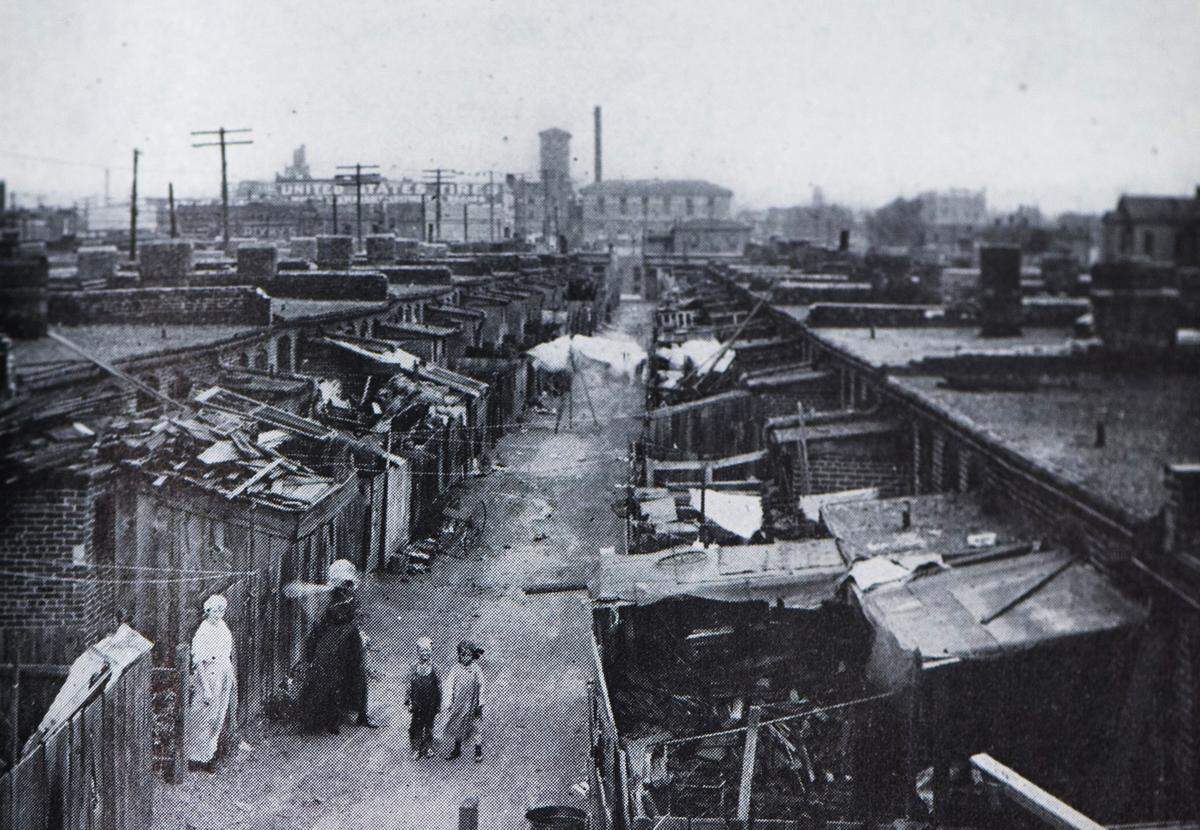
Pages of old news stories reveal striking parallels between how the pandemics of 1918 and 2020 played out in Kansas City: wars of words over safety vs. commerce. Outbreaks at schools (the Army motor school in 1918; college campuses now). Sporting events with masks. Vacillating decisions on school closings and openings — Kansas City in 1918 and 1919 would be the only major city in the United States to shut and open schools three times.
Then, like now, officials declared the pandemic to be little more than overhyped hoo-ha or, as one Kansas City council member put it then, “Hun propaganda,” even as infections rose.
Left to find their way: the schools.
“There was a lot of infighting and not much leadership, particularly from the public health department,” said Mary Battenfeld, a professor of American and New England studies at Boston University.
“There wasn’t really either state or federal oversight. It was kind of each district for themselves.”
Colleges, too.
Kansas University, as KU was then known, closed for six weeks. Missouri University, Mizzou, instantly quarantined all students to campus, and ruled, as The Star reported on Oct. 7, “no leave of absences to the city will be allowed.”
Although that month would rank as one of the flu’s deadliest, Wentworth Military Academy’s football team not only played in late October, but thrashed St. John’s Military Academy by a score of 78 to 3. A newspaper account could not but note: “The game was unique and probably a record establisher in that the twenty-two players started the game wearing influenza masks.”
KU reopened that November, but its game against the University of Oklahoma would be played behind locked gates. The headline: “No Crowd to See Game.” The only spectators allowed were members of the Student Army Training Corps.
A growing pandemic
The historical irony, of course, is that it is now generally believed that despite its name, the Spanish flu likely originated in Kansas, in March, with soldiers infected at Fort Riley’s Camp Funston. From there,the flu traveled across the Atlantic to the trenches of World War I and back as a plague that eventually would claim at least 50 million lives worldwide. In the United States, it killed an estimated 550,000 people between September 1918 and April 1919.
It hit hardest during school. By mid-September, officials had been on alert.
Headlines in The Kansas City Times and The Star declared, “Influenza Spreading in Boston,” “Influenza Rages in East among Soldiers and Sailors,” “Influenza in Philadelphia,” “Influenza Coming West.”
When, in the last days of September, it inevitably erupted in Kansas City, it did so at a school for soldiers.
“Influenza Hits Army Here,” The Star printed on Sept. 27 of the Sweeney Automobile and Tractor School, a private building at 24th Street and Baltimore Avenue that had been converted for use as an Army motor school. The school’s commander said that the first case had been reported nearly a week prior, Saturday, Sept. 21, at 1:30 p.m.
By 7:30 that night, 136 more men were ill. The commander predicted nearly 500 of his 4,200 men were infected. The Star reported the contagion was already out among the public:
“Three Young Women Who Visited Soldiers Show Symptoms,” the headline read. Some historians note that the first civilian cases might have come days earlier from Fred Harvey’s restaurant at Union Station.
Oct. 1: “First Influenza Death Here.” The victim: Lloyd Snelling Miller, 22. A graduate of Northeast High School and a cashier at the Holland Shoe Co., he had been sick for six days. He died at home in the company of his parents and two brothers and was buried in Liberty.
Daily infection counts began to rise: 1, 4, 13, 32, 30, 55, 43.
By Oct. 5, 32 men at the motor school were dead, nine just the night before. The commander estimated that 60% of his infected men might likely die.
Physician Maclay Lyon, the supervisor for medical inspections for Kansas City’s schools, wanted action. No cases had yet been reported in grade schools; a single case was in the high schools. Still, he told the press he wanted the schools shut.
“The fact that army authorities believe 60 per cent of their cases of pneumonia resulting from influenza at the training detachment will prove fatal,” he said, “shows what might happen if the disease breaks out in the city schools. For my part, I don’t believe we should run the risk of exposing a whole school.”
One day later, Oct. 7: “STOP GATHERING,” a Star front-page headline blared.
“Schools, Theaters, Film Shows and Churches Closed Until Influenza is Checked,” by order of the city board of health. Following the health board’s lead, the Board of Education would shut schools that very day.
“It has come to my knowledge and I hereby proclaim,” Kansas City Mayor James Cowgill said in a printed statement, “that a malignant, infectious and contagious disease, commonly known as Spanish influenza, is prevalent in Kansas City.”
He vested the Board of Health with broad powers to take “all steps and use all measures necessary to avoid, suppress and mitigate such disease, and to employ such officers, agents, servants and assistants, establish such hospitals, provide necessary furniture, medical attendants, nurses, food, clothing, shelter and relief as in the opinion of the said board may be necessary and advisable.”
All “persons, firms and corporations in Kansas City” were required, the mayor said, to comply with all reasonable orders to put down the disease. Board of Education President D.M. Pinkerton said the board would “act immediately” to shut all schools.
Schools outside city limits did the same. No “distance learning” then.
“How could there be remote learning?” said Albert Marrin, author of “Very, Very, Very Dreadful: The Influenza Pandemic of 1918.” Even by 1920, only about a third of houses even had telephones.
One exception was Los Angeles, which offered upper-grade students mail-in correspondence courses.
“They did the best they could,” Marrin said. “They understood that close contact was dangerous, except when they needed to have close contact, as on troop ships and factories and coal mines.”
Schools close, and then open
But one problem may be that KC’s schools didn’t remain closed for long.
In a 1996 paper, “Emerging Infections: Pandemic Influenza,” that examined the 1918 flu and subsequent pandemics, Baylor University researcher W. Paul Glezen noted that the largest death tolls (more than 280,000 pneumonia deaths) were found in healthy young adults, ages 20 to 40. Vulnerable children, under age 5, and the elderly over age 65, were next hardest hit.
But the highest proportion of those made sick by the flu, even though they did not die in the same numbers, were school-age children. Surveys at the time showed a high of 39.1% of children ages 5 to 9 had likely been attacked by the flu, with numbers generally decreasing with age.
“The fires of the epidemic,” Glazen wrote, “are fed by healthy, susceptible school children, college students, and employed persons who have many daily contacts.”
In 2007, University of Michigan researchers, led by Howard Markel, published a study in the Journal of the American Medical Association, looking at how early interventions affected weekly death rates from the 1918-1919 flu in what were then the country’s 43 most populous cities.
Perhaps not surprising, it found that cities that took early action — banning public gatherings, closing schools, businesses, churches, isolating the sick, wearing masks — had the lowest mortality rates. Cities that kept the measures in place the longest did the best.
Kansas City, like St. Louis and San Francisco, did act quickly and decisively. Within 10 days of its first case, it closed schools, theaters, implemented bans that, by some estimates, possibly reduced transmission rates up to 30% to 50%.
But the town of then 250,000 residents failed to keep it up.
Instead, as historians have documented, it turned to political infighting between factions that wanted to keep businesses closed to protect health and those who wanted businesses open to protect commerce. Businesses closed and reopened, closed and reopened.
The result:
“People died,” Susan Sykes Berry told The Star. Sykes Berry’s is a retired librarian whose 2010 master’s thesis, “Politics and Pandemic in 1918 Kansas City,” describes the wranglings that turned Kansas City into one of the hardest hit cities in the nation.
Same with schools.
“In Kansas City, it was not good,” Battenfeld of Boston University said. “They closed in early October, and then reopened based on pressure from business interests. Then they closed again for another month. Then they reopened and closed again.
Like today, some argued the entire pandemic was overblown. At an Oct. 14 meeting of the city council, with the pandemic growing, one alderman called the matter “Republican bull.” Alderman George Harrington, The Star reported, “dismissed the whole influenza problem with a wave.”
“There may be a little influenza,” he said. “We’ve had it before and never thought much about it. But all this talk about a dangerous epidemic is Hun propaganda.”
Kansas City’s record
And three major cities — New York, Chicago and New Haven, Connecticut — didn’t close their schools. Those cities were deeply wedded to the school hygiene movement, where schools had doctors and nurses routinely checking children’s eyes, ears, lungs and more. The thinking was that for many children, being in school was healthier than being left to fend in the squalid or crowded tenements many students called home.
Each one of those cities had lower death rates than Kansas City. More than 100 years on, its reaction to the flu is often found wanting.
In 2007, the Federal Reserve Bank of St. Louis put out a report, “Economic Effects of the 1918 Influenza, Pandemic Implications for a Modern-day Pandemic,” that ranked Kansas City’s influenza mortality rate of 718 people per 100,000 population as the 17th worst among what were then America’s 50 largest cities.
Pittsburgh had the highest mortality rate, but Kansas City was worse than St. Louis, Omaha, Minneapolis. Cleveland, Chicago, Detroit and two dozen more.
Markel’s Kansas City number, 580 excess pneumonia and influenza deaths per 100,000 population, ranked it as the 12th worst among the 43 biggest cities.
To be sure, whether schools are open or closed, and for how long, was just one factor among many. In his paper, Markel notes that Kansas City is the only one of the nation’s 43 biggest cities that opened and closed its schools three times.
Although it came with pushback.
An Oct. 15 headline: “School Won’t Open Today.”
“Taking the advice of physicians, instead of politicians, the board of education, at a special meeting yesterday afternoon, voted to keep the schools closed until next Monday in an effort to stop the influenza epidemic.”
The action, the story says, was taken after the city board of health, against the advice of physicians, agreed to lift the ban against public gatherings.
Two days later, the raging flu forced the city’s hand: “A DRASTIC BAN IS ON.”
Effective “indefinitely”: All gatherings of 20 or more people prohibited, including at parties, weddings and funerals. All theaters and motion picture shows closed; all churches closed. All schools closed.
“Indefinitely” lasted one month.
Nov. 18: “BACK TO SCHOOL TODAY.”