
Police departments embrace social media to inform the public
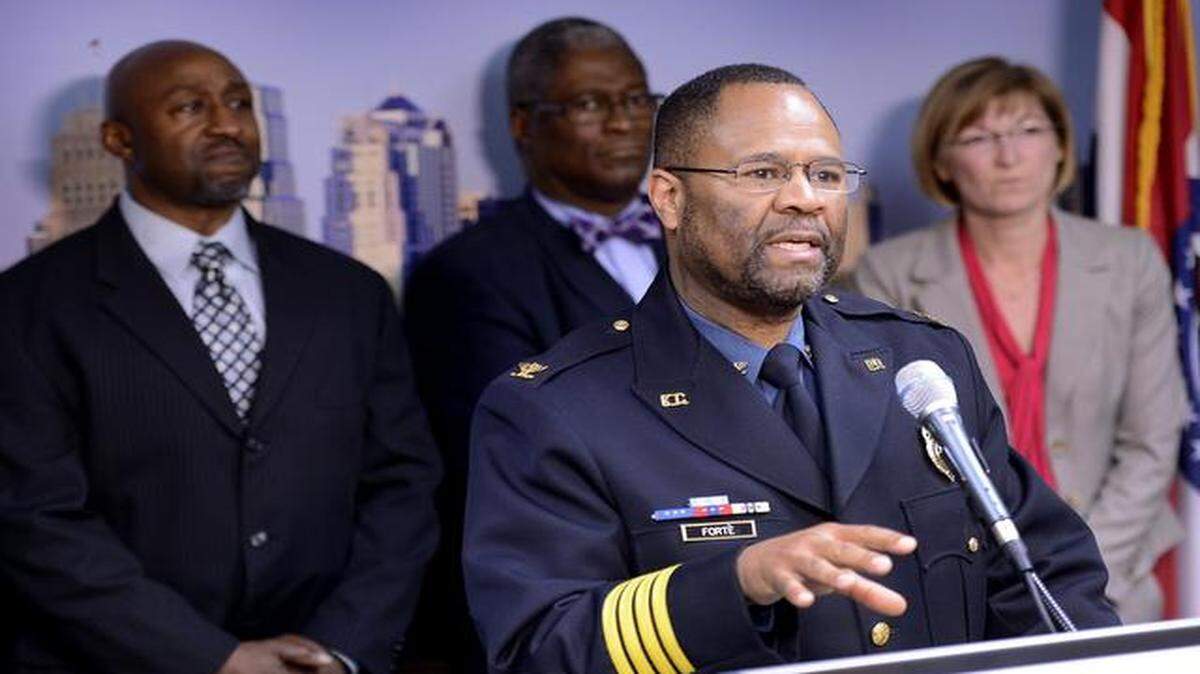
Moments after Kansas City tactical officers arrested a suspect in a series of highway shootings that wounded three and terrorized countless motorists, Police Chief Darryl Forté announced the big news in an unconventional way.
He pulled out his cellphone and typed:
@kcpolice Highway shooter suspect in custody. Will provide additional at 7:30 PM. Stand-by for location.
Several dozen officers had just descended on a Grandview fourplex in April to arrest suspect Mohammed Whitaker. Forté accompanied them so he could use Twitter to inform a city that had been on edge for weeks.
“It is the way of the times, and you are going to miss out on a lot of communications if you are not engaged in social media,” Forté said recently. “There are 140 characters (allowed), but we can reach so many more people and such a broad range.”
In ever-expanding ways, Kansas City police and dozens of other local law enforcement agencies have taken to Twitter, Facebook, YouTube, Instagram, Flickr, LinkedIn, Pinterest, Next Door and other social media platforms to push out crime alerts, seek help in solving crimes, improve their image and strengthen community ties.
Social media allow law enforcement to quickly disseminate unfiltered information to a broad and often young audience, they say. About 95 percent of police agencies nationwide use some form of social media, according to a 2013 survey by the International Association of Chiefs of Police survey. Their favorites: Facebook, Twitter and YouTube.
And roughly 80 percent of the 500 law enforcement agencies surveyed indicated that social media have helped them solve crimes.
Some area departments and agencies began experimenting with social media as far back as a few years ago, but others just recently joined the trend. Just last week, Overland Park police sent out the department’s first tweet. And Independence police tweeted the department’s first ride-along earlier in November.
Boston police made extensive use of social media when searching for the marathon bombers in 2013. They also used social media to dispel rumors and ease public speculation during the investigation.
Police realize that social media can have drawbacks, too. Cellphone video of arrests, shootings and police stops can turn up on YouTube at any time. Just look east to Ferguson, Mo., where several witnesses captured cellphone video of the aftermath of the police shooting of unarmed black teenager Michael Brown. A few days later, someone else posted cellphone video online of St. Louis police officers fatally shooting a man armed with a knife.
Sometimes, the public helps law enforcement — by posting videos of good deeds, such as the Independence police officer who befriended youth in a local restaurant, or the Kansas City police officers who played a pickup game of basketball with neighborhood children.
“Community relations and a positive image are particularly important given recent high-profile incidents that have increased negative public sentiment for police,” said Rion Martin with Infegy, a Kansas City-based social media company that specializes in digitally tracking and analyzing Internet conversations.
The Johnson County Sheriff’s Office uses LinkedIn as a recruiting tool. The Clay County Sheriff’s Office recently conducted tweet-alongs that allowed followers to observe deputies responding to emergencies and other service calls.
During that session, Jon Bazzano, who also works as a dispatcher, tried to make the best of an otherwise uneventful morning as he rode in the backseat of a patrol car driven by Sgt. Chad Wilderdyke.
As they traveled west on Missouri 210, Wilderdyke clocked an eastbound vehicle going 10 mph over the speed limit. Wilderdyke quickly whipped a U-turn. The license plates, he noticed, didn’t match the registration for the rented vehicle.
But no drama materialized, leaving Bazzano to tweet:
Confirmed w/ rental co that car is theirs. Registration isn’t the drivers fault — but a written warning for speed was issued. #TweetAlong
In 2009, the Kansas City Police Department conducted internal discussions about how it could respond better to public comments and criticism.
Sarah Boyd, a civilian employee on the communications staff, wrote a 10-page memo on why then-Police Chief Jim Corwin should write a blog. She saw it as a way to share department news while also responding to community concerns.
About that time, Twitter was becoming popular. Boyd suggested the department expand into that social media area as well.
“There was reticence,” recalled Boyd, who joined the department in 2007 after previously working as a reporter at the Olathe Daily News. “A lot of people asked, why did we need this? It didn’t seem necessary. We can fax reports, so why did we need to do something like this?”
Boyd kept pushing. Corwin soon saw the potential.
“If he said yes, then everybody said yes,” said Boyd, who calls social media “an amazing tool.”
The department’s tweets and Facebook postings quickly became popular, attracting thousands of followers and “likes.”
“It is going where the people are,” said Boyd, who has made presentations about the department’s social media efforts at police conferences. “In the age of Ferguson, we are trying to build up a friendly relationship with the people that we serve.”
The department now uses Twitter, which targets a younger audience, to post breaking news, crime tips and other safety items.
Among police departments with more than 1,000 officers, Kansas City ranks fifth behind Boston, New York, Seattle and Baltimore for the most Twitter followers. Kansas City has 54,700.
Forté’s announcement about the Whitaker arrest was re-tweeted 302 times.
These days, Forté frequently tweets information and even photos from crime scenes.
“What I like best is, this is an opportunity to problem-solve at my level and get an overall snapshot of what is going on in the community,” he said.
The department’s Facebook page promotes its work in the community and reveals a softer side of gritty police work.
After a citizen made a video of Officer Jeff Krebs taking part in an impromptu dance-off with children, the video was sent to police by a Facebook message. Boyd posted it on the department’s Facebook and YouTube pages. It got more than 20 million views and eventually aired on “Good Morning America.”
Another wildly popular Facebook video featured officers who briefly blocked street traffic to play pickup basketball with some children.
“It showed the kind of things that have been happening all along but nobody really knew about it,” Boyd said.
And then there was the tweet sent out during the Royals playoff run. It asked motorists to drive safely and for criminals to take the evening off so officers could listen to the game. The plea was re-tweeted 23,000 times.
The department started a YouTube channel to broadcast surveillance videos, public service announcements and other information. It became the first police department in the nation with Pinterest boards targeted at women and featuring pins of women police officers, historic photos, officers in the community and photos about drugs to help parents identify them.
Across the state line, the Johnson County Sheriff’s Office also embraces social media as a way to reach different demographics.
“It is important to connect with our community because that is the community that we serve,” said Master Deputy Jill Koch, whose office conducted a tweet-along in the county detention center. “We cannot connect with them from afar.”
The public expects law enforcement to have a presence on social media, said Independence Officer John Syme, who manages his department’s Twitter and Facebook accounts.
“If people want to find out what is going on in their area, they want to pull out their smartphone or (mobile) device to find out,” he said.
To reach Glenn E. Rice, call 816-234-4341 or send email to grice@kcstar.com.