‘Alarming in so many ways’: After record homicides, will new Kansas City efforts help?
Killings in Kansas City reached the highest level recorded during a single year in 2023, even as most major cities around the U.S. saw significant declines.
There were 185 people killed in the city last year, according to data maintained by The Star, most of them shooting victims, in cases that included petty arguments, domestic violence and retaliatory violence.
Meanwhile, steep drops in homicide were seen in other major cities around the country, including New York, Philadelphia, Chicago, Los Angeles and Detroit.
Despite its increase in homicides, the total number of shootings in Kansas City dropped in 2023 compared to 2020, which was previously the deadliest in its history with 182 homicides. As of Dec. 31, there were 513 people shot in Kansas City last year who survived, according to police data. In 2020, there were 630 people injured by gunfire — a difference of 19%.
Local leaders have taken notice that Kansas City is bucking the national trend with regard to its homicide count.
Explanations for the uptick in homicides vary, ranging from Missouri’s lax gun laws, to poor conflict resolution skills and a low clearance rate by police in solving nonfatal shootings. Likewise, the proposed solutions also cover a range of options, from hiring more police officers, to building a city jail and creating a citywide focused deterrence program.
One common theme echoed by city leaders is a commitment to increase collaboration in 2024.
During a recent press conference at Kansas City Police Headquarters, Chief Stacey Graves said the department was implementing various strategies, including longer 11-hour shifts for police officers as work continues to address “critical” staffing shortages. She also said KCPD is “just one part of the solution” to stem the violence.
“It’s going to take all of us to come together in Kansas City,” Graves said. “And that’s why we talk about a citywide approach to violent crime. Because that’s what it’s going to take to break the generational violence that we have here in our city.”
Efforts to stop the bloodshed during 2023 included newer partnership programs organized through City Hall, the Jackson County Prosecutor’s Office and the Kansas City Police Department in concert with area nonprofit groups.
One initiative rolled out through 2023 is Partners for Peace, a collaboration of local agencies focused on connecting families affected by violence with social services. And in the Santa Fe neighborhood on the East Side, city leaders have already touted some early successes of a pilot program called KC360, which is modeled after a similar one in Omaha that is credited with reducing shootings there by 74% over the course of 15 years.
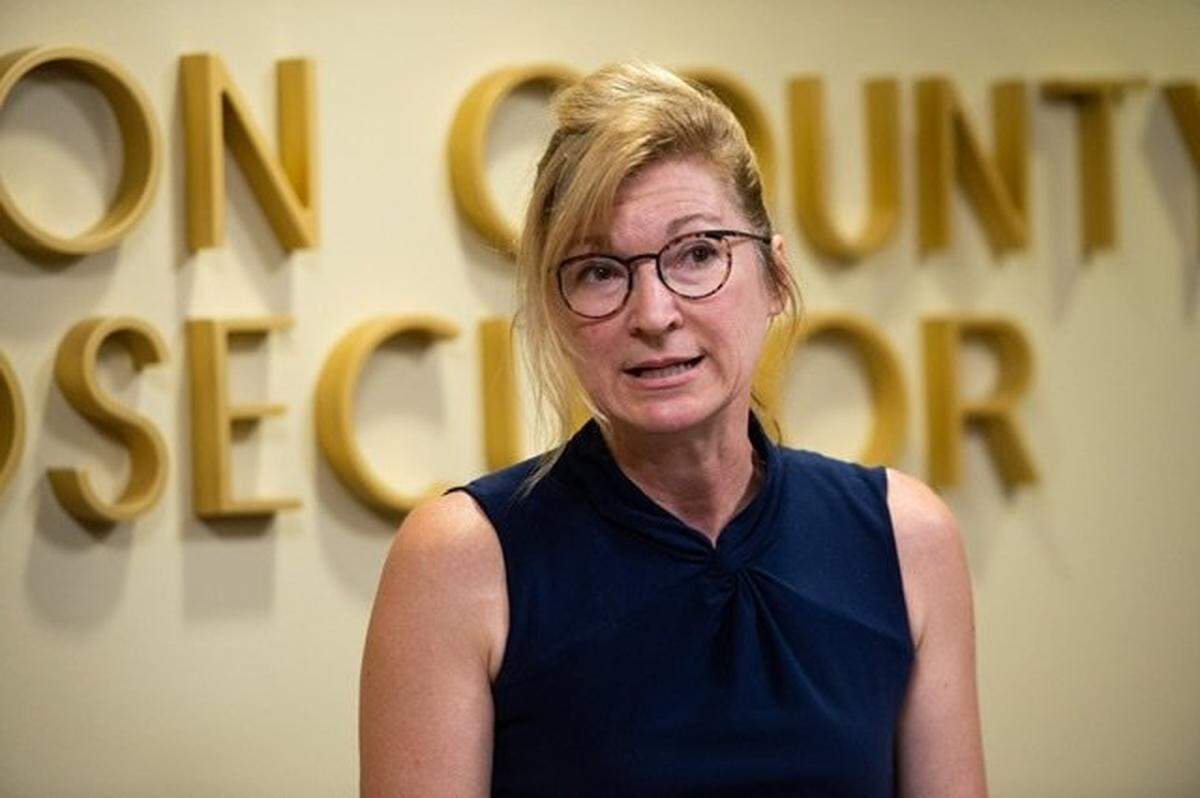
Jackson County Prosecutor Jean Peters Baker envisions building on those efforts by bringing back a citywide focused deterrence program in 2024. Working with KCPD, Jackson County COMBAT and others, the focused deterrence model takes aim at known violent offenders, offering social services, and directing them to change behavior or face consequences.
“Without an actual focused plan to address this issue, one should expect that violence won’t abate,” Baker said during a recent interview with The Star. “This year I get to put a strong ‘however’ on that: We are in the process of planning to roll out efforts with KCPD to address this violence problem.”
Further work will come out of City Hall, Mayor Quinton Lucas said last week, as he pointed to cases where city regulations can help address trouble spots in neighborhoods before a violent situation unfolds. He referenced a summertime shooting at an unsanctioned nightclub that had been subject to dozens of code violations and neighborhood complaints, saying KCPD had “done its job, coming time and time again” beforehand.
“Sometimes this is a requirement for the city to step up,” Lucas said. “It might be the schools being a part of it. Our medical partners. That’s what we talk about now in terms of collaborative programs and work.”
‘Violence has normalized’
Jasity Strong, a mother of two, killed during a mass shooting while she was out celebrating her 28th birthday.
Zameyanna Williams, 18, who was shot during an argument with her boyfriend.
Manuel Valentine-Ruperto, 58, fatally shotgunned in broad daylight amid a dispute over a used Ford Mustang.
Darrell Welldon, a 17-year-old high school junior and football player, who was shot to death while preventing a gunman from entering his family home.
All were among the 185 slain in Kansas City during 2023.
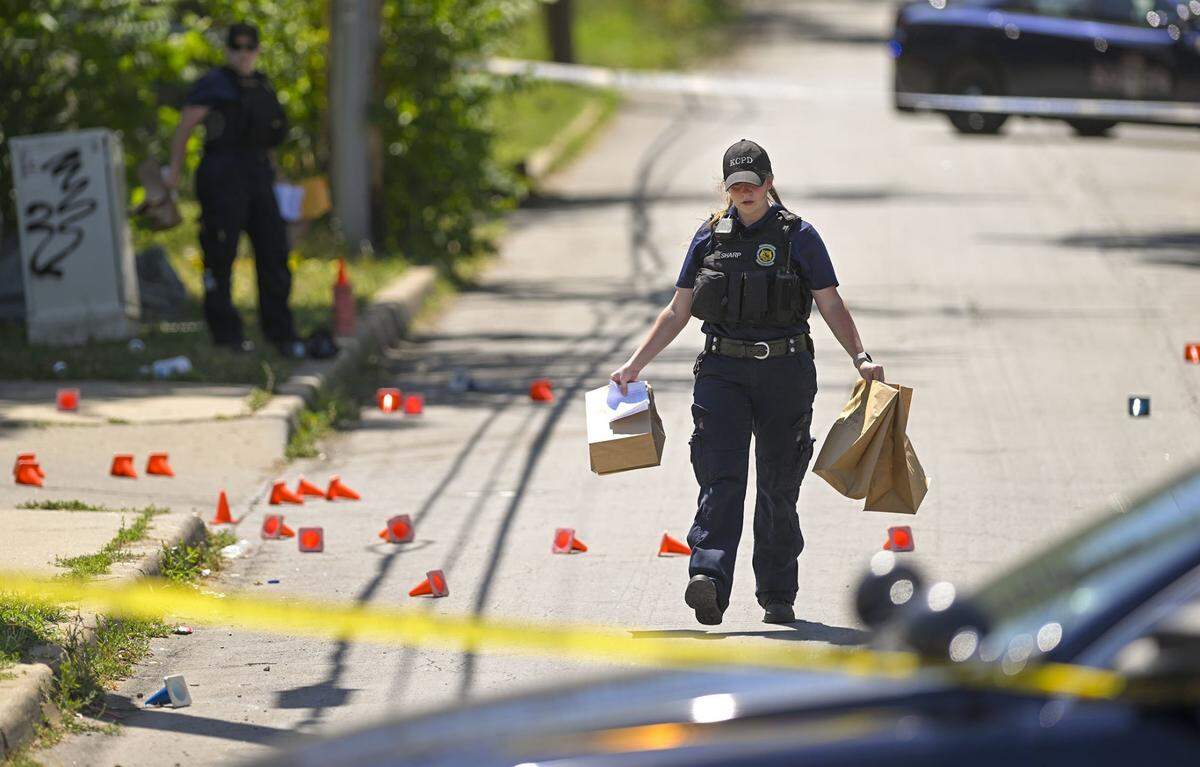
Police data show the predominant underlying factor in homicides in 2023 was arguments. These accounted for 67 homicides, or 37% of the 182 investigated by KCPD. The Star’s homicide count of 185 differs from KCPD’s to account for fatal shootings by police officers, which the department does not count in its data.
Motive was unknown in 47, or 26%, of last year’s homicides, police data show. Of the remaining known motivators, domestic violence ranked second, with 22 killings, followed by 19 drug-related homicides and 18 retaliatory killings.
Gun violence was a factor in all but 20 of Kansas City’s homicides in 2023. That tracks with recent years past, where firearms were used in about 90% of homicides.
Disproportionately affected are the city’s Black residents, especially men, in neighborhoods with higher rates of poverty. Last year, Black males, who make up roughly 13% of the city’s population, accounted for 65% of Kansas City’s homicide victims. The second-largest group was white males at 12% of homicide victims.
Kansas City police data also show 31% of the city’s homicide victims in 2023 were 24 years old or younger. Nineteen of those homicide victims were 17 years old or younger.
Young adults between the ages 18 and 24 also made up the largest share of homicide suspects identified by police last year, at 24%. Seven more suspects were juveniles.
It’s part of a continued trend where young people are becoming involved in violent crime, often in communities that have historically been subjected to a severe lack of economic investment and resources, said Damon Daniel, president of the nonprofit Ad Hoc Group Against Crime.
“When you deprive neighborhoods for decades, if not nearly centuries, in terms of access to real resources and economic development, these are the results of that. These are the symptoms,” Daniel said.
“This is the biggest elephant in the room,” Daniel added. “The racialized institutional policies that once existed, with the redlining and all of that, has created these pockets of poverty. And those pockets of poverty have been giving birth to a lot of crimes and violence. And you can see that when we look at where the violence is happening.”
About 85% of those who receive services through Ad Hoc are not strangers to violence, Daniel said, meaning many have lost multiple family members to violent crime or have themselves been victims. It all plays a role in what Daniel describes as a generational trauma that he believes will take generations — and significant investment — to heal.
“It has gotten to a point where I think at least that violence has normalized in Kansas City, not only in terms of the frequency that we hear about violence, particularly gun violence, but the frequency by which people resolve conflict, as well,” Daniel said. “And I think that that is alarming in so many ways.”
In the Jackson County prosecutor’s office, one key factor Baker views as a driver of violence is the confluence of lax gun laws with the expansion of self-defense law.
In 2017, Missouri did away with permits and safety training as requirements to carry concealed firearms in most places. One consequence of that is the loss of a criminal law that Baker believes was an opportunity for law enforcement “to intervene in someone’s life before something worse happened.”
Shooting cases have become more difficult to prosecute in the face of an expanded self-defense statute that can can shield someone from criminal liability for accidentally shooting an innocent bystander during a dispute.
“The law does allow for a lot more behavior than it did before,” Baker said. “So, law enforcement is stuck to kind of deal with that situation.”
Focused deterrence
In 2014, Kansas City saw homicides drop to the lowest point ever with 82 recorded that year. The reduction was largely credited to the focused deterrence program known as Kansas City No Violence Alliance, or KC NoVa.
The program operated under the concept that a small group of individuals are responsible for most violent crimes. Law enforcement efforts focused on known offenders with a carrot-or-stick approach.
The carrot: Receive social services, including job training, substance abuse counseling, housing and education. The stick: Go to jail.
Despite major reductions seen in its first year, the success of the program was short-lived. Over the following two years, Kansas City’s homicide totals climbed back to 111 in 2015 and 131 in 2016. A later analysis by the National Institute of Justice, a federal agency, determined there was no effect on violent crime during the program’s latter years, and KC NoVa was ultimately shuttered in 2019.
As leaders look to address violent crime in 2024, an expanded focused deterrence model is being eyed again by KCPD and the Jackson County prosecutor’s office. Similar initiatives have been put in place in Boston, Detroit and Oakland, California.
Baker expects the new approach to look somewhat different compared to a decade ago, including a larger focus on a high delivery of social services. She said leaders are “significantly down the road” in planning the program, though key components are in the works, and a launch is expected early in the year.
“It’s a much higher degree of collaboration than it was 10 years ago when we were planning this before,” Baker said. “We were effective. We did reduce violence. We worked together in a much better way back then. But we also left out some key partners. So this time, I want to make sure that that’s rectified.”
“I’m really hopeful,” Baker added. “There are going to be people who are going to moan and complain and say we can’t do it. And I say well, why don’t you just get out of our way. And let’s see what we can do together.”
“Because when we all sit back and complain and kind of point fingers at each other it’s pretty clear what the outcome for the community is going to be.”
This story was originally published January 11, 2024 at 6:00 AM.