
How does a pardon work in Missouri? Here’s what it may mean for the DeValkenaere case
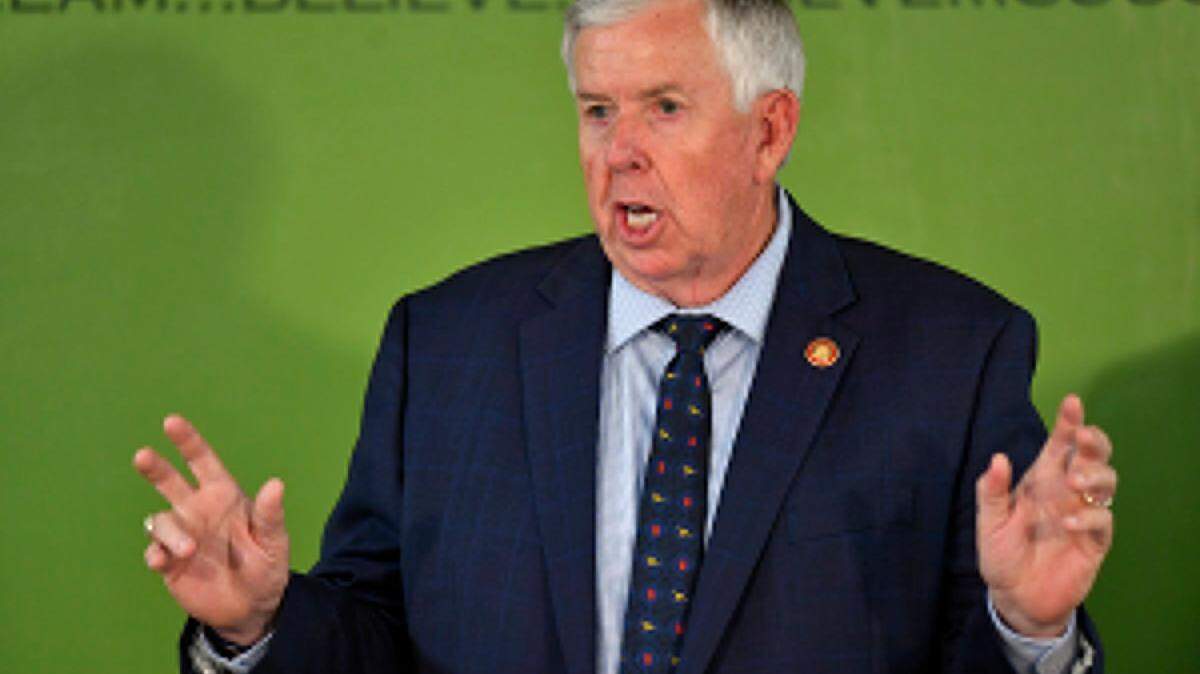
The ability to pardon those convicted of crimes is one of the most unilateral executive powers enjoyed by Missouri’s governor.
In high-profile cases, a pardon might make the news — but they’re more common than you might think. Gov. Mike Parson has pardoned dozens of people convicted of state crimes each month for years, according to his office’s press releases.
On Tuesday, Jackson County Prosecutor Jean Peters Baker sent a letter to Parson urging him not to pardon former Kansas City police detective Eric DeValkenaere, who was convicted of manslaughter in the 2021 of killing of a Black man named Cameron Lamb. Sentenced to six years in prison, DeValkenaere is appealing his conviction.
The power to pardon originates in the state’s constitution, and those with convictions need to apply for clemency to be considered.
Here’s what to know about how the pardon process works in practice.
How do pardons work in Missouri?
Missouri’s state constitution assigns the governor the power to “grant reprieves, commutations and pardons, after conviction, for all offenses except treason and cases of impeachment.”
Here’s what each of those mean:
Reprieve: The temporary suspension or delay of a criminal sentence being implemented.
Commutation: The reduction of a criminal sentence to a lesser punishment.
Pardon: The elimination of some or all of the punishment for a criminal conviction.
In all three cases, the person in question has to be convicted of a state-level crime and sentenced to a punishment like jail or prison time, fines or another penalty.
The governor has the power to delay, reduce or eliminate this punishment — but only for state-level crimes. Federal convictions can only be pardoned by the U.S. president.
None of these forms of relief are the same as an expungement, which clears some or all of your criminal record. Convictions that have been reprieved, commuted or pardoned will stay on your record — only the punishment you have to face for them will change.
How does the governor decide who to pardon?
People convicted of state crimes in Missouri can apply for “executive clemency,” an umbrella term that encompasses reprieves, commutations and pardons.
These applications are available both to incarcerated people hoping to be released from prison and those who have served their sentences but are seeking to restore rights like voting, running for office, serving on a jury or owning a firearm.
Applicants for executive clemency must have tried and failed to obtain all other avenues for sentence reduction first, including expungement and judicial appeals.
Incarcerated people can find the application for executive clemency here. You can either apply because you are claiming innocence, you have served more than 25 years in prison or you are over 70 years old and have served more than 12 years in prison.
Currently incarcerated people can apply for the following forms of clemency:
▪ A full commutation for immediate release from prison
▪ A partial commutation to reduce the rest of their sentence.
▪ A reprieve to delay the beginning of their sentence.
Formerly incarcerated people can find the application for executive clemency here. You can apply to reinstate one or more of your civil rights every five years after you have completed your sentence, including parole, and been conviction-free for five years.
Formerly incarcerated people can apply for the following forms of clemency:
▪ A full pardon to remove the punishments associated with their conviction.
▪ A partial pardon to reinstate some of their civil rights.
In the past year, Missouri Gov. Mike Parson has issued 230 pardons. Take a look at the graph below to see how many people he has pardoned each month since May 2022.
What does this mean for the DeValkenaere case?
In a statement Tuesday, a spokesperson for Parson’s office indicated that DeValkenaere, the Kansas City police detective convicted of second-degree involuntary manslaughter and armed criminal action in the fatal shooting of Lamb, has not yet applied for clemency.
“Every application goes through a thorough and thoughtful review before any decision is made,” spokesperson Kelli Jones said of the clemency process. “Eric DeValkenaere’s will be treated the exact same if he applies.”
In order to apply for any type of clemency, DeValkenaere will have to prove that he has exhausted all other legal options to have his sentence reduced. He is still in the middle of an appeal process.
Other avenues that those convicted of crimes must take before they can apply include seeking an expungement of one’s criminal record, post-conviction relief and a court appeal called a writ of habeas corpus. DeValkenaere may not be able to pursue the first option, expungement, due to state restrictions on expunging crimes that involve a death.
Because DeValkenaere has not completed his six-year prison sentence, he is not eligible to apply for a full pardon to reinstate his civil rights. Instead, he may choose to apply for a commutation to reduce his sentence or a reprieve to further delay it.
DeValkenaere was convicted in 2021 and sentenced to prison time in 2022, but has been out of prison on bond since then as he appeals his conviction. He is the only Kansas City police officer ever to be convicted of killing a Black man.
Do you have more questions about the parole process in Kansas City? Ask the Service Journalism team at kcq@kcstar.com.
This story was originally published June 15, 2023 at 5:00 AM.
.jpg)